Home › Up at Nookaheevah › Up at Nookaheevah: Porter
Up at Nookaheevah: Porter
Porter read and pondered over this perplexing letter. He felt sure that the letter was from Bainbridge; and in the allusion to St. Salvador and Rio Janeiro, he perceived the commodore's wish for a rendezvous at one of those places. But what could be the secret of the times of cap. tivity? Suddenly a thought struck him. Might there not be something written in sympathetic ink? Hurriedly calling for a candle, he held the letter above its flame, and saw, under the influence of the heat, words and sentences appearing where before all was blank paper. "I am bound off St. Salvador," it read; "thence off Cape Frio, where I intend to cruise until the Ist of January. Go off Cape Frio to the northward of Rio, and keep a lookout for me."
That afternoon the governor of the island, looking out toward the harbor, was surprised to see the "Fanny" standing out under a full spread of canvas. Porter had gained all the information that he wished, and was off in search of his consorts. This search he continued until the 20th of January, cruising up and down off the Brazilian coast, and taking one or two small prizes. In this unprofitable service the ship's stores were being rapidly consumed. Among other things, the supply of rum began to run short; and in connection with this occurred a curious incident, that well illustrates the character of sailors. The daily rations of bread were reduced one-half, and the rations of salt meat onethird, without a word of remonstrance from the patient crew. Next the discovery was made that the rum was giving out, and a proportional reduction in the rations of grog was duly ordered. The jackies put in a vigorous and immediate protest. They were prepared, they said, to go without grog, should the supply of rum be unhappily exhausted; but so long as any of the precious fluid remained, their rations of grog should not be curtailed. But to this Porter would not accede, fearing that, should the men be altogether deprived of their grog, the health of the crew might suffer. Accordingly, when the crew were piped to "splice the main brace" the next day, they were told that half rations only would be issued; and, if the grog was not taken up in fifteen minutes, the tub would be overturned, and the rum spilled into the sea. So dire a threat was too much for the rebellious seamen: they sprang into line, with their tin cups, and drew their curtailed rations without more ado.
Some days after this occurrence, the "Essex" overhauled a Portuguese vessel, from the captain of which Porter learned that an American frigate had shortly before fought and sunk an English frigate off the coast of Brazil; also, that it was rumored that an American corvette of twenty-two guns had been brought into Rio, a prize to a British seventy-four. This intelligence placed Capt. Porter in some perplexity. He felt convinced that the successful American frigate was the "Constitution;" a conjecture in which he was correct, for the news referred to the celebrated action of that ship with the "Java." The captured American corvette, he concluded, must be the "Hornet;" but herein the captain was wrong, for the "Hornet" was at that moment blockading the "Bonne Citoyenne." Porter now found it necessary to decide upon a course of action. The news which he had received made it appear most improbable that he would fall in with either of the United States vessels for which he was seeking. He was far from home, cruising in seas much frequented by British men-of-war. There were no naval stations or outposts belong. ing to the United States, into which he could put for protection or repairs; for then, as now, the nation ignored the necessity of such supplystations. To return home was peculiarly distasteful to the captain, who had set sail with the intention of undertaking a long cruise. In this dilemma, he wasted but little time in thought. By rounding Cape Horn, he would carry the "Essex" into the Pacific Ocean, where British merchantmen abounded and men-of-war were few. It was an adventurous and a perilous expedition to undertake; but Porter, having decided upon it, wasted no time in getting under way. That very night he took his ship out of the snug harbor of St. Catherine's, and started upon his long voyage around the Horn.
A winter voyage around Cape Horn, even in the stoutest of ships, is an undertaking to be dreaded by the most courageous seamen. The "Essex” seemed to meet with more than her share of stormy weather. From the night when she set sail from St. Catherine's, until she dropped anchor in a harbor of the Island of Mocha, almost every day witnessed a struggle for supremacy between the raging ocean on the one side, and skilful seamanship and nautical science on the other. Capt. Porter, however, proved himself ready for every emergency. No peril of the deep was unforeseen, no ounce of prevention unprovided. The safety of his ship, and the health of his men, were ever in his thoughts; and accord ingly, when the "Essex" rounded into the Pacific Ocean, both men and ship were in condition to give their best service to the enterprise in which they were embarked.
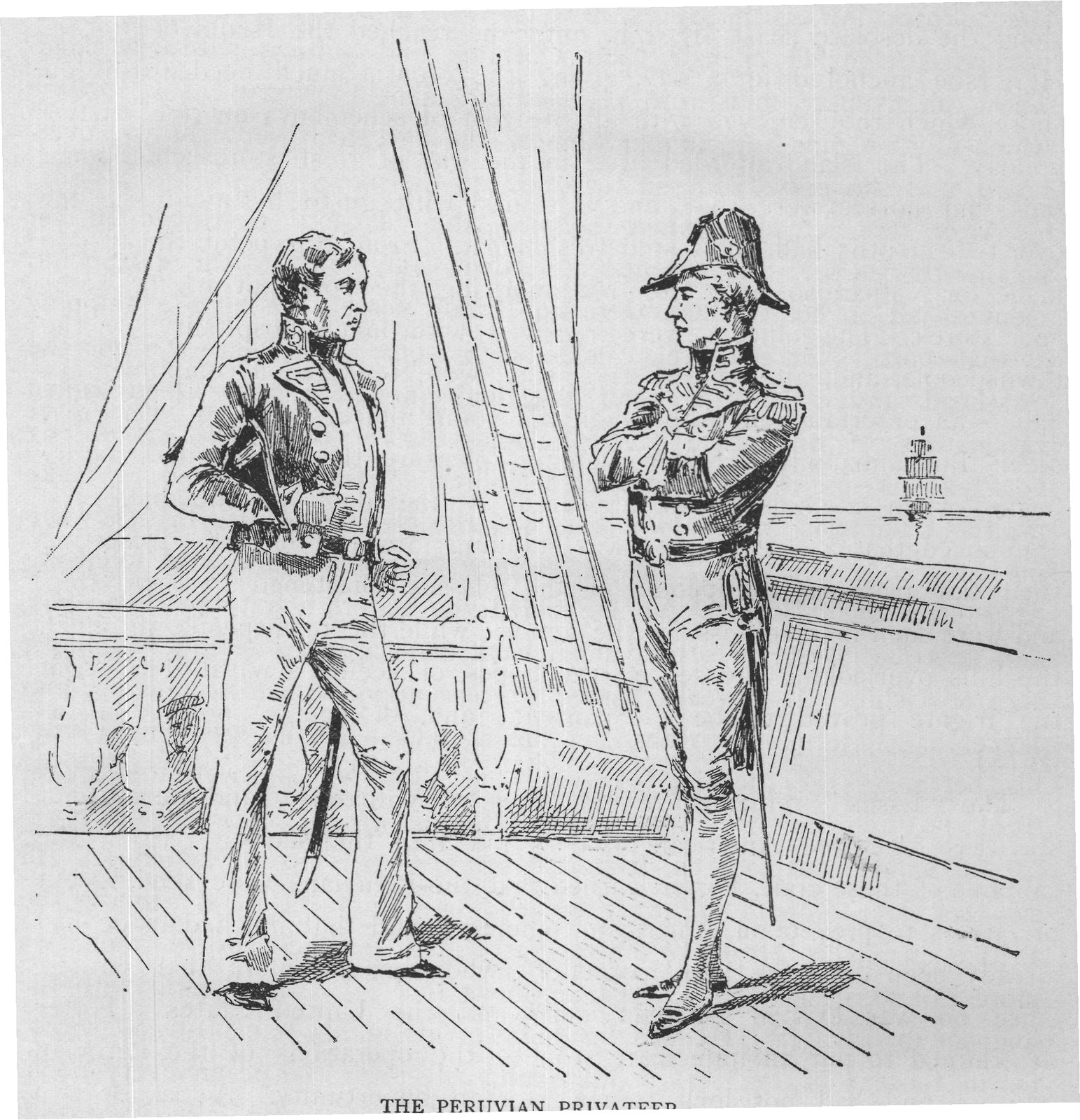
After rounding Cape Horn, the "Essex" made her way northward along the desolate coast of Chili, until she reached the Island of Mocha. Here she anchored for a day, giving the crew a much needed run on shore, which they enjoyed with all the zest of schoolboys out for a day's holiday. The island afforded little in the way of fresh stores; but some pigs and horses were shot, and devoured with gusto by men who for over two months had not tasted fresh meat. From this point the frigate made for Valparaiso, and, after reconnoitring the port, put in for water and stores. The officers were received with much hospitality by the townspeople, and, after a few days' stay, were tendered a complimentary ball, - an entertainment into which the young officers entered with great glee. But, unhappily for their evening's pleasure, the dancing had hardly begun, when a midshipman appeared at the door of the hall, and announced that a large frigate was standing into the harbor. Deserting their fair partners, the people of the "Essex" hastened to their ship. and were soon in readiness for the action; while the townspeople thronged the hills overlooking the sea, in the hopes of seeing a naval duel. But the frigate proved to be a Spaniard; and, of course, no action occurred. Porter The "Essex" remained several days at Valparaiso, and during her stay two or three American whalers put into the harbor. From the captains of these craft, Porter learned that the Peruvians were sending out privateers to prey upon American commerce, and that much damage had already been done by these marauders, who were no more than pirates, since no war existed between Peru and the United States. determined to put an immediate stop to the operations of the Peruvian cruisers, and had not long to wait for an opportunity. A day or two after leaving Valparaiso, a sail was sighted in the offing, which was soon near enough to be made out a vessel-of-war, disguised as a whaler. Porter hung out the English ensign, and caused an American whaler, with which he had that morning fallen in, to hoist a British flag over the stars and stripes. At this sight, the stranger hoisted the Spanish flag, and threw a shot across the bow of the "Essex." Porter responded by a few shot that whizzed through the rigging just above the Spaniard's deck. The latter thereupon sent a boat to the "Essex;" and the officer who came aboard, thinking that he was on a British man-of-war, boasted of his ship's exploits among the American whalers. His vessel was the