Home › Rameses II › Rameses II: Seti
Rameses II: Seti
Yet, after all, it matters but little to the history of humanity whether Rameses II. was a member of the eighteenth dynasty, as Champollion thought, or with his grandfather Rameses I., his father Seti I., and Menephta and Seti II., his son and grandson, made up the nineteenth dynasty, as some of the successors of the above-named writer hold.- What interests us, at our great distance in time from Rameses, is to form some idea of the political and social condition of the world when he was summoned to agitate it with the sceptre and the sword: and also to comprehend the elements that had prepared the state of things of which he was, as it were, the consequence, and also those the germs of which he left behind him. We have already, in our former book, endeavored to set forth the first; and in the following pages we shall strive to complete. our review by extending it to the second.
II.
SON of Seti I. and of the Queen Twea-the second wife of that prince-Rameses Mei-Amoun must have been born during the quarter of a century that preceded the year 1400 before our Era. The long duration attributed to his reign, and the place that Moses held after him in chronoogy, do not admit of the date of this event falling any later. It was, says Diodorus, the occasion of an act magnificent and truly royal. The recital that the Greek historian has transmitted to us on this subject is tinged with the marvellous, as his readers may remember, the dream in which a god announces to Pharaoh that the empire of the Earth is promised to the child just born; the means conceived by the happy father to prepare his son for this high destiny; all the young Egyptians born on the same day with the little prince, gratuitously furnished with nurses and teachers, subsequently brought together around him and with him subjected to a complete education and discipline, made common to them all, so that he might, one day, find in the companions and the studies of his childhood, instruments devoted to him and worthy of his designs as a man and his glory as a King. Then, Arabia and Libya conquered; their deserts traversed and their wild beasts subdued, formed, so to speak, the climax of this masculine education, and, as it were, the first essay in the field made by the prince and his young brethren in arms.
If, in the monuments discovered, nothing has been found to confirm the legendary part of this narrative, at the same time nothing has been found to invalidate it. History sees no objection there to her admitting that Seti was the fortunate adversary of the Asiatic nations, and that, in one of his triumphs, he was enabled to display the images and captives taken from forty-eight of them whom he had subdued, the prisoners saluting him and applauding him as the son of the Sun, the Lord of diadems, the favorite of Phtah, the good Deity, sovereign of two worlds and eternal as the Sun itself!" That such a man as this should have dreamed still greater things for his son, and that he should have surrounded the boy's education with all sorts of precautions and all the incitements that could favor his designs, when, at that age of humanity, he had power exalted to the height of divine control at his disposal, is not, by any means, incredible.
Still more: the monuments show us Rameses associated with the crown from his earliest infancy, and receiving the homage of the Egyptians while in his cradle. "You were yet in the egg," his subjects say to him, "and you had the honors of a prince. While still a very little child, wearing plaited hair, no monument was made without you. ... At the age of ten, you commanded armies." This is an inscription of the year III. In fact, there are portraits of Rameses in a child's dress; the double crown is on his head, and he still carries his finger at his mouth, the symbol adopted to designate infancy.* • * At the Museum of the Louvre in Paris may be seen in case C, in the Historic Hall, on the first floor, two bas reliefs representing Rameses II. In one of them the prince is already a youth : he is standing near a lion, with a bow in his hand; but he still wears the plait of hair, the distinguishing emblem that was laid aside on attaining manhood. In the other fragment, Rameses II., still a mere infant, is III.
THE monuments, while they are silent with regard to the termination of Seti's reign, and his death, have transmitted to us details concerning the consecration ceremonial of the Pharaohs of his dynasty, which enable us, without making any great archaic efforts, to retrace the scene of his son's coronation. At the moment when the existing generation is dying out around us, while it looks on with coldness and mockery at the last essays of monarchy now dilapidated by time and deprived of credit by the progress of ideas, it may not prove uninteresting, perhaps, to see what it was at the outset in the ages of monarchic fervor and popularity. Nothing, it seems to us, enables one to appreciate the distance traversed so perfectly, as to reascend the stream of time, in fancy, to the period when society was in its youth, and the masses of men, well or ill conducted during their passage through life, rolled along inert, from the cradle to the tomb, in blind nevertheless King, as the uræus, viper or nazha, which surmounts his crest, and the titles carved around him, bear witness. He wears the long dangling tress, and carries his finger at his mouth, as a token of childhood. adoration of their guides; when human thought, shut up in the depths of the temples, had no other perception of the divine ideal than in objects of surprise and terror-the brutalities of matter in nature, and in humanity, the tyranny of Kings. When, after the 72 days of mourning prescribed by the funereal regulations, the corpse of Seti had been deposited in the magnificent tomb which he had prepared for himself in the holy mountain of the West,* beside the last resting places of the other terrestrial gods, his predecessors; and when, by virtue of other consecrated rites, the moment for the establishment of his son Mei-Amoun upon the throne had been decided and proclaimed, Thebes, the city of Ammon, saw flowing in to her all the * This tomb is that discovered and described by Belzoni. The Museum of the Louvre has a superb fragment of it, in No. 7 of the bas reliefs.
Most of the tombs of the valley of Biban-el-Moluk have remained unfinished, because, upon the death of the sovereigns who caused them to be excavated, the work ceased and the corpse was deposited and sealed in its resting-place in the condition in which the sepulchre happened to be at that moment.
There was no exception to this rule for any but Seti, Rameses Hikpun, and his son Rameses IV. The tomb of the great Mei-Amoun, destroyed, undoubtedly, by the Persians, has never been pointed out. - See Lenormand, Musée des Antiq. égypt., F. 20. functionaries of the two first classes who by right or through duty had a marked place in the panegyrics, or great public ceremonies. The entrenched camps with which, in emulation of the ancient Hycsos camp of Wara, the Pharaohs of the eighteenth dynasty had covered their capital on both banks of the Nile, received, within their spacious enclosures, the deputations of the army sent from all the cantonments that maintained on the uttermost frontiers the integrity of the empire or the submission of the newly subjugated tribes. The rich dwellings which the great vassals had to keep up around the palace of their sovereign became peopled with Eris, intendants of the Egyptian nomes, or governors of conquered territories. These brought with them, mingling in their showy retinues, and laden with rich tribute, the chiefs of distant countries of the south who had been reduced to subordinate rank or positively conquered and made vassals. Many of the latter also were from the western region of the oases, or the shores of the Red Sea, and the Asiatic confines. In word, the mysterious dwellings of the great Theban triad; the innermost retreats of the sacerdotal colleges were thrown open to give hospitality to the eponymic divinities of all the local religions of the valley of the Nile, which, a borne in pomp along the river by their prophets, their pontiffs and their choristers, came to intercede respectfully with Ammon-Ra, their lord and father, in favor of the mortal who was to become the guardian Sun of justice among men. IV.
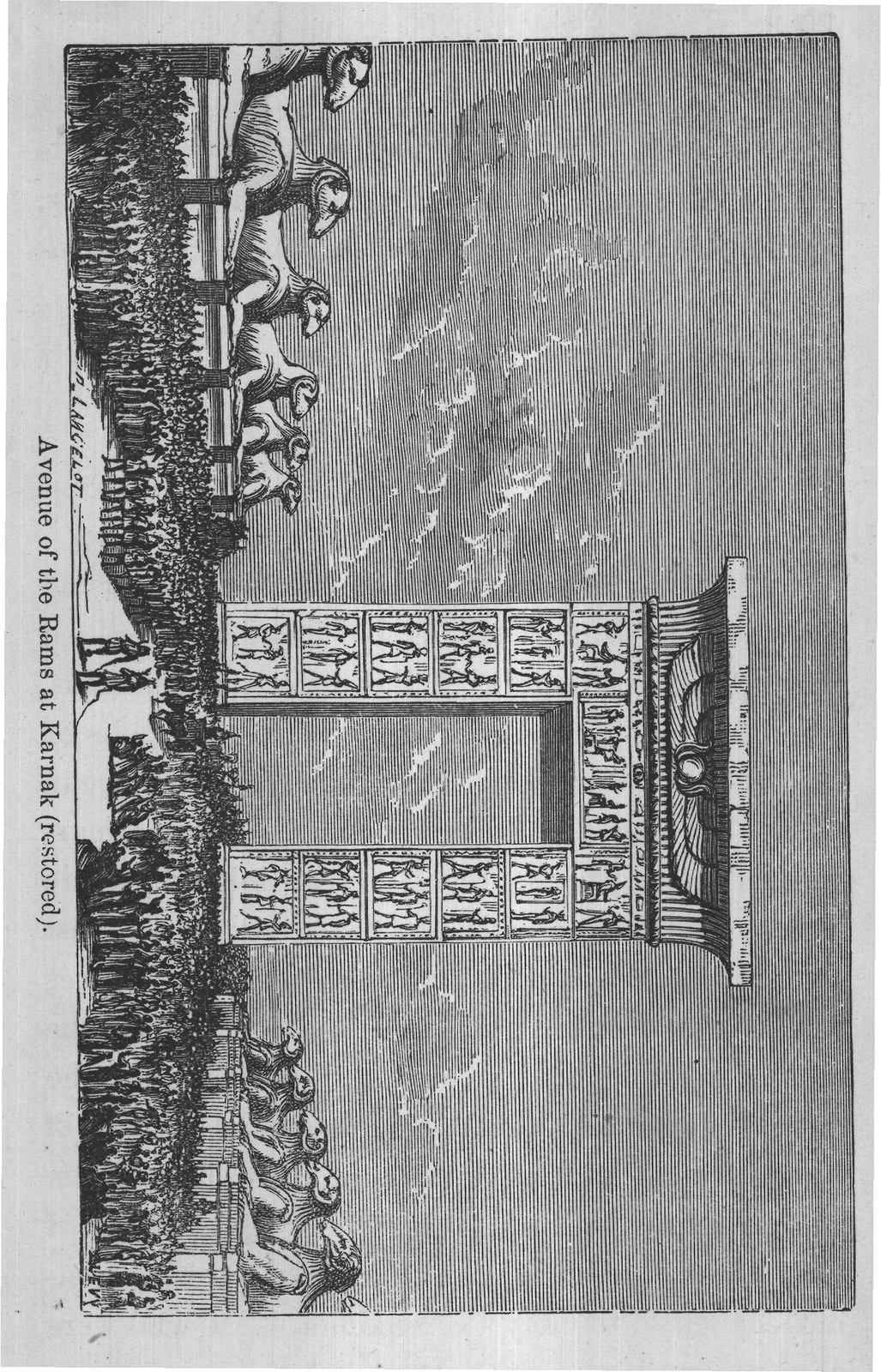
On the appointed day, so soon as the sun rising above the horizon of the Arabic chain, had gilded the opposite summits of the Libyan mountains, sanctified by the presence of the royal necropolis or city of the dead, and floods of sparkling light began to ripple along the masses of sandstone and marble, red porphyry and black or rose-colored granite which, reared in gigantic temples; hewn in the vast pylons; carved in obelisks; sculptured in sphinxes and colossi, seemed, at Thebes more than in the rest of Egypt, like the material envelope of the empire's mysterious soul, a tremendous clamor of human voices and instruments of music, rising from the bosom of the city, saluted the appearance of the Pelasgic god and gave the signal for the commencement of the day's ceremonies. All who were to take part in the latter hastened to range them- LANGELOT Avenue of the Rams at Karnak (restored). 4 selves along the approaches to the palace where Mei-Amoun had passed, in seclusion, the period of his mourning. Under the main portico stood a magnificent naos * upon supports of econy carved in symbolical caryatides. It contained a throne of ivory, the base of which represented in gilded relief the sphinx, the emblem of wisdom united with strength, and the lion, the symbol of courage.
Of this throne the colored statues of Tmei, the goddess of justice, and of Hor-Mœi, the sun-god of truth, with outstretched arms and expanded wings, formed the background and sustained the dais. The king, his forehead encircled with a simple band surmounted with a golden uræus set with jewels, having seated himself in this kind of case or shrine, twelve Oeris or warrior chieftains, the first in the empire in dignity and birth, uplifted him on their shoulders. Other great personages then took hold, each one of some particular part of the supports and steps leading to the throne, and all moved off together, preceded by an immense crowd, to the temple of Ammon.
The march was opened by a band of vocal and instrumental music in which figured the rudimentary types of the flutes, trumpets and drums still in * A car or chair of state. use. The members of the king's household and the functionaries of his home establishment came next, and immediately after them, the royal naos surrounded by attendants, by fanbearers and young children of the sacerdotal caste carrying the sceptre, the arms and the other insignia of the monarch, before whom the first of the princes of the blood and the son of the high priest burned incense in golden censers.