Home › Extracts from the Sallier Papyrus › Extracts from the Sallier Papyrus: Earth
Extracts from the Sallier Papyrus: Earth
The loins of IX. "HOWEVER, on the next day, so soon as it was daylight on the Earth, Rameses caused the battle to be joined afresh, and rushed into the combat like a bull that dashes among the geese.
The warriors, in their turn, went into the fight like the hawk darting upon his prey.
And the king hurled flames into the faces of his foes, like the Sun, when he appears in the morning, darting his fires on the wicked.
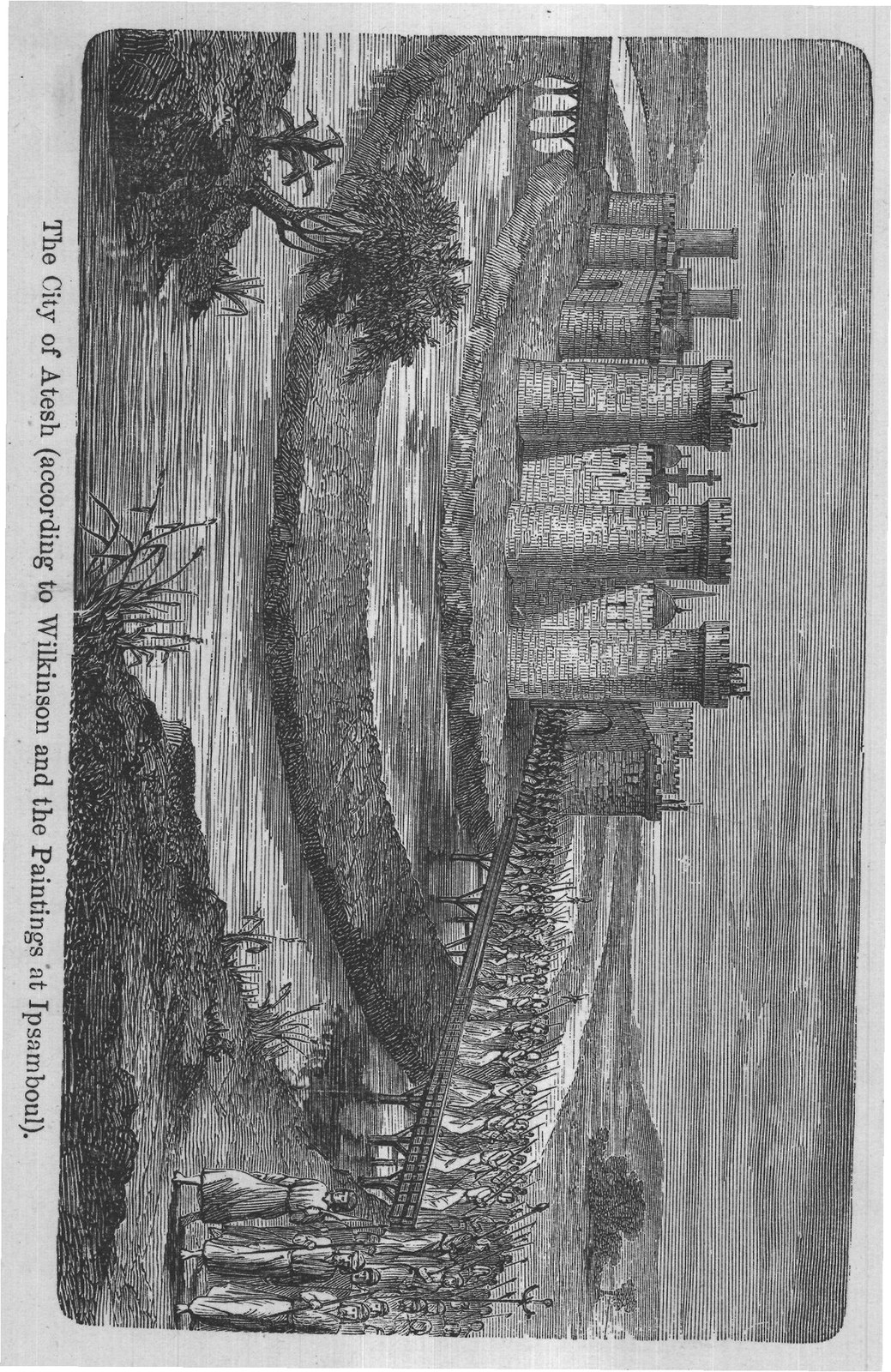
The great lion that walked beside his coursers, fought with him; rage filled all his members, and whoever ap- 'proached him was overthrown. The king seized upon them or slew them, so that not one could escape. Hewn to pieces in front of his horses, their dead bodies, extended on the ground, formed but a single heap of bleeding remains."* One circumstance which has frequently repeated itself in scenes of warfare, rendered the disaster * See the Vicomte de Rougé at the passage cited. that befell the army of the confederates still more decisive. With a river close behind thein, they seem to have had for their line of retreat nothing but the bridge leading to the city which they had wished to defend. Toward it the main struggle concentrated; Mei-Amoun, guided by his terrible military instinct, doing his utmost to force his way as far as that bridge, and Khetasar, his antagonist, fighting desperately to cover its approaches. [There, the forests of spears, the clouds of arrows, the shields and the chariots crossed and recrossed each other, and met in the deadly shock of battle with such re-echoing uproar that the Earth trembled to its depths, as though Apophis, the great serpent, had broken away from the chains with which the gods have fastened him to the foundations of the world.* There valiantly fought, and not ingloriously fell, around the chief commander of the Khetas, his most faithful warriors, such as Grabatusa his squire, and Khirapsar, his librarian or rhapsodist;† * In the Egyptian mythology, Apophis, the serpent, is the great enemy of the Sun; in several hypogees he is represented as struggling against the gods of the Amenti, who succeed in capturing and chaining him. See Champollion's Letters from Egypt. t Writer of Books, says the text.
The City of Atesh (according to Wilkinson and the Paintings at Ipsamboul). and his most tried lieutenants, such as Rabsuna, chief of the archers, and Tarekennas, general of the cavalry. But, when Rameses the II. had hewn a broad and bloody passage for himself to the banks of the river over the bodies of these champions of Asia, mangled and yet palpitating beneath the wheels of his chariot, the defeat of the confederated army, now cleft in twain and without any common rallying-point, degenerated into a frightful rout, in which death in every form struck down the fugitives. Thousands of men fell under the sword, some to rise no more and others to survive themselves, mutilated as they were for life, by the terrible hooked chariotscythe. And if the river spared a few who, following Masraim, the brother of their king, succeeded in swimming across, it swallowed up a far greater number and, especially noted among them, "the chieftain of the land of Tonira, and the prince of the bad race of the Khirabs, who was separated from his warriors while flying before king in the direction of the water.” From the foot of the walls to which he had been pushed back step by step, all the time fighting, Khetasar, beholding the tremendous disaster that his gallantry had been unable to avert, resolutely took the only course that presented itself to him to save his capital from the consequences of an assault that had now become unavoidable.] He turned with his hands extended toward the smiling sun.
He sent forth to invoke the great name of his Majesty: "It is thou who art the Sun, the god of the two horizons! It is thou who art Soutekh, the great conqueror, the son of heaven; Baal is in all thy members. Terror is in the land of Kheta, in such wise that thy feet are on her reins forever."
Announcement was made that a messenger had presented himself bearing a writing addressed to the great names of Majesty.... May this writing satisfy the heart of the god Sun, the mighty Bull, loving justice; the supreme King who himself directs his soldiers; the sword of terror; the rampart of his army on the day of battle: the King of Upper and of Lower Egypt, with the mighty courage and the boundless ardor; the Sun, lord of justice, the chosen one of the god Phra, the son of the Sun.
Rameses Mei-Amoun.* ...
The slave says, addressing his Majesty: "My good master, son of the Sun, since Ammon has taken thee from out his loins and has given thee all the countries united together, that Egypt and the * This series of titles constitutes the official protocol of King Rameses II. ١٠ people of Kheta may be slaves beneath thy feet :
Phra has granted to thee, dominion over them.
Thou canst slaughter thy slaves; they are in thy power; not one of them will contend against thee.
Thou camest yesterday, and thou hast slain an infinite number of them; thou comest to-day,-do not continue the slaughter. We are prostrate on the ground, ready to obey thy orders: oh valiant king! honor to the race of warriors! grant to us the breath of life.".... ...
Then his Majesty caused the chief leaders of the army to come, and gathered them together that they might hear the message of the great Prince of Kheta so as to write an answer. They said to his Majesty: "He hath done well, he throws his heart before the supreme king, his lord; he makes no conditions.
He does hom- ... age to thee to appease thy wrath." • [The king hearkened to their word and gave the vanquished his assurance of pardon and clemency; then, addressing himself to the Eris assembled in a throng around him, he added: "Give yourselves up to rejoicing, oh my comades; let it ascend to heaven! "We have triumphed over the strangers by our might; we have fallen upon them like lions and we have pursued them like hawks. We have crossed their rivers, burned their fortified places, annihilated their guilty souls. The terror of my name has hovered over them and their hearts have been filled with it. "Rejoice, then, oh my warriors! "I am for the land of Kemi what the God Month has been. I have done battle with all the parts of the earth. Ammon-Ra has been at my right and at my left (in the battles ;) his mind has inspired my own and has prepared the downfall of my enemies. Ammon-Ra, my father, has brought the whole world low beneath my feet, and I am on the throne forever."] Thereupon, Rameses, directing his march southward, returned peaceably to Egypt with his princes and his army, leaving all the nation terrified at his exploits, and the princes prostrating themselves before him, doing homage to his countenance. "His Majesty arrived in the city of Rameses Mei-Amoun,* the great image of Phra, and rested between his royal double pylons with a serene existence, like the Sun in his double abode in the heavens." * Erected by the Asiatic captives and the Hebrews between the present sites of Heliopolis and Suez on the fresh water canal which once ran, and, after an interval of 3000 years, is again to run from the Nile to the Red Sea. X.
WHEN, some time after that period, Rameses led back his army to his country, laden with the spoils of the East, and dragging numberless captives in its train; when, having passed through the cities of the Delta and the Heptanomis, more as a divinity than as a simple mortal, he came to the great temple of Thebes, to make in the presence of all Egypt, the emphatic recital of which we have just given the substance; and then, in enumerating, in grand outlines, the palpable results of his conquests; the roving tribes of the North hurled back and restrained within their native steppes, by the sword or by the faith of treaties; the frontiers of the Empire pushed beyond the Taurus and the Tigris and covered by military colonies which, from the Euxine to the Ocean, guaranteed the fidelity of nations that were vassals or in tutelage, he terminated, at last, with "the tributes imposed, their weight in gold and silver; the number of weapons and horses; the quantities of ivory and of incense for the temples; the grain and other products which each subjugated country was to furnish, and the aggregate of which equalled all the imposts that the arms of the Parthians or Roman power have raised since then!"*-Assuredly, it was a fine day in the life of that man and of his people, whatever may have been the price that one and the other had paid for it!
No doubt that in the thinned ranks of the victors many a vacant place summoned the tears of many a family, for fathers, sons and husbands who had remained on the roads they had traversed. If we are to believe testimony quite unanimous,† Rameses himself, as he first re-appeared upon his natal soil, but narrowly escaped the plottings of a brother armed against his life, and had to inflict condign punishment upon his own flesh and blood. But the broodings of domestic misfortune and private sorrow were lost in the intoxication of triumph and the glory shared by all; for it is the peculiar quality of great events to draw closer the bonds of fellowship that unite communities, in rejoicing as in grief, and to cause generations to sympathize with one another athwart the lapse of time.
More than three thousand years have gone since these events, and yet we, who know how much each of its tardy steps of progress cost humanity; we who have it in our power to connect with the labors of Rameses and of his companions their ultimate * Tacitus: Annals, Book II. ch. 60 and 61. + Herodotus, Diodorus, Manetho. results, which in their time no one could even conjecture beforehand, with their complete victories over the roving tribes, the whole future of the western world based upon agriculture and the rearing of permanent cities; - with their gigantic journeyings, the enlargement of general views with regard to the world, and the drawing nearer together of a part of the long dispersed fragments of human tradition;-well, we confess aloud that, far from being tempted to smile at the ingenuous emphasis with which these men of the antique time express themselves and their infatuated delight in the indulgence of their own pride, we cannot remain coldly unsympathetic with the invocation of the day that we have mentioned, however deeply hidden it may be in the strata of history; and we feel irresistibly drawn to applaud the words of the high priest of Thebes responding to Mei-Amoun in the name of his God: ["May thy return be joyous! "Thou hast pursued, and dispersed the barbarians; thou hast broken their bows and triumphed over their leaders. The world has seen thee, at my command, pierce the heart of the accursed nations, and make free the breath of those who followed thee under my sacred ensigns; and the world has stood still before thee! doth praise thee!"] My mouth "Thus," says the bard Penta-ur, in conclusion, "Thus Rameses, child of the Sun, and friend of Ammon, seated himself upon his throne, like the Sun, forever, all the nations of the Earth having been subdued by him."
At this point historical truth is found to disagree with the lyrical enthusiasm of the poet, for, although the achievement of Rameses, the battle of Atesh and the occupation of that city terminated the campaign, they did not put an end to the war.
Numerous monuments offer us the pictures of many other expeditions by Rameses, and long additional lists of tribes brought under subjection by his arms. In his campaign of the year XI., he returned to attack and capture by storm several fortresses in the land of Canaan, and among them, Ascalon, which had again fallen into the hands of the rebels. It is in this locality (Askaluna) frontier town, and not at Pelusium, that we should be tempted to place the scene of the treason of which Herodotus has left us the legendary recital.
In fine, it is only in the twenty-first year of his reign that Rameses, amid the pageantries of a panegyric celebrated at Thebes in honor of Ammon, sees a solemn embassy come in from the Prince of a the Khetas, soliciting a definitive treaty of peace from the Pharaoh. Khetasar then acknowledged himself the vassal and tributary of Rameses, and bound himself to furnish an auxiliary contingent whenever required. This treaty, put under the protection of the national gods of each contracting party, was carved upon a memorial pillar, and exhibited to the gaze of all, in the temple of Ammon. Reciprocal matrimonial alliances cemented it, and Rameses admitted the eldest daughter of Khetasar to his harem with the rank of one his wives. "This peace bore lasting and prolific fruit for Egypt, where, for a very long time, engraved inscriptions recalled the fact that the tribes of Kheta and of the borders of the Nile, a thing unheard of until then,* had but one heart to serve Rameses Mei-Amoun." * See the Vicomte Em. de Rougé's previously cited Memoir.