Writs of Assistance Denounced by Otis
A crisis soon came. The officers of customs asked for writs of assistance--warrants to empower them to call upon the people and all officers of government in America to assist them in the collection of the revenue, and to enter the stores and houses of the citizens at pleasure, in pursuit of their vocation. These writs were granted, and the people seeing the great peril to which their liberties were thereby exposed, resolved to openly resist the measure. It was contrary to the cherished theory of English liberties, that "every man's house is his castle," when the "meanest deputy of a deputy's deputy" might enter his dwelling at will. There was also a scheme on foot for establishing the ritual of the Church of England or the state mode of worship in the colonies, and this rekindled the smouldering fires of Puritan zeal in defence of the right of conscience. In these propositions the king and the aristocracy of Great Britain were the exponents of the feudalism which still moulded the policy of rulers in Europe, but which was entirely incompatible with the more advanced and enlightened ideas of human liberty which then prevailed in America.
The writs of assistance were first issued in Massachusetts. Their legality was questioned, and the matter was brought before a court held in the old Town Hall in Boston, in February, 1761. There were calm men there, and there were fiery men there. The calm advocate of the crown (Mr. Gridley) argued that as Parliament was the supreme legislature for the whole British realm, and had authorized the writs, no subject had a right to complain. The calm Oxenbridge Thacher, an eminent lawyer, answered his arguments with keen legal reasoning, showing that the rule in English courts was, in this case, not applicable to America. The fiery James Otis, one of Gridley's pupils, in a speech full of telling logic, expressed with eloquence and impassioned manner, also replied to the attorney-general. He denounced the writs as "the worst instruments of arbitrary power; the most destructive of English liberty and the fundamental principles of law." "No act of Parliament," he said, "can establish such a writ; even though made in the very language of the petition, it would be a nullity. An act of Parliament against the constitution is void." Referring to the arbitrary power of the writ, he said: "A man's house is his castle; and whilst he is quiet, he is as well guarded as a prince in his castle. This writ, if it should be declared legal, would totally annihilate this privilege. Custom-house officers may enter our houses when they please; we are commanded to permit their entry. Their menial servants may enter, may break locks, bars, and everything in their way; and whether they break through malice or revenge, no man, no court may inquire." "I am determined," he said, "to sacrifice estate, ease, health, applause, and even life to the sacred calls of my country, in opposition to a kind of power, the exercise of which cost one king his head and another his throne."
These words of Otis went forth with amazing power. They stirred the hearts of the people through all the provinces. The speech and event constitute the opening scene of resistance in America to British oppression. On that day the trumpet of the Revolution was sounded; the seeds of patriots and heroes were then and there sown; and when the orator exclaimed, "To my dying day I will oppose, with all the power and faculties God has given me, all such instruments of slavery on one hand and villainy on the other, as this writ of assistance is," "the independence of the colonies," John Adams afterward said, "was proclaimed." But absolute independence was not then desired. Even Otis deprecated the idea. The colonists were proud of their political connection with Great Britain. They asked only for justice and equality, and the privilege of local self-government as British subjects. The topic of American representation in Parliament, which assumed large proportions about two years afterward, was not then discussed.
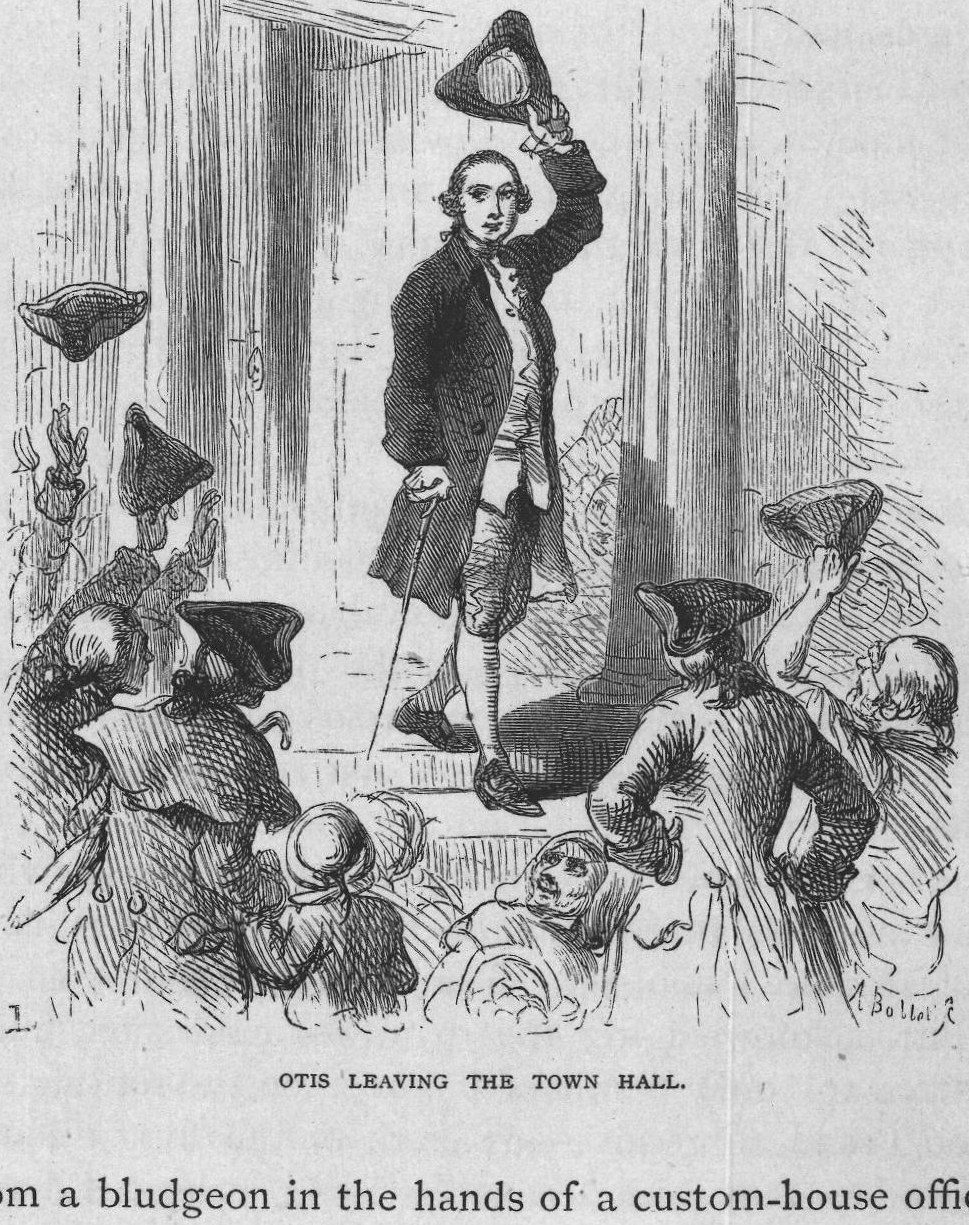
When Otis left the Town Hall that day, he was greeted by loud huzzas from the populace, who threw up their hats in token of their delight; and from the day of that remarkable event in our history, that unflinching patriot, then six-and-thirty years of age, led the van of the phalanx of revolutionists in Massachusetts for several years. His eloquence and presence were magnetic. He was the incarnation of courage and independence. He had resigned the office of advocate-general of the colony that he might, with a good conscience, wield the sword of opposition. The royalists feared and hated him. His election to a seat in the Massachusetts Assembly in the spring of 1761, alarmed them. "Out of this," wrote the tory Timothy Ruggles, "a faction will arise that will shake this province to its foundations." The Governor (Bernard), fearing the influence of his tongue, exhorted the new legislature not to heed "declamations tending to promote a suspicion of the civil rights of the people being in danger. Such harangues might well suit in the reign of Charles and James, but in the time of the Georges they are groundless and unjust," he said. At that very moment the perfidious governor was secretly promoting the scheme of the Board of Trade for taking away the colonial charters.