Violations of Solemn Engagements
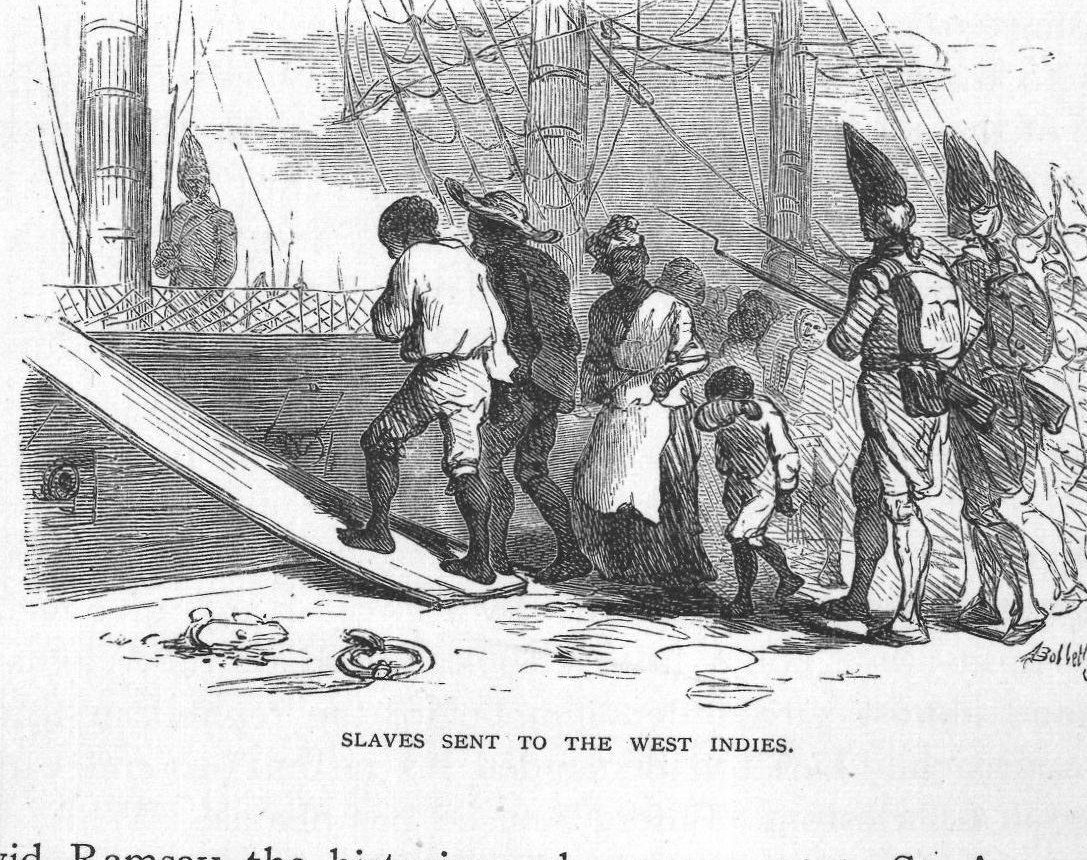
The city was given up to pillage by the British and Hessian troops. When the whole amount of plunder was appraised for distribution, it aggregated, in value, a million and a half dollars, Clinton and his major-generals each receiving about twenty thousand dollars. Houses were rifled of plate and other valuables; confiscation of the estates of the Whigs was threatened, and afterward executed; and slaves, even those who had sought British protection, were seized and sent to the West Indies for sale to swell the money-gains of the conquerors. Over two thousand were sent at one embarkation. They were driven on board the ships in gangs of four or five, lashed together by ropes--men and women--without regard to the separation of families or the supplications of parting kindred. Only upon the promise of unconditional loyalty was British protection offered to any citizen; and in gross violation of the terms of the capitulation, a large number of the leading men of Charleston were taken from their beds, in August, by armed men, and carried on board prison-ships, under the false accusation that they were concerned in a conspiracy to burn the town and murder the loyal inhabitants. In these ships hundreds suffered terribly. Among the more prominent citizens thus treated were Lieutenant-Governor Gadsden and David Ramsay, the historian, who were sent to St. Augustine, where Governor Tryon, the North Carolina "Wolf," was in command. Tryon offered them their liberty on parole. Gadsden, the sturdy patriot, refused. He would make no further terms with men who had broken solemn pledges. "Had the British commander," he said, "regarded the terms of capitulation at Charleston, I might now, although a prisoner, enjoy the smiles and consolations of my family under my own roof; but even without a shadow of accusation preferred against me, for any act inconsistent with my plighted faith, I am torn from them, and here, in a distant land, invited to enter into new engagements. I will give no parole." "Think better of it," said Tryon; "a second refusal of it will fix your destiny--a dungeon will be your future habitation." "Prepare it, then," replied the inflexible patriot. "I will give no parole, so help me God!" And the petty tyrant did prepare it. For forty-two weeks that brave man, almost three-score years of age, never saw the light of the blessed sun, but lay incarcerated in the castle at St. Augustine. And when he, and other prisoners, were exchanged the next year, they were not allowed to enter Charleston, but were sent to Philadelphia, whither their families had been exiled.
The fall of Charleston and the loss of the Southern army were severe blows to the republicans. It paralyzed their strength; and, for awhile, South Carolina lay helpless at the feet of the oppressor. With an activity unusual for British officers in America, Clinton took immediate steps to extend and secure his conquests, and to re-establish royal authority in the South. With a mistaken policy he used harshness instead of conciliation toward the smitten and humbled inhabitants. He sent out three strong detachments to overrun the country and awe the people by a display of power. One of these, under Lord Cornwallis, marched up the course of the Santee River, to Camden; another, under Lieutenant-Colonel Cruger, was ordered to penetrate the country to Ninety-Six; and a third, under Lieutenant-Colonel Brown, went up from Savannah to Augusta.
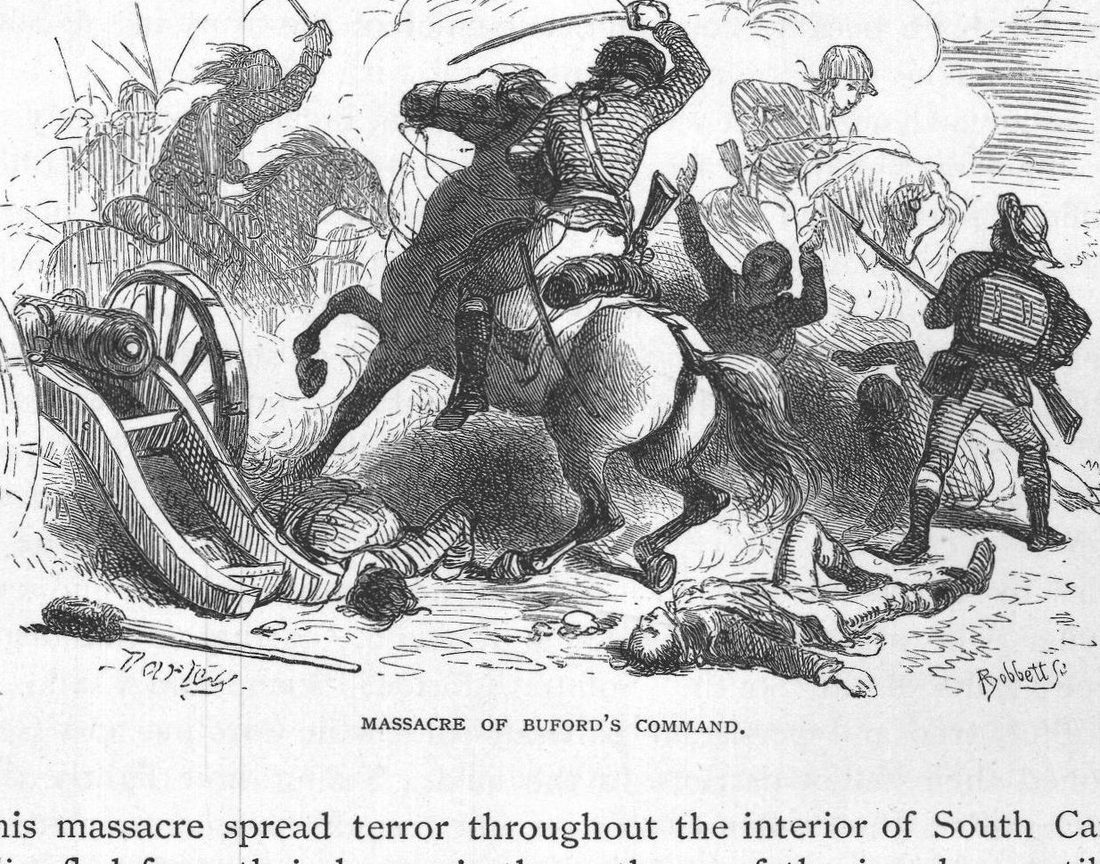
Meanwhile Colonel Abraham Buford, with four hundred Continental infantry, a small number of cavalry and two cannon, who had hastened toward Charleston to help Lincoln, had been dreadfully smitten by Tarleton. Buford had retreated from Camden toward Charlotte, in North Carolina, on the approach of Cornwallis. Tarleton, with seven hundred cavalry and mounted infantry, was sent in pursuit. By a forced march of one hundred and five miles in fifty-five hours, he overtook Buford, on the Waxhaw (May 29th, 1780), and almost surrounded him before the republican leader was aware of his approach. Tarleton demanded his instant surrender upon the terms granted at Charleston. Buford refused compliance. While flags for conference were passing and re-passing, Tarleton, contrary to military rules, made preparations for assault when that conference should end. The instant he received Buford's reply, his cavalry made a furious charge upon the unprepared and astonished Americans. All was confusion. Some resisted; others threw down their arms and begged for quarter. None was given, and men without arms were hewn in pieces by the British cavalry. One hundred and thirteen were slain; one hundred and fifty were so maimed as to be unable to travel; and fifty-three were made prisoners, and graced Tarleton's triumphal march into Camden. The spoils of victory were Buford's artillery, ammunition and baggage. Cornwallis eulogized this savage act of Tarleton; Stedman, one of Cornwallis's officers, and a historian of the war, wrote: "On the occasion, the virtue of humanity was totally forgot." Tarleton received the special favor of Lord George Germain, for the cold-blooded massacre; and "Tarleton's quarter," became the synonym for cruelty. It was the war-cry for vengeance of the patriots in the field afterward. Among the witnesses of that massacre was Andrew Jackson, then a lad thirteen years of age. The event fired his patriotism, and he and his brother Robert entered the military service under Sumter. They were made prisoners, and while in captivity the spirit of the future military hero and headstrong President of the United States was displayed. A British officer ordered Andrew to clean his muddy boots. The boy refused to do this menial service for an enemy of his country, and received from the officer a sword-cut, the scar of which he bore to the grave sixty-five years afterward.