De Kalb
This massacre spread terror throughout the interior of South Carolina. Families fled from their homes in the pathway of the invaders, until there was no place of refuge for them. The exasperated patriots were ready to fight, but there was no military organization. Taking advantage of their helplessness, the conqueror now attempted to crush out all independence in the State by requiring every able-bodied man to join the British army, and take an active part in the re-establishment of royal rule, and threatening all who should refuse compliance with treatment as "rebels to the government of the king." The silence of fear and weakness overspread the State. Mistaking this lull in the storm, and the numerous applications for protection, for permanent tranquillity, Clinton and Arbuthnot, with a large body of troops, returned to New York. On the eve of his departure, Clinton wrote to Germain: "The inhabitants from every quarter declare their allegiance to the king, and offer their services in arms. There are few men in South Carolina who are not either our prisoners or in arms with us."
The lull in the tempest of war was brief. To aid the Southern patriots, Washington had sent the Baron De Kalb, with Maryland and Delaware troops, to help Lincoln at Charleston. He was a brave but slow moving French officer, about sixty years of age, who accompanied Lafayette to this country, and was commissioned a major-general by the Congress, in September, 1777. He was yet in Virginia, whose leading men were making noble sacrifices to strengthen him, when he heard of the surrender of Charleston, and it was late in June when he entered North Carolina. By the capture of Lincoln, De Kalb became commander-in-chief of the army in the South, a position which he was not competent to fill with efficiency. Washington desired to have General Greene succeed Lincoln, but the Congress, yielding to the importunities of the friends of Gates, procured his appointment to that difficult position. That body gave the favorite orders to act independently, and to report directly to them. He was gratified by the trust reposed in him, and joined De Kalb on the 25th of July. The prospect before him was far from flattering. An army without strength; a military chest without money; an inefficient commissary department; a climate unfavorable to health; the spirit of the republicans cast down; loyalists and timid patriots swarming in every direction, and a victorious enemy pressing on to spread his legions over the territory Gates had come to defend, were the grave obstacles to success before him. But the approach of the "conqueror of Burgoyne," who was yet surrounded by the glory of that event, inspirited the republicans of the South. Sumter, Marion, Pickens and Clarke, brave and skillful, true and persistent partisan leaders in Carolina and Georgia, summoned their fellow-patriots to the field. Seeing how lightly the invaders regarded their solemn pledges, the republicans, renouncing their "paroles" and "protections," flocked to the standards of these brave partisans, and prepared the way for Gates. They swept over the country with celerity, in small bands, striking British detachments here or a company of Tories there, such unexpected, sharp, quick and decisive blows that the enemy, alarmed and perplexed, was checked in their invading march into the interior.
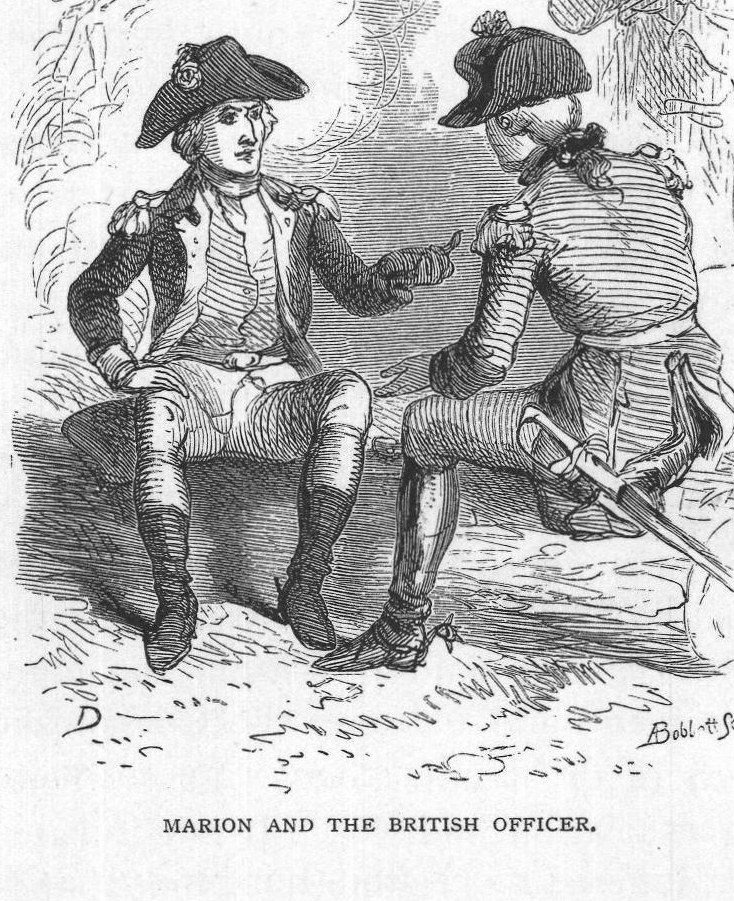
General Thomas Sumter now first appeared in power on the borders of the Catawba River. The Whigs, following local leaders, had already assailed the enemy at different points between the Catawba and Broad rivers. Sumter, meanwhile, had gathered a considerable force, and on the 30th of July (1780) he attacked a British post at Rocky Mount, on the right bank of the Catawba, where he was repulsed but not disheartened. He crossed the river and fell upon another British post under Major Carden at Hanging Rock, a few miles eastward, on the 6th of August. A large body of British and Tories were there. They were at first dispersed; but Sumter's men, seeking plunder, and drinking the liquors found in the camp after they had secured it, lost the victory through separation and intoxication. The ranks of the patriots became disordered. The enemy rallied, and a very severe contest ensued. The British were reinforced, and Sumter was compelled to retreat. But he had handled his enemy so severely, that he did not attempt to follow. In the meantime Colonel Francis Marion (soon afterward a brigadier-general), a soldier of the French and Indian war, a hero at Fort Sullivan in 1776, a brave combatant at Savannah in 1779, and an active partisan leader in his native State (South Carolina) afterward, was smiting the enemy with sudden and fierce blows among the swamps in the low country, on the borders of the Pedee. So brave and wily were these partisans, that the British called Sumter "The Carolina Game-Cock," and Marion "The Swamp Fox." The latter was one of the most noted and beloved of the partisan leaders in that struggle, and was more feared by the British and Tories in the South than any other, for they never knew where he was until they felt his blows. He was
A moment--and away
Back to the pathless forest,
Before the break of day."
At the same time Colonel Andrew Pickens was annoying Cruger in the neighborhood of Ninety-Six and the waters of the Saluda, and Colonel Elijah Clarke was calling for the patriots of the country along the Savannah, Ogeechee, and Alatamaha, to drive Brown from Augusta.