Threatened Dangers Unheeded: White House and Bladensburg
The President and his cabinet did not sleep that night, and on the morning of the 24th, while Winder was in consultation with them, a courier came in great haste to tell them that the British were marching on Bladensburg. Winder immediately sent troops to join those already there, and he speedily followed in person. His little army was evidently in great peril, for the invaders had overwhelming numbers. He must either fight or surrender, for to retreat would be equally perilous. He chose to fight, and at a little past noon a sharp battle began in sight of the village of Bladensburg. The militia soon broke and fled in confusion; and the brave Barney and his gallant men, who stood fire, sustained the brunt of the battle until that leader was severely wounded, when Winder, seeing no sign of a hope of winning a victory, ordered a general retreat. The troops which had not already dispersed, retreated toward Montgomery Court-House, in Maryland, leaving the battle-field in possession of the invaders. The latter had gained the advantage at the fearful cost of the loss of more than five hundred men in killed and wounded, among them several officers of distinction. The battle lasted almost four hours, when it was ended and the retreat began. President Madison, Secretary of State Monroe, Secretary of War Armstrong and other civil officers, who went out to see the fight and give assistance if possible, hastened back to the city as fast as fleet horses could carry them, and were the pioneers of a considerable multitude who followed. This race created much merriment afterward, especially among the opposition. A writer in a New York newspaper said: "Should some Walter Scott [his Marmion was then very popular] in the next century write a poem and call it Madison, or the Battle of Bladensburg, we should suggest the following lines for the conclusion:
Were the last words of Madison."
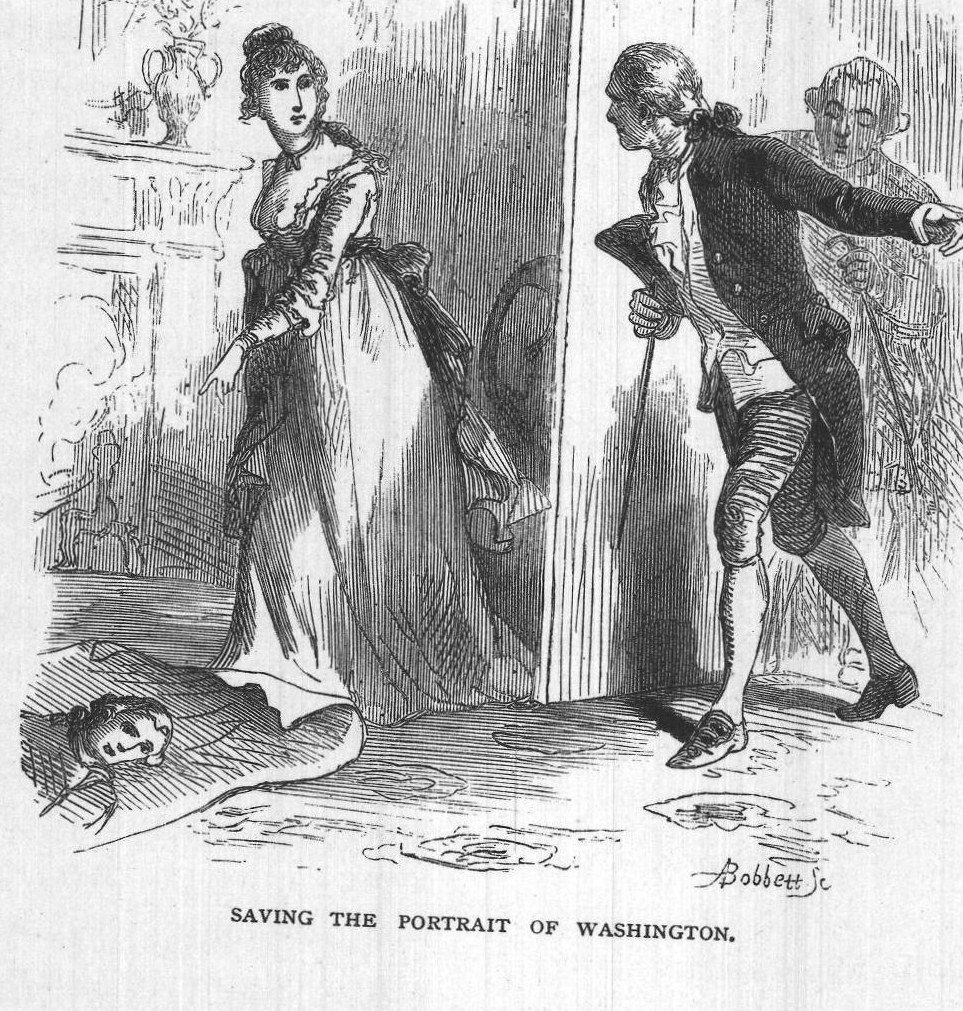
The President and his party of fugitives announced the startling intelligence that the British, victorious, were probably marching on the town. Mrs. Madison, at the White House, had already been apprised of danger, by a messenger sent by her husband, when the militia fled. She had ordered her carriage to be at the door ready for flight, and had sent away to a place of safety silver-plate and other valuable articles. While anxiously waiting for her husband, and at the moment when she had cut out of the frame, for preservation, a full length portrait of Washington by Stuart, the late Jacob Barker and another gentleman entered the house and bade her fly, for the enemy were near. "Save that picture!" she said, as it lay prone upon the floor; "save or destroy it, but do not let it fall into the hands of the British." Then snatching up the precious parchment on which the Declaration of Independence was written, and which contained the names of the fifty-six signers of that document, she entered her carriage with her sister and one or two others, and was borne away to a place of safety beyond the Potomac. The picture was saved, and it now adorns one of the reception-rooms in the White House.
The British entered Washington on the evening of the 24th (August, 1814), and at once proceeded to plunder and destroy. The Capitol, President's house, Treasury buildings, Arsenal and barracks were burned, and of the public buildings only the Patent-office was saved. Some private houses were plundered and others were burned. While these buildings were blazing in the city, the public vessels and other government property at the Navy-Yard were in flames, for Commodore Kinzey, who was in command there, had been ordered to destroy this property in case it was likely to fall into the hands of the invaders. The value of the property destroyed by the Americans and British at that time, was estimated at about two million dollars. Right-minded Englishmen deplored the barbarism of their troops in burning the national buildings. "Willingly," said the London Statesman newspaper, "would we throw a veil of oblivion over our transactions at Washington. The Cossacks spared Paris, but we spared not the capital of America." While the people of England loudly condemned the act, the British government caused the tower-guns to be fired in honor of Ross's victory; and on his death a few weeks later, his government decreed him a monument in Westminster Abbey.
The events at Washington caused intense excitement throughout the country. The disaster was followed by another humiliating occurrence, and then by a glorious triumph. While Ross was crossing Maryland to the national capital a part of the British fleet, under Commodore Gordon, had gone up the Potomac River, and in defiance of the guns of Fort Washington, appeared before Alexandria on the evening of the 27th. Meanwhile the British at Washington, apprehending a large gathering of the militia, had stolen away from the capital very secretly on the night of the 25th, and re-embarked on their transports. Alexandria was almost defenceless; and when Gordon demanded an enormous amount of property as a ransom for the doomed city from destruction, the town and its inhabitants were at the mercy of the invaders. The inhabitants were allowed only an hour to consider the terms. Of course they had to submit; and the British squadron sailed down the river with a large amount of plunder, annoyed some of the way by the batteries planted on the shores.