Threatened Dangers Unheeded
While Washington was suffering, Baltimore was threatened. Indeed all the shores of the Chesapeake Bay were menaced with plunder and devastation. After resting and recruiting several days at the mouth of the Patuxent, the British sailed for the mouth of the Patapsco River, on the banks of which Baltimore stands, ten miles from the Chesapeake. The fleet spread terror along the entire coasts of the bay, the people fleeing from their dwellings; and at every light-house and signal-station alarmguns were fired. On Sunday, the 11th of September, the British vessels appeared off Patapsco Bay, having at least six thousand fighting men on board; and victorious Ross boasted that he would make Baltimore his winter-quarters. It was a city of forty thousand inhabitants at that time. It had sent out so many clipper-built vessels as privateers, that the British held a grudge against the place, and resolved to capture or destroy it.
The citizens of Baltimore, wiser than those of some other places, had cast up defences before the enemy were at their doors. When they heard of the capture of Washington, they turned out in force to strengthen these defences. A large number of troops were gathered around the city. Fort McHenry, that commands the harbor, was garrisoned by about a thousand men, under Major Armistead, and was supported by redoubts. Such were the preparations for receiving the enemy, who, that evening (September 11, 1814,) appeared off Patapsco Bay, and before sunrise on the 12th had landed, nine thousand strong, at North Point, twelve miles from Baltimore. At the same time the fleet entered the harbor to attack Fort McHenry. When news came that the British were landing on North Point, General Smith, who had about nine thousand men under his command, sent General Stricker, with more than three thousand of them, to watch the enemy and act as circumstances might require.
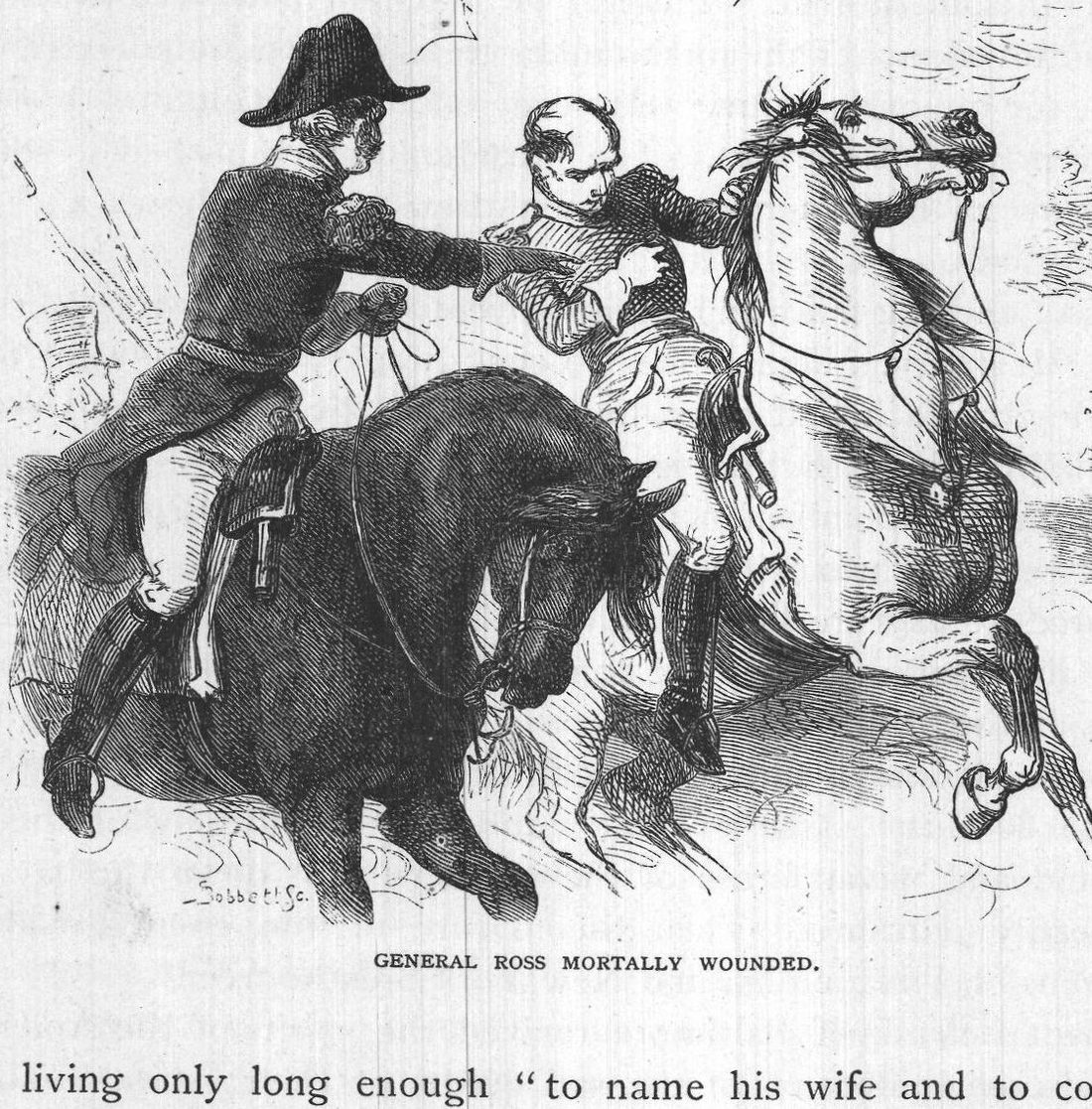
Feeling confident of success, Ross and Cockburn were riding gayly in front of their troops, who were marching on Baltimore, when a rifle-ball from a small number of Stricker's advance troops, concealed in a hollow, mortally wounded the general. Ross died before his bearers could reach the boats, living only long enough "to name his wife and to commend his family to the care of his country." The command now developed upon Colonel Brooke, who pressed forward and met Stricker's advance troops seven or eight miles from Baltimore. There a severe engagement occurred lasting about two hours, when Stricker ordered a retreat to his reserve corps. There he re-formed his brigade and fell steadily back toward the city, as far as Worthington's Mill, where he was joined by General Winder with some fresh troops. The British bivouacked on the battle-field that night.
Early on the morning of the 12th, frigates, schooners, sloops, bomb-ketches and rocket-vessels entered the harbor of Baltimore and moved up toward Fort McHenry. They anchored out of reach of its moderate-sized guns until evening. Then the fleet were so disposed as to bombard Fort McHenry and batteries not far off on the next morning, when Brooke should move forward with the land forces to attack the city. At the time specified the bomb-vessels opened a heavy fire upon the American works. Armistead immediately opened the batteries of Fort McHenry upon the fleet, but his missiles falling short, were harmless. The garrison was exposed to a tremendous shower of shells for several hours, without power to check the firing of the antagonist. Finally, to the delight of Armistead, the bomb-vessels moved nearer the fort to make their shells more effective, when his turn came for inflicting injury. He ordered a cannonade and bombardment from every part of the fort. The intruders were punished so severely that in the course of half an hour they withdrew to their former anchorage very much bruised.
All that day and the following night--twenty-five hours--the fleet bombarded Fort McHenry. Meanwhile Colonel Brooke, with the land forces, had been trying to reach Baltimore, but was foiled by Stricker and Winder. On the evening of the 13th, finding it impossible to accomplish his object, and learning that the bombardment had very little effect, Brooke obtained an interview with Cochrane, when they concluded that the efforts of the combined forces to capture Baltimore was already a failure. They resolved to relinquish the enterprise, and the bombardment suddenly ceased early on the morning of the 14th. The troops had begun their retreat in a heavy rain and intense darkness, at three o'clock that morning. They were taken on board the fleet the same evening; and on the morning of the 15th, the entire land and naval forces of the invaders went down the bay crestfallen and badly punished. This discomfiture of the enemy made the alarmed citizens of Philadelphia and New York breathe freer.
This gallant defence of Baltimore revived the spirits of the Americans, which were drooping because of the sad events at their capital. The disappointment of the enemy was very great. After the capture of Washington, Ross felt that the taking of Baltimore would be like a holiday pastime. Sir George Prevost postponed public rejoicing at Montreal because of the capture of Washington, until the capture of Baltimore should be accomplished, when both events might be celebrated at the same time. On the very day when Ross anchored off North Point (September 11, 1814), Prevost was vanquished at Plattsburg, and made to fly back to Canada.