The Spirit of Independence
In the gray of the early morning, Major Pitcairn and his scarlet-clad soldiers appeared, and halting not far from the line of Minute-men on Lexington Common, loaded their muskets. The patricts stood firm. They had been ordered not to fire a shot until they were assailed by the invaders. A pause ensued, when Pitcairn and other officers galloped forward, waving their swords over their heads, and followed by the shouting troops in double-quick time. "Disperse, you villains! Lay down your arms! Why don't you disperse, you rebels? Disperse!" cried the major. In rushing forward the troops had become confused. As the Minutemen did not immediately obey the command to lay down their arms, Pitcairn wheeled his horse, and waving his sword, shouted: "Press forward, men! surround the rascals!" At the same moment some random shots were fired over the heads of the Americans by the British soldiers, but without effect. The Minute-men had scruples about firing, until their own blood had been spilled. Pitcairn was irritated by their obstinacy, and drawing his pistol, discharged it, at the same moment shouting fire! A volley from the front rank followed the order, with fatal effect. Some Americans fell dead or mortally wounded, and others were badly hurt. There was no longer hesitation on the part of the Minutemen. The conditions of their restraint were fulfilled. The blood of their comrades had been shed; and as the shrill fife of young Jonathan Harrington set the drum a-beating, the patriots returned the fire with spirit, but not with fatal effect. The blood of American citizens stained the green grass on Lexington Common, but no British soldier lost his life in that memorable conflict. Captain Parker, perceiving his little band in danger of being surrounded by overwhelming numbers and massacred, ordered his men to disperse. They did so; but as the British continued to fire, the Americans returned the shots with spirit, and then sought safety behind stone-walls and buildings. Four of the Minute-men were slain by the first fire, and four afterwards, and ten were wounded. Only three of the British were wounded, with Pitcairn's horse.
So ended the opening act in the great drama of the Old War for Independence. The bells that were rung on that warm April morning--the mercury marking 85 deg in the shade at noon--tolled the knell of British domination in the old thirteen colonies. When the firing began, Samuel Adams was lingering in his tardy flight on a wooded hill near Clarke's house, and when the air was rent by the first volley on Lexington Common, he uttered these remarkable words: "What a glorious morning for America is this!" With the vision of an inspired seer at that moment, the sturdy patriot perceived in the future the realization of his cherished dreams of independence for his beloved country. Those words are inscribed on the Lexington Centennial Medal.
When the Minute-men at Lexington were dispersed at sunrise, the British drew up in line on the Common, fired a fcu de joic, gave three cheers in token of the victory, and in high spirits marched rapidly toward Concord. They had just been joined by Colonel Smith and his party, and felt sure of the success of the expedition. But the sunset told a sad tale for the invaders.
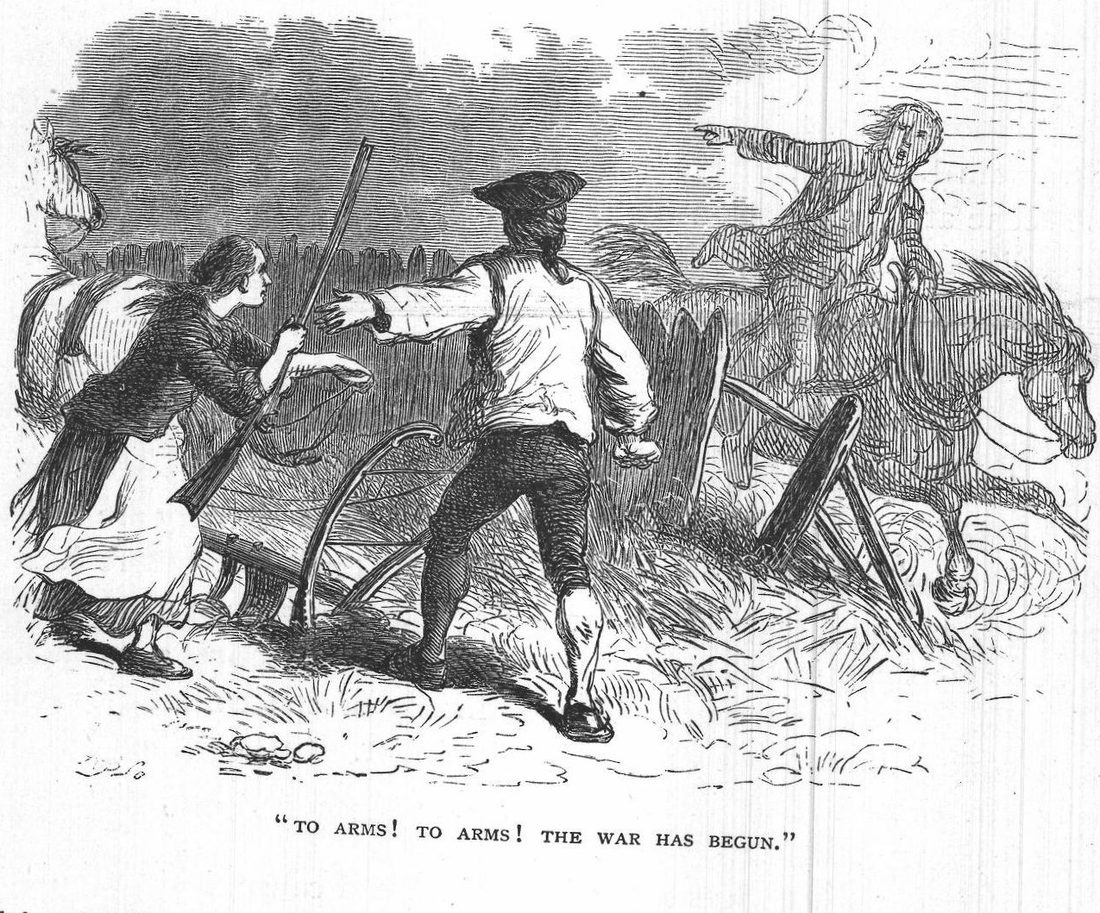
Meanwhile the news of the skirmish was spreading with great rapidity over the province. Before noon that day, the tidings reached Worcester, thirty miles from Lexington. "An express came to the town," says Lincoln, the local historian, "shouting as he passed through the streets at full speed, `To arms! to arms! the war has begun !' His white horse, bloody with spurring, and dripping with sweat, fell, exhausted, by the church. Another was instantly produced, and the tidings went on. The bell rang out the alarm; the cannon were fired, and messengers were sent to every part of the town to collect the soldiery. As the news spread, the implements of husbandry were thrown by in the fields, and the citizens left their homes with no longer delay than to seize their arms. In a short time the Minutemen were paraded on the Green, under Captain Timothy Bigelow; after fervent prayer by Rev. Mr. McCarty, they took up their line of march. They were soon followed by as many of the train-bands as could be gathered under Captain Benjamin Flagg."
The scene at Worcester on that occasion, was a type of a hundred others enacted within twenty-four hours after the skirmish at Lexington. It affords a vivid picture of the spirit of the people.
The serious question arose, Who fired first at Lexington, the British or the Provincials? Upon the true solution of that question depended, in a degree, the justification or condemnation of the belligerent parties, for the American had resolved not to be the aggressors. So late as May the next year, a London journal said: "It is whispered that the ministry are endeavoring to fix a certainty which party fired first at Lexington, before hostilities commenced, as the Congress declare, if it can be proved that American blood was first shed, it will go a great way toward effecting a reconciliation on the most honorable terms." The testimony of contemporaries seems to prove, beyond a doubt, that the British fired first. Stiles, in his MS. Diary, cited by Mr. Frothingham in his History of the Siege of Boston, under date of August 19, 1775, wrote: