The Republican Party
Brown was suspected of being an emissary of the Abolitionists, and attempts were made to implicate leaders of the Republican party and the inhabitants of the free-labor States generally in a scheme for liberating the slaves. A committee of the United State Senate, with the author of the Fugitive-Slave Law (James M. Mason) at its head, was appointed to investigate the subject. The result was positive proof that Brown had no accomplices and only about twenty-five followers.
John Brown's attempt to free the slaves was a crazy one in itself, and utterly failed, but it led to events that very soon brought about the result he so much desired. His bitterest enemies acknowledged that he was sincere, and a real hero, and he became, in a manner, the instrument of deliverance of millions from bondage. His effort aroused the slumbering party spirit of the combatants for and against slavery to great activity, and at the beginning of 1860, a remarkable and growing strength of the Republican party was everywhere manifested. Its central idea of universal freedom attracted powerful and influential men from all other political parties, for it bore a standard around which persons differing in other in other things might gather in perfect accord. The elections held in 1858 and 1859 satisfied the opponents of this party that they were rapidly passing to the position of a hopeless minority, and that the domination in the National Councils which the friends of the slave-system had so long enjoyed would speedily come to an end.
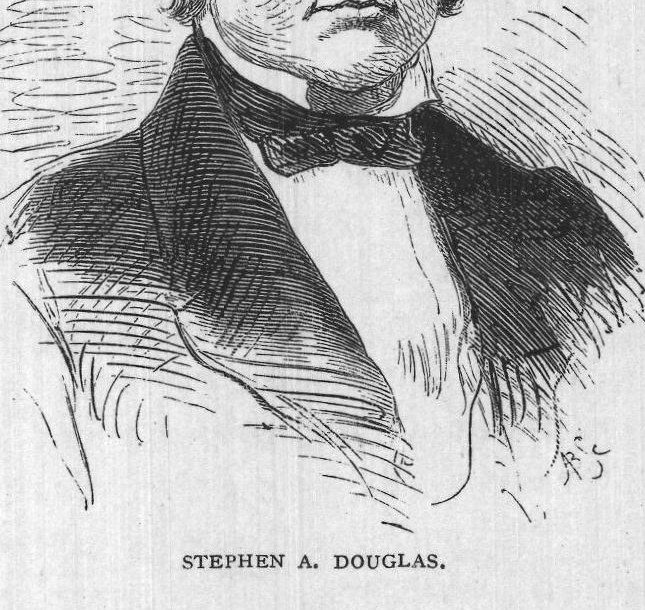
The sagacious leaders of the pro-slavery party in the South, who had been for years forming plans and preparing a way for a dissolution of the Union, so as to establish the great slave-empire of their dreams within the Golden Circle (to be noticed presently), believed that they would not be able to elect another President of their choice, and that the time had come for the execution of their destructive scheme. A pretext more plausible than that of the violations of the Fugitive-Slave Act at the North afforded them, must be had, for that act had become too odious in the estimation of righteous men and women in all parts of the Union to inspire them with a desire for its maintenance. No such pretext existed, and the politicians in the slave-labor States deliberately prepared to create one, which, they knew, would be powerful. At that time they were in full alliance with the Democratic party of the North, which was then in power. If it should remain a unit and the fraternal relations with the Southern wing of the party should continue undisturbed, there might be a chance for the supremacy of the coalition awhile longer. But there were omens already of a speedy dismemberment of the Democratic party, for the Fugitive-Slave Law and the attempt to nationalize slavery had produced wide-spread defection in their ranks. A large portion of that party, led by Senator Stephen A. Douglas, showed a proclivity toward independent action, and even of affiliation with the Republican party on the subject of slavery; and the hopes of the friends of that system, of the undivided support of the Northern Democracy, vanished.
In view of this impending crisis, the Southern politicians deemed it expedient to destroy absolutely all unity in the Democratic party and make it powerless, when the Republicans might elect their candidate for the Presidency in the fall of 1860. Then would appear the pretext for a revolution--the election of a sectional President. Then the plausible war-cry might be raised--"No sectional President! No Northern domination! Down with the Abolitionists!" This would appeal to the hearts and interests of the Southern people, especially to the slave-holding class, "fire the Southern heart," and produce, as they believed, a "solid South" in favor of breaking up the old Republic and forming an empire whose "corner-stone should be slavery." With this end in view, leading politicians in the South, who afterward appeared conspicuous among the confederated enemies of the National Government during the Civil War, entered the Democratic National Convention assembled at Charleston, South Carolina, on the 23d of April, 1860, for the purpose of nominating a candidate for the Presidency of the United States and setting forth an embodiment of political principles.
On the appointed day, almost six hundred chosen representatives of the Democratic party assembled in Convention in the hall of the South Carolina Institute, in Charleston, and chose Caleb Cushing, of Massachusetts, their chairman. It was evident from the first hour after the organization of the Convention that the spirit of Mischief was there enthroned; and observing ones soon discovered omens of an impending tempest which might topple from its foundations the organization known as the Democratic party.
The choice of Mr. Cushing as chairman was very satisfactory to the friends of the slave-system in the Convention. He was a statesman of great experience, and then sixty years of age; a scholar of wide and varied culture, and a sagacious observer of men. Because he had joined the Democratic party at the time of Mr. Tyler's defection; had been a conspicuous advocate of the war with Mexico and other measures for the extension and perpetuation of the system of slavery, he was regarded by the Southern men in the Convention as their fast political friend and coadjutor; but when they made war upon the unity of the Republic the next year, he gave his influence in support of the National Government.