The Northern Frontier
BUT small preparations for war had been made on the northern frontier of New York when it was declared. Brigadier-General Jacob Brown was charged with the defence of that frontier from Oswego to Lake St. Francis (an expansion of the River St. Lawrence), a distance of about two hundred miles. There was only one American war-vessel (the Oneida) launched in 1809, on Lake Ontario, commanded by Lieutenant Melancthon Woolsey; while the British, in anticipation of difficulties, had built at Kingston, at the foot of the lake, a small squadron of light vessels-of-war. Brown and Woolsey were authorized to defend the frontier from invasion, but not to act on the offensive except in certain emergencies.
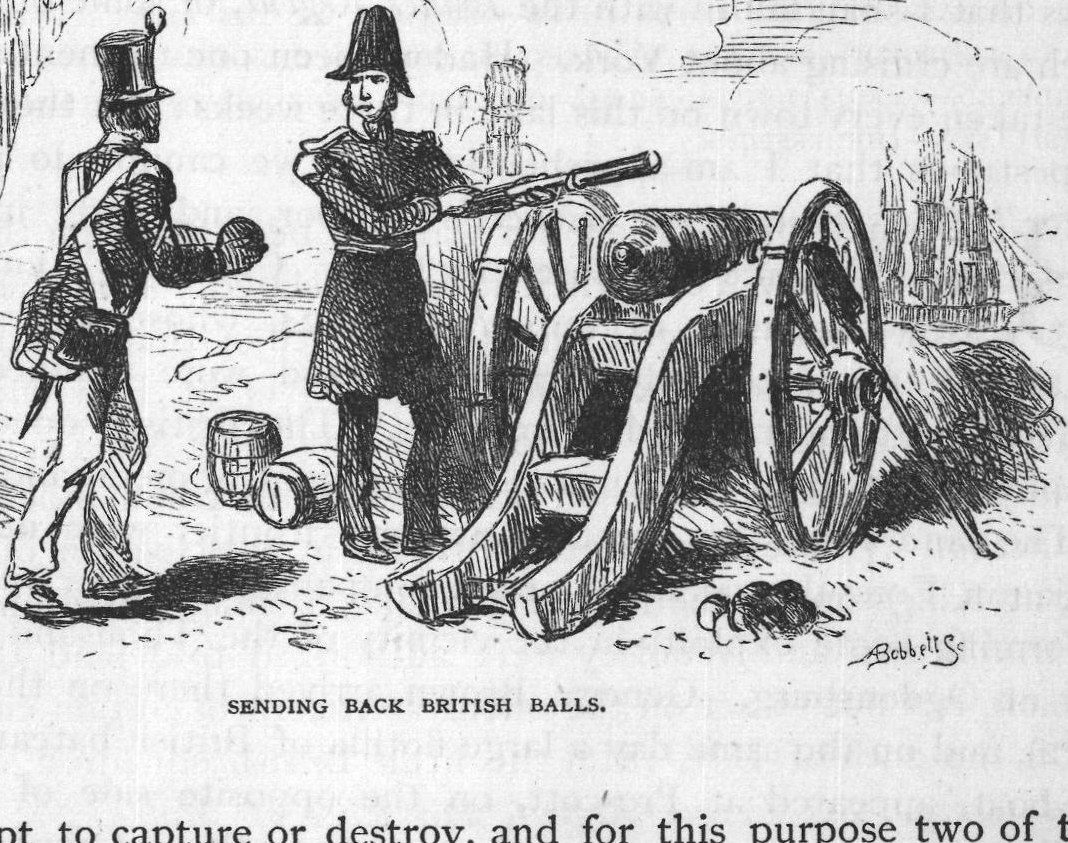
On the 29th of July, 1812, the little British squadron, composed of the Royal George, 24; Prince Regent, 22; Earl of Moira, 20; Simcoe, 12; and Seneca, 4, appeared off Sackett's harbor at the eastern end of Lake Ontario. The Oneida was in the harbor, and a considerable body of militia under Colonel Bellinger were there. The Oneida was laid so as to give a broadside to the approaching enemy, while an old 32-pound iron cannon, dragged up from the shore, was placed in battery on a rocky bluff in charge of Captain Vaughan, a sailing-master in the navy. A cannonade between the Royal George and the big guns on shore was kept up for about two hours with very little effect, when a 32-pound ball from the former came over the bluff and ploughed a furrow near where some soldiers were standing. A sergeant caught up the ball and running with it to Captain Vaughan, said, "I've been playing ball with the red-coats, and I have caught them out." Vaughan put it in his gun. It fitted better than his own balls, and he sent it crashing through the Royal George from stern to stem, sending splinters as high as her mizzen top-sail yard, killing fourteen men and wounding eighteen. The squadron, alarmed, immediately sailed out of the harbor.
The command of the lakes was now an important consideration for both parties, and the Americans prepared to create a navy to cope with that of the British. The quickest way to do so was to convert merchant-schooners into vessels-of-war. Eight of these had been caught at Ogdensburg, when the declaration of war was made, and were unable to escape to the lake. Two had been burned, and six remained there. These the British determined to attempt to capture or destroy, and for this purpose two of their armed vessels went down the St. Lawrence immediately after the affair at Sackett's Harbor. They were followed by the American armed schooner Julia, with sixty volunteers from the Oneida, and a rifle company in a Durham boat. They overtook the British vessels among the Thousand Islands, on the 31st of July, fought them for three hours, and in the shadows of an intensely dark night, relieved occasionally by flashes of lightning, reached Ogdensburg in safety before morning. The armistice already mentioned, that followed, allowed the Julia and her consort and the six schooners to make their way to the lake, where the latter were converted into vessels-of-war.
At the close of August, Isaac Chauncey, one of the best practical seamen of his time, was commissioned commander-in-chief of the navy on Lakes Ontario and Erie; and the eminent ship-builder, Henry Eckford, with a competent number of men, hastened to Sackett's Harbor to prepare a squadron for Lake Ontario. On the 8th of November, Chauncey appeared in those waters with a little fleet consisting of the armed schooners Conquest, Growler, Pert, Scourge, Governor Tompkins, and Hamilton. With these he made a cruise toward Kingston, skirmished with the enemy, and blockaded the British squadron in Kingston harbor. In this short cruise of a few days Chauncey disabled the British flag-ship Royal George, destroyed one armed schooner, captured three merchant-vessels, and took several prisoners. On the 12th of November, leaving vessels to blockade Kingston harbor until the ice should effectually do so, he sailed toward the western end of Lake Ontario, at the same time writing to Governor Tompkins: "I am in great hopes that I shall fall in with the Prince Regent, or some of the royal family which are cruising about York. Had we been one moment sooner, we could have taken every town on this lake in three weeks; but the season is now so tempestuous that I am apprehensive that we cannot do much more this winter." He returned to Sackett's Harbor, and early in December the navigation of the lake was closed by frost. Chauncey's entire squadron of eight vessels (exclusive of the Madison, 24, whose keel was laid before his arrival) mounted only forty guns, and were manned by four hundred and thirty men, including marines. The British squadron had double the power of that of the Americans, in weight of metal and number of men.