The "Monitor" and "Merrimac"
At the moment when the Confederates evacuated Manassas, a strange naval battle occurred in Hampton Roads. The insurgents had raised the Merrimac, one of the vessels that was sunk in the river at Norfolk, and had converted it into an iron-clad warrior, which they named Virginia, commanded by Captain Buchanan of our navy. On the 8th of March, this vessel attacked and destroyed the wooden sailing frigates Congress and Cumberland, at the mouth of the James River, and it was expected she would annihilate other transports and war-vessels in Hampton Roads, the next morning. Anxiously the army and navy officers in that vicinity passed the night of the 8th. There seemed to be no competent human agency near to arrest the impending disaster, when, at a little past midnight, a strange craft entered the Roads, from the sea, unheralded and unknown. It appeared like a floating platform, sharp at both ends, lying almost level with the surface of the water, and having a round tower made of heavy iron. This tower was pierced for two guns. It was twenty feet in diameter, and about ten feet in height above the platform; and it was made to revolve so as to bring its heavy guns within to bear upon an object, independently of the position of the vessel. This strange craft had been constructed at New York, under the direction of the eminent civil engineer and scientist, Captain John Ericsson, and took the name, so appropriate after its first display of power, of Monitor. The little vessel was in command of Lieutenant John L. Worden, of the navy, and had been towed to the Roads, after encountering a heavy gale and rolling sea, by a steamship. It was her trial-trip.
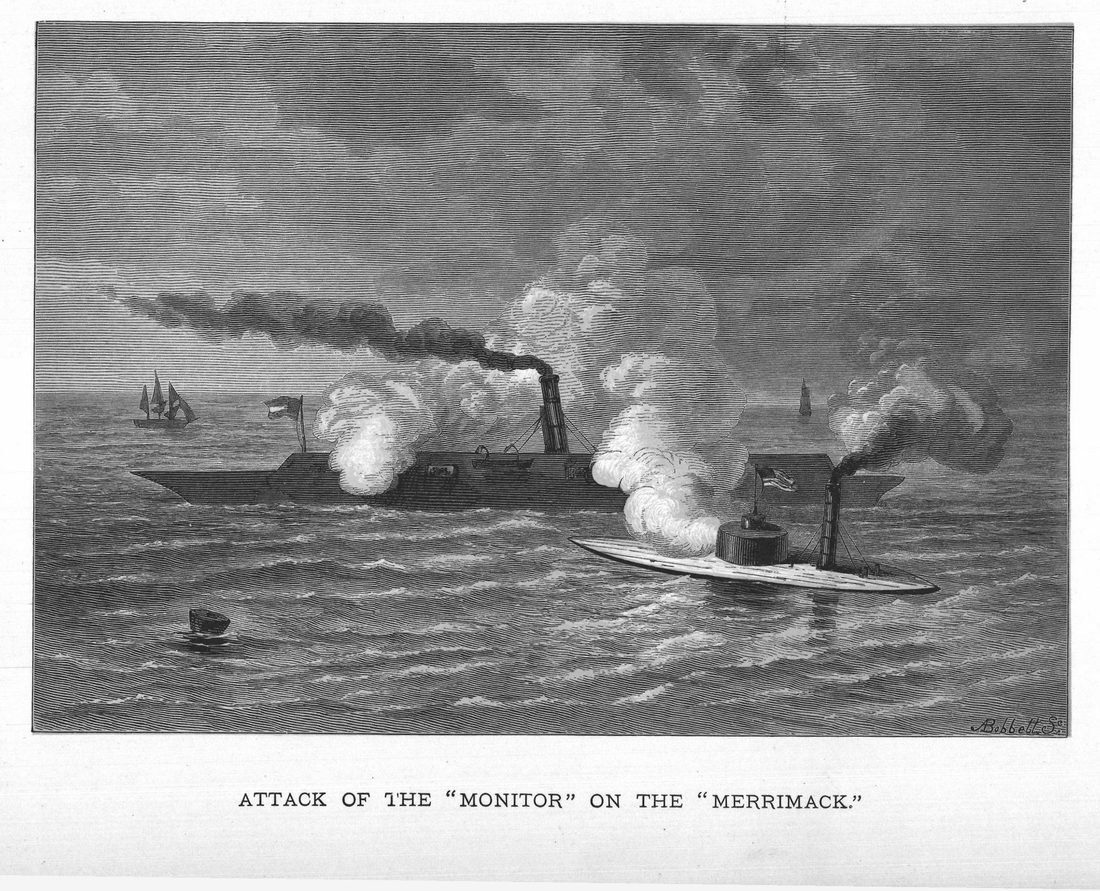
On his arrival, Worden reported to the flag-officer in the Roads, and learning the situation of affairs there, he promptly prepared to meet the iron-clad monster from Norfolk the next morning--the Sabbath. That morning dawned brightly, and in the gray twilight (March 9, 1862), the Merrimac was seen sweeping out of the Elizabeth River on its destructive errand. The Monitor, like a little David, moved to meet the Confederate Goliath, whose commander looked with contempt upon the "floating cheese-box," as he called his strange antagonist; but he soon found it to be a citadel, strong and well filled with destructive energy. Her revolving turret was invulnerable to the heaviest shot and shell thrown by her antagonist, and they glanced from the tower like pebbles from granite. The conflict that ensued was terrific. The ponderous missiles hurled from the Monitor soon bruised the Merrimac so fatally, that she fled up to Norfolk, her wounded commander confounded by the energy of his mysterious little antagonist. The Merrimac did not venture out again. The gallant Worden, who was regarded as the saviour of his country at a critical moment, was severely injured by having cement around the "peep-hole" in the turret through which he was watching his antagonist, thrown violently in his face by a heavy shot that struck that point. He has been rewarded with the commission of Admiral.
The exploit of the Monitor seemed to promise safety to National vessels navigating the James River; and McClellan prepared to transfer the Army of the Potomac to Fortress Monroe, which place he designed to make a base of supplies for his army while marching on Richmond. To secure Washington city, it was necessary to hold the Confederates in check in the Shenandoah Valley, where they were led by the zealous and gallant "Stonewall Jackson." He had been defeated by the dashing General Lander, at Blooming Gap, on the 14th of February; and when Johnston and his Confederates evacuated Manassas, Jackson had taken post at Winchester. General N. P. Banks was then in command of National troops near Harper's Ferry, destined for operations in the Shenandoah Valley; and when Jackson went further up that valley, he sent General Shields in pursuit. Shields soon turned back, and with a considerable body of troops encamped at Winchester. Jackson, re-inforced, came down the Valley in force, infantry and cavalry, and attacked Shields at Kernstown just west of Winchester. Shields had only about seven thousand men, and twenty-four heavy guns. The battle that ensued (March 22, 1862) was short and severe. Shields was badly wounded. The Confederates were defeated, and fled up the valley closely pursued by Banks, who remained in that region to watch the insurgents while McClellan should move upon Richmond.