Army of the Potomac
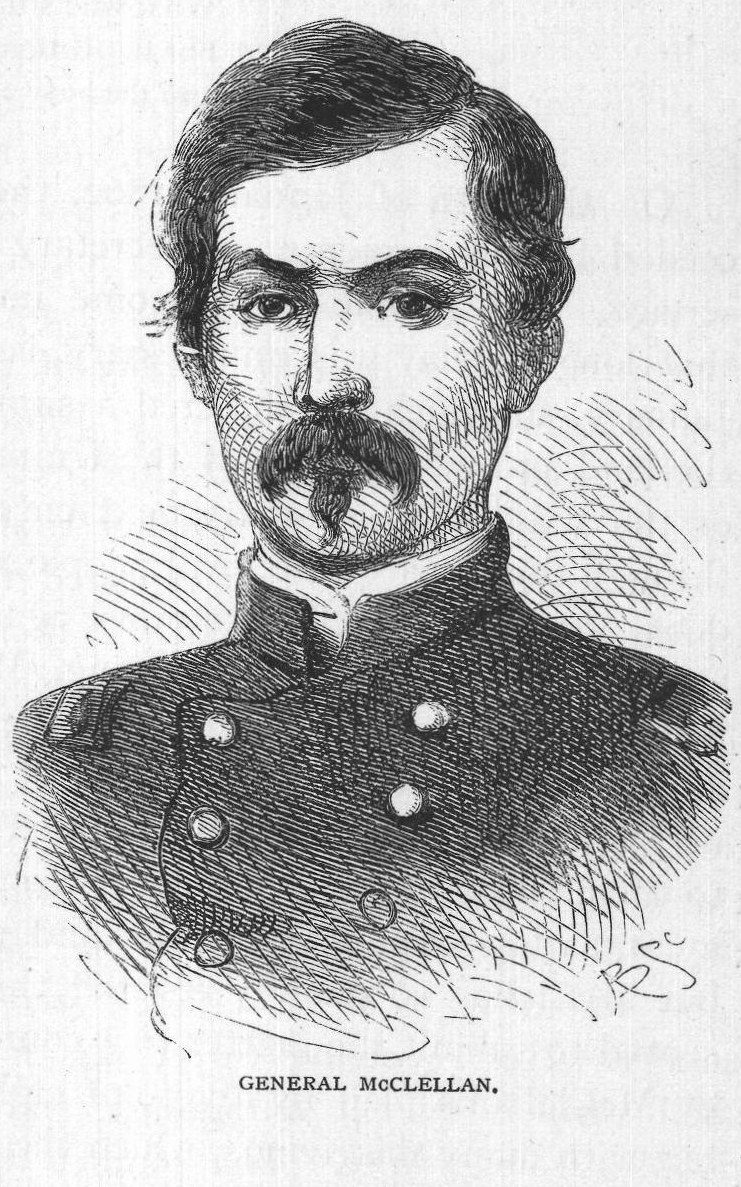
WHILE great activity prevailed in the valley of the Mississippi, the Grand Army of the Potomac, under General McClellan, had been lying almost inactive much of the time, in the vicinity of the National capital. It had, however, been growing in numbers and discipline; and early in 1862, it was composed of full two hundred thousand men. The battles of Ball's Bluff and Drainsville, already mentioned, had prevented its rusting into absolute immobility; and the troops were gladdened, from time to time, by promises of an immediate advance upon the Confederates at Manassas. On account of that expectation, very little had been done toward placing the troops in winter-quarters, and much suffering and discontent were the consequence. Efforts were made by many officers to break the monotony of camp-life; and the Secretary of War (Mr. Cameron) permitted the musical Hutchinson family to visit the camps and sing their simple and stirring songs. They were diffusing sunshine through the gloom of the army by delighting crowds of soldiers who listened to their sweet melody, when their career was suddenly checked by the following order:
"By direction of General McClellan, the permit given to the 'Hutchinson Family' to sing in the camps, and their pass to cross the Potomac, are revoked, and they will not be allowed to sing to the troops."
Why not? Because a few of the officers of the army were afraid of offending the confederated slaveholders, and the Hutchinson's had been guilty of singing Whittier's stirring song, then lately written, to the tune of Luther's Hymn, "Ein feste burg ist unser Gott," in which, among eight similar verses, was the following:
What points the rebel cannon?
What sets the roaring rabble's heel
On th' old star-spangled pennon?
What breaks th' oath
Of th' men o'th' South?
What whets the knife
For the Union's life?
Hark to the answer: Slavery."
On the 13th of January, 1862, the energetic Edwin M. Stanton succeeded Simon Cameron, as Secretary of War, and infused new life into the service. The people had become impatient; and the President, satisfied that longer delay was unnecessary, issued a general order on the 27th of January, in which he directed a simultaneous forward movement of "all the land and naval forces of the United States against the insurgent forces on the 22d day of February next ensuing. This order sent a thrill of joy through the heart of the loyal people, and it was heightened when the President ordered McClellan to move against the inferior force of Confederates at Manassas. Instead of obeying, McClellan remonstrated, and proposed to take his army to Richmond by the circuitous route of Fortress Monroe and the Peninsula, between the York and James rivers, instead of attempting, with his large and well-equipped army, to press the Confederates back to their Capital. The President strongly urged the trial of the direct movement, as less expensive in time and money, and less perilous to the army; but McClellan so steadily resisted this plan, that the patient Lincoln consented to submit the matter to a council of officers. They decided in favor of McClellan's plan by a vote of eight to four. The President acquiesced, but with many misgivings, which the result justified. The General-in-Chief had declared that he intended to wait for the forces in the West to gain victories before he should move upon Richmond. Well, the Grand Army of the Potomac had not fairly inaugurated its campaign in the spring of 1862, before the active little army of General Grant, and the forces under Generals Pope, and Buell, and Mitchel, and the gun-boats of Foote, had accomplished far more in the West than McClellan ever dreamed of being possible.
Informed that McClellan (who would not trust his commander-in-chief with his military secrets) intended to take to the Peninsula nearly the entire Grand Army of the Potomac, the President issued an order on the 8th of March, that no change of base in the operations of that army should be made without leaving a competent force for the protection of the Capital; that not more than fifty thousand troops should be removed toward the Peninsula until the navigation of the Potomac from Washington to the Chesapeake should be freed from the enemy's batteries and other obstructions; that the new movement should begin as early as the 18th of March, and that the army and navy should co-operate in an immediate attack upon the Confederate batteries on the Potomac. Meanwhile the Confederates at Manassas had retired, and were falling back toward Richmond, in fear of the execution of the President's order to move upon them on the 22d of February. When McClellan heard of this evacuation he crossed the Potomac and ordered his whole army to advance, not, as he afterward explained, to pursue the alarmed fugitives and to take Richmond, but to give his own army a little active experience "preparatory to the campaign!" After making a grand display of power at abandoned Manassas and a little beyond, the army moved back to Alexandria. This "promenade" (as one of the McClellan's aids, a scion of the royal Orleans family of France called it) of the Grand Army of the Potomac, disappointed the people and disgusted the President, who, satisfied that McClellan's official burdens were greater than he could profitably bear, kindly relieved him of the chief care of the armies, on the 11th of March, giving him command of the Department of the Potomac.