The Indians and the Johnson Family
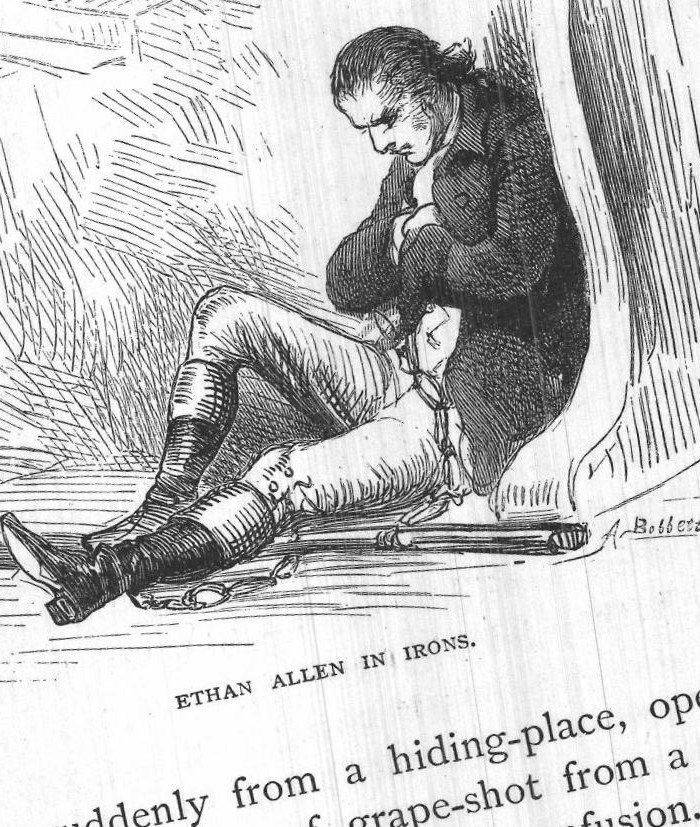
Some victories and disasters had occurred at other points during the siege. Colonel Allen, with about one hundred recruits, mostly Canadians, crossed the St. Lawrence to attack Montreal. He was misled by the advice of Major Brown, who agreed to cross at another place and join in the attack. General Robert Prescott was in command of the city. He sallied out with a considerable force of regulars, Canadians and Indians, and after a sharp skirmish made Allen and his men prisoners. For reasons never explained, Brown did not cross the river, and the attacking party were overwhelmed. When Prescott learned that Allen was the man who seized Ticonderoga in May, he was greatly enraged. He ordered his chief prisoner to be bound hand and foot with irons, and sent to England to be tried for treason. Prescott caused his shackles to be fastened to a bar of iron eight feet in length. With this, Allen was thrust into the hold of a war-vessel, where he was kept five weeks without a seat, or a bed to lie upon, when she sailed for England, and more humane treatment was given him. Allen was kept in close confinement in England, Halifax, and New York until the spring of 1778, when he was exchanged.
At the close of October (1775), detachments under Colonel Bedel and Majors Brown and Livingston, captured the strong fort (but feebly garrisoned) at Chambly, a few miles from St. Johns, with a large amount of provisions and munitions of war. When Carleton heard of this disaster, he left Montreal with a mixed force to reinforce Major Preston. He crossed the St. Lawrence in flat-boats and bateaux, and was about to land at Longueuil, when Green Mountain Boys and New Yorkers under Colonel Seth Warner, rising suddenly from a hiding-place, opened a terrible fire from their muskets and a storm of grape-shot from a four-pound cannon, which drove them across the river in great confusion. These two events caused Preston to surrender, as we have observed.
After the capture of St. Johns, Montgomery pushed on toward Montreal. Carleton, conscious of his weakness, prepared to fly, with the garrison, to Quebec. Montgomery sent a detachment to the mouth of the Sorel, where the flotilla bearing General Prescott and the garrison was intercepted and captured, with a considerable quantity of munitions. Carleton, passing by in the night, in a boat with muffled oars, escaped to Quebec. On the 13th of November, Montgomery entered Montreal in triumph. He treated the inhabitants so generously, that he gained their confidence and respect. There he found a large supply of woollen goods with which he clothed such of his men who agreed to remain beyond the term of their enlistment, and he prepared for further aggressive movements. Although the strongholds in Canada, excepting the capital, were then in his possession, he wrote to the Congress: "Till Quebec is taken, Canada is unconquered."
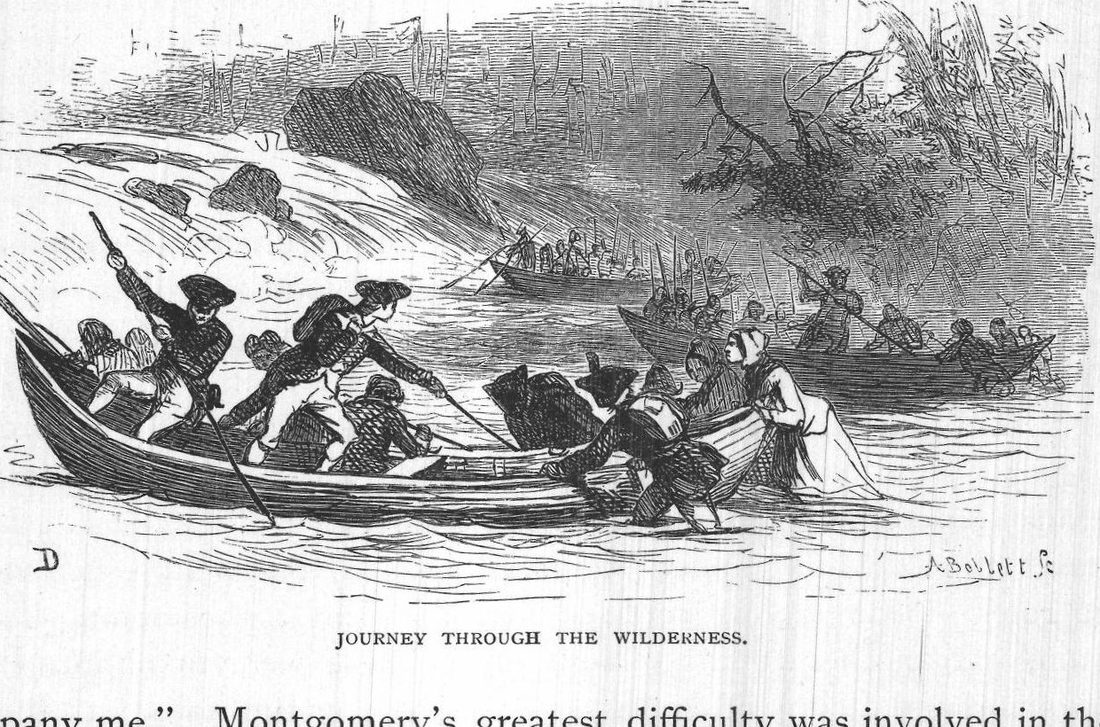
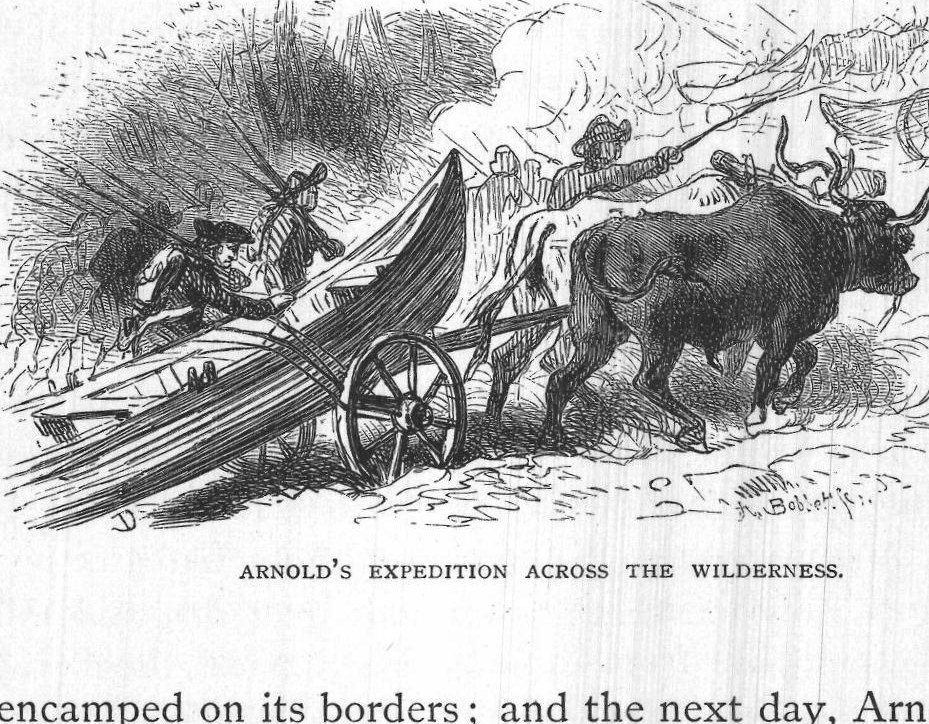
Meanwhile the co-operating expedition mentioned by Washington in his letter to Schuyler, had done its marvellous work. Late in August, the commander-in-chief had perfected his plan. Arnold was then at Cambridge making loud complaints of ill-usage upon Lake Champlain. The proposed expedition, promising wild adventure and the exercise of rare courage and skill, seemed to be suited to his nature, and Washington, to silence his complaints and to secure his services, commissioned him a colonel in the Continental Army, and gave him the command of the troops to be used, comprising eleven hundred hardy men selected from the forces at Cambridge. These were composed of New England musketeers and riflemen from Virginia and Pennsylvania under Captain Daniel Morgan. At the middle of September they sailed from Newburyport, in transports, for their general rendezvous at Fort Western on the Kennebec River, opposite the present city of Augusta. They were then on the verge of an uninhabited wilderness, excepting by a few Indian hunters. There they were furnished with bateaux wherewith to navigate shallow streams and little lakes; and at Norridgewock Falls, where Father Rale had his Indian mission, already mentioned, their first labors began. Their bateaux were drawn by oxen, and their provisions were carried on their backs around the falls--a wearisome task often repeated afterward. But they pressed on with cheerfulness toward the headwaters of the Kennebec, often wading and pushing their bateaux against swift currents. At length they left that stream, and over craggy knolls, tangled ravines, deep morasses and gentle brooks they made their way to Dead River--a portage of fifteen miles broken by three ponds. Upon the placid bosom of that sluggish stream, on the great watershed between the St. Lawrence and the Atlantic, they moved quietly, in fine weather, and were suddenly confronted by a lofty mountain capped with snow. At the foot of this hill Arnold encamped. Major Bigelow ascended to its summit, hoping to see the spires of Quebec; and it has been called Mount Bigelow to this day.