Disposition of the Opposing Armies
When Schuyler arrived at Ticonderoga, he found great confusion prevailing. Colonel Arnold, who claimed precedence to all others because of his earlier commission from the Provincial Congress of Massachusetts, refused to acknowledge the authority of Colonel Hinman; and most of the Green Mountain Boys, disgusted by Arnold's offensive bearing toward Allen and other officers, had returned home. Complaint of his conduct was made to the body who commissioned him. It was a difficult case to deal with. Nobody doubted Arnold's bravery and skill, and his usefulness as a leader. But he was ambitious, unscrupulous, and so quarrelsome that few could endure him in his mood at that time. A committee was sent to investigate the matter. They were empowered to order his return to Massachusetts, or to submit to Hinman's authority. When their errand was revealed to Arnold, he was enraged. He stamped, swore, cursed all Congresses and kings, fate, committee-men in general and his present inquisitors in particular, and, with horrid oaths, he declared that he would be second to no man. Then he threw up his commission, disbanded his men, and rode to Cambridge to lay his grievances before Washington.
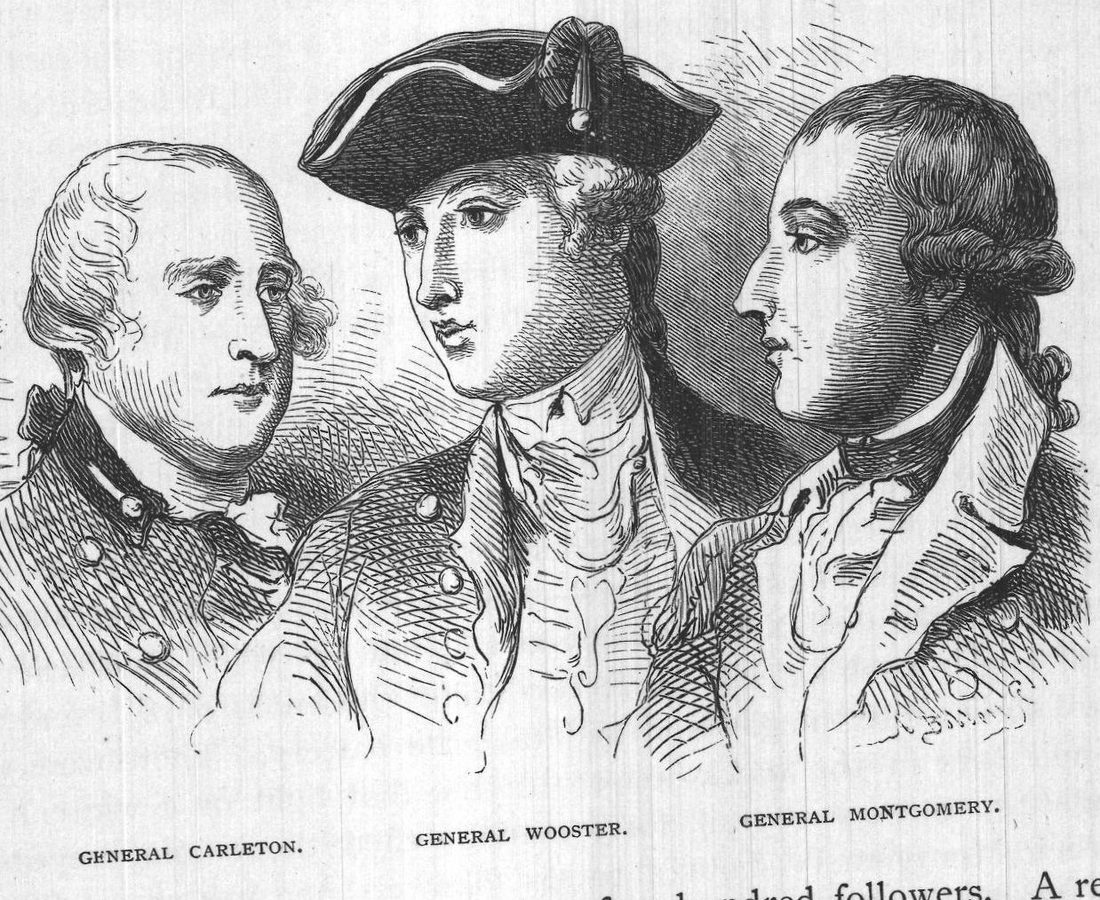
Schuyler's first object was to ascertain the state of the province he was about to invade. He employed Major Brown, an American resident on the Sorel, employed by Adams and Hancock for the same purpose, to obtain desired information. The major soon reported that there were only seven hundred regulars in Canada; that the militia would not serve under French officers lately appointed; that the peasantry were generally friendly toward the "Bostonians," and that it was a most auspicious time to invade the province. Meanwhile Schuyler had attempted to organize the crude army which had been slowly gathering at Ticonderoga, composed chiefly of Connecticut troops under Wooster. The general was, in his daily habits of life, a strict disciplinarian, and the insubordination which he encountered at the outset, annoyed him exceedingly. The Connecticut troops were extremely democratic in their notions. Each man felt himself equal to his officers in command, and could not brook the restraint of necessary discipline. Schuyler chafed under this state of things, and the friction then visible prevailed during the whole campaign.
Schuyler had a divided duty as leader of the army and head of the Indian Commission. The duties of the latter then imperatively demanded his attendance, and he summoned Montgomery, his favorite brigadier, to the actual leadership of the expedition. This handsome Irish gentleman, then forty years of age, had achieved distinction in the British army, and had lately married a sister of Robert R. Livingston, who was afterward the eminent chancellor of the State of New York. His devoted young wife accompanied him as far as the country seat of General Schuyler, at Saratoga, where he bade her adieu, kissed the tears from her cheeks, and with cheerfulness said at parting: "You will never have cause to blush for your Montgomery." Arriving at Ticonderoga on the 17th of August, he was placed in active command of the expedition, and Schuyler returned to Albany, where he soon afterward received a letter from General Washington, urging him to hasten the invasion of Canada.
Meanwhile Montgomery, with a little more than a thousand men, had gone to Isle La Motte to prevent British vessels a-building on the Sorel, passing into Lake Champlain. There he was joined by Schuyler on the 4th of September. They pushed on to Isle aux Noix, and with a considerable force appeared before the fort at St. Johns, the first military post within the Canadian border. Deceived concerning the strength of the garrison and the disposition of the Canadians, they fell back and waited for reinforcements. There Schuyler was prostrated with sickness, and at the middle of the month he was compelled to return to Ticonderoga. Fever, gout, and rheumatism tortured him for a long time, and he did not rejoin the army, but did better service in sending forward reinforcements and supplies.
Montgomery was now in full command of the army. He immediately invested St. Johns with about a thousand men. New York troops had already joined him. Lamb's company of artillery came late in September. Some troops from New Hampshire under Colonel Bedel, and Green Mountain Boys led by Colonel Seth Warner, also joined him. The garrison was commanded by Major Preston, and was well supplied with provisions and ammunition. This circumstance, the injudicious movements of Colonel Ethan Allen and Major Brown, who were recruiting south of the St. Lawrence, and the insubordination and mutinous spirit displayed by the Connecticut and New York troops, prolonged the siege. It lasted fifty-five days. On the evening of the 2d of November, when Preston heard of the defeat of a considerable force under Carleton, on their way to relieve him, he surrendered the fort, garrison, and munitions of war to Montgomery. The spoils of arms, ammunition, provisions and clothing, were considerable. Five hundred regular soldiers, and one hundred Canadian volunteers, were made prisoners of war.