The Continental Navy
WE have observed on page 828 that late in 1775, the Congress ordered the establishment of a Continental navy. The thirteen vessels then authorized to be built or purchased were furnished early in 1776, and these, with many privateers, did good service on the ocean. The affairs of the little navy were at first managed by a committee of Congress only. This committee was modified from time to time, and finally, in October, 1779, it assumed the form and name of a "Board of Admiralty," with a salaried secretary, and was composed of members of Congress and three paid commissioners who were not members of that body. This organization continued until 1781, when General Alexander McDougal was appointed "Secretary of Marine," whose functions were essentially those of our Secretary of the Navy at the present time. Very soon afterward he was superseded by an "Agent of Marine," and in that office the name of Robert Morris often appeared. That eminent financier of the Revolution had more to do with the management of naval affairs than any other man. He sent out privateers on his own account, a business in which other patriots engaged. Washington was, at one time, part owner of a privateer.
Esek Hopkins, of Rhode Island, was appointed commander-in-chief of the little Continental navy. The avowed object of the armament was to intercept British vessels bearing supplies for the British armies in America, but the Continental war-ships were frequently more aggressive. Hopkins sailed on his first cruise in February, 1776. He left the Delaware with a small squadron of five vessels, carrying an aggregate of ninety-eight guns. The Alfred, 28, was his flag-ship, and his first-lieutenant was John Paul Jones, who afterward became famous. Jones raised on the Alfred, in the Delaware, in December, 1775, the first American ensign ever shown on an American vessel-of-war. Hopkins's captains were Whipple, Biddle, J. B. Hopkins and Hazard, all of them but Biddle, Rhode Island men. The first cruise was against Lord Dunmore, then distressing the Virginia coast. Hopkins extended his cruise to the Bahama Islands to capture British stores at Nassau, New Providence, and was successful. Among the spoils were one hundred cannon. Retiring, he operated off the New England coasts; but the Congress censured him for departing from the line of his instructions, and dismissed him from the service. His lieutenant, Jones, was placed in command of the Alfred, the following autumn. No naval commander-in-chief was subsequently appointed.
Jones was always successful. While in command of the Providence, in September, 1776, he was chased by two British ships-of-war off the Carolina coasts, but escaped, and sailing eastward as far as Nova Scotia, he captured and carried into Newport fifteen prizes. Meanwhile Whipple and Biddle were equally successful off the eastern coasts; and the New England colony vessels were very active. These, and the Continental cruisers, deprived the British army of about five hundred soldiers during the summer and fall of 1776. No less than three hundred and forty-two British vessels fell into the hands of the Americans that year.
In the fall of 1776, the Continental ship Reprisal, Captain Wickes, carried Dr. Franklin, as American Commissioner, to France, where she cruised in European waters, the first American armed ship that had appeared there. She captured several British prizes in the Bay of Biscay. Among these was the royal English packet on its way from Falmouth to Lisbon. These prizes were sold in French ports, and the proceeds were used by the American commissioners in Paris for purchasing other vessels in French ports. In the summer of 1777, Wickes, with a little squadron of three vessels, sailed entirely around Ireland, sweeping the channel in its whole breadth, and capturing or destroying a great number of British merchant vessels. This cruise produced a powerful impression on the public mind in England, and France was required to renounce its friendship for the rebellious colonists or pronounce a disclaimer. Policy, then, dictated the latter course, and the American vessels were ordered to leave the French coast. When the Reprisal was returning homeward, she was wrecked on the coast of New foundland, and Captain Wickes, and all of his people but the cook, perished.
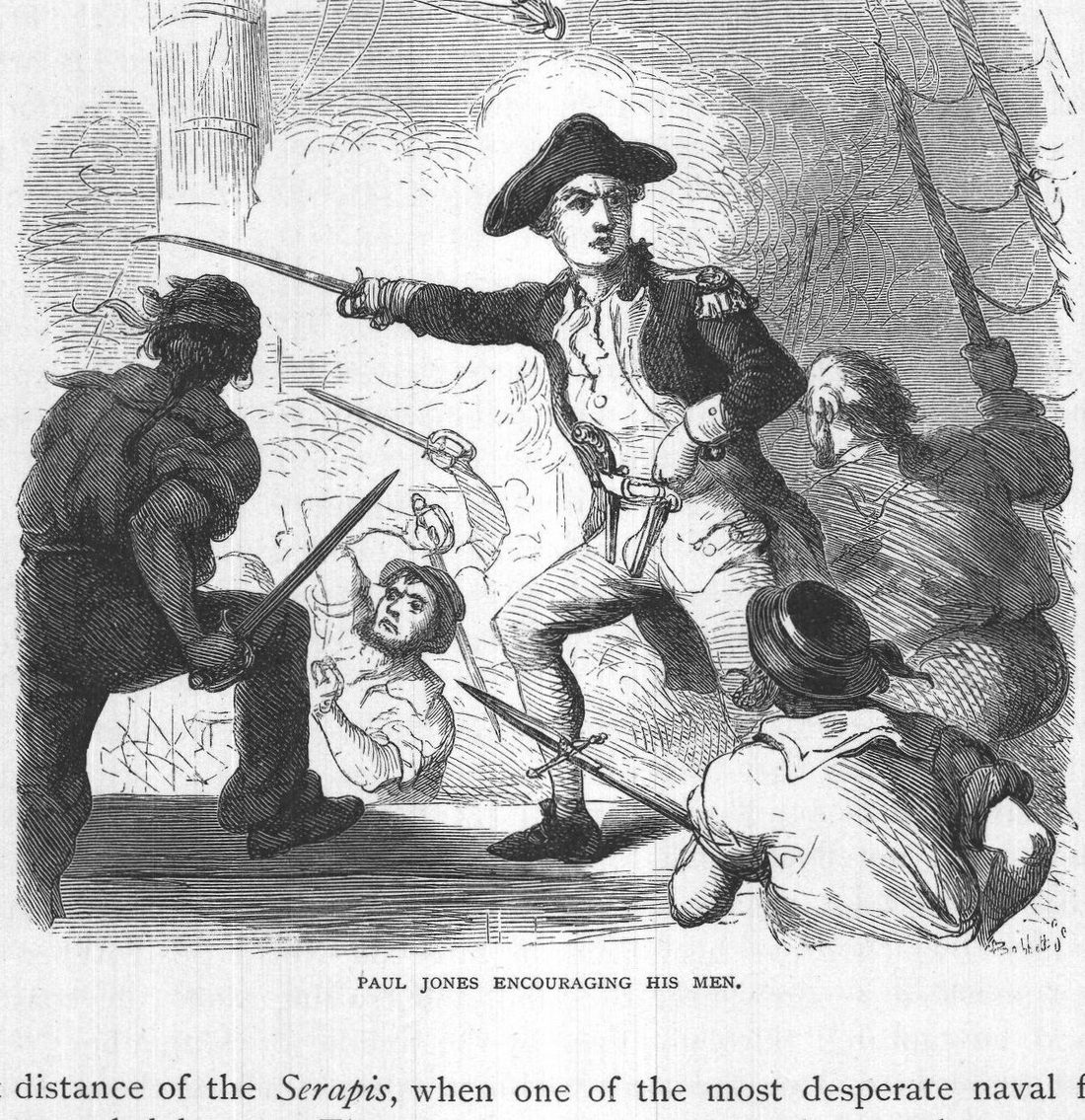
The duplicity of France, at that time, caused much trouble. Franklin carried with him a number of blank commissions from the Congress, for army and navy officers who might be willing to enter the Continental service. One of them was given to Captain Conyngham, who sailed from Dun-deemed to be a mean robbery, with the greatest delicacy. The frightened Lady Selkirk delivered up the plate with her own hands; and when the marauders returned to the boat, they found Jones walking moodily among the old trees. He had laid his plans for the future. When the prizes of the Ranger were sold in the harbor of Brest, in May, he bought the plate and returned it to Lady Selkirk with a letter, in which he expressed his regret because of the annoyance she had suffered.
Late in April, Jones again appeared off Carrickfergus, when the Drake went out to give the Ranger battle. They fought more than an hour, when the Drake, much shattered, and forty of her men slain, surrendered. With this prize Jones went around Ireland and arrived at Brest on the 8th of May. Meanwhile D'Estaing had sailed for the Delaware, and his arrival made the American cruisers more active and bold. Captain Barry performed some notable exploits in the fall of 1778; and early in 1779, the Alliance, Captain Landais, sailed for France, bearing Lafayette, who went home to urge his king to send troops to America.