The British Evacuate Philadelphia
This foolish pageant had just ended, when orders reached Philadelphia for the troops to evacuate that city and the fleet to leave the Delaware River. The rescript of the French monarch, as we have observed, was regarded in England as tantamount to a declaration of war, and the British government saw the danger that threatened their land and naval forces should a French fleet blockade the Delaware, a circumstance which speedily occurred. At the middle of April, Admiral the Count D'Estaing, a major-general in the French service, sailed from Toulon with twelve ships-of-the-line and three frigates, and after a rough voyage of ninety days, anchored in the Delaware. Fortunately for Lord Howe's fleet, it had left those waters a few days before, and was safely anchored in the broad bay off the mouth of the Raritan River. The British army had also escaped to New York, after great perils by the way.
The order for the evacuation of Philadelphia, and its execution, produced wide-spread consternation and distress in that city, lately so gay with scarlet uniforms, martial music and banners, dashing young officers and a brilliant display of the pastimes of half-barbarous nations five hundred years before. The change from bright promises of protection to the despair caused by cruel desertion was awful. It was like the sudden gathering of a fierce tempest in a serene sky. About three thousand of the most tenderly-bred of the inhabitants left their homes, their property and their cherished associations, and fled for refuge from the indignation of their Whig neighbors, whom they had outraged in many ways, to be borne away, they knew not whither, to a fate which they could not foresee.
Meanwhile the condition of Washington's army at Valley Forge, which the British despised, and ridiculed in plays by amateur performances in a theatre in Philadelphia, was greatly improved in every respect. At the middle of May the troops fit for duty numbered about fifteen thousand men. The Congress had just ratified the treaty with France, and so gave great encouragement to the American people. The warmth of approaching summer diffused physical comfort, life, and vigor through the camp; and the fact, when known, that the British had been ordered to leave Philadelphia and the adjacent waters, inspired the soldiers with joy and hope.
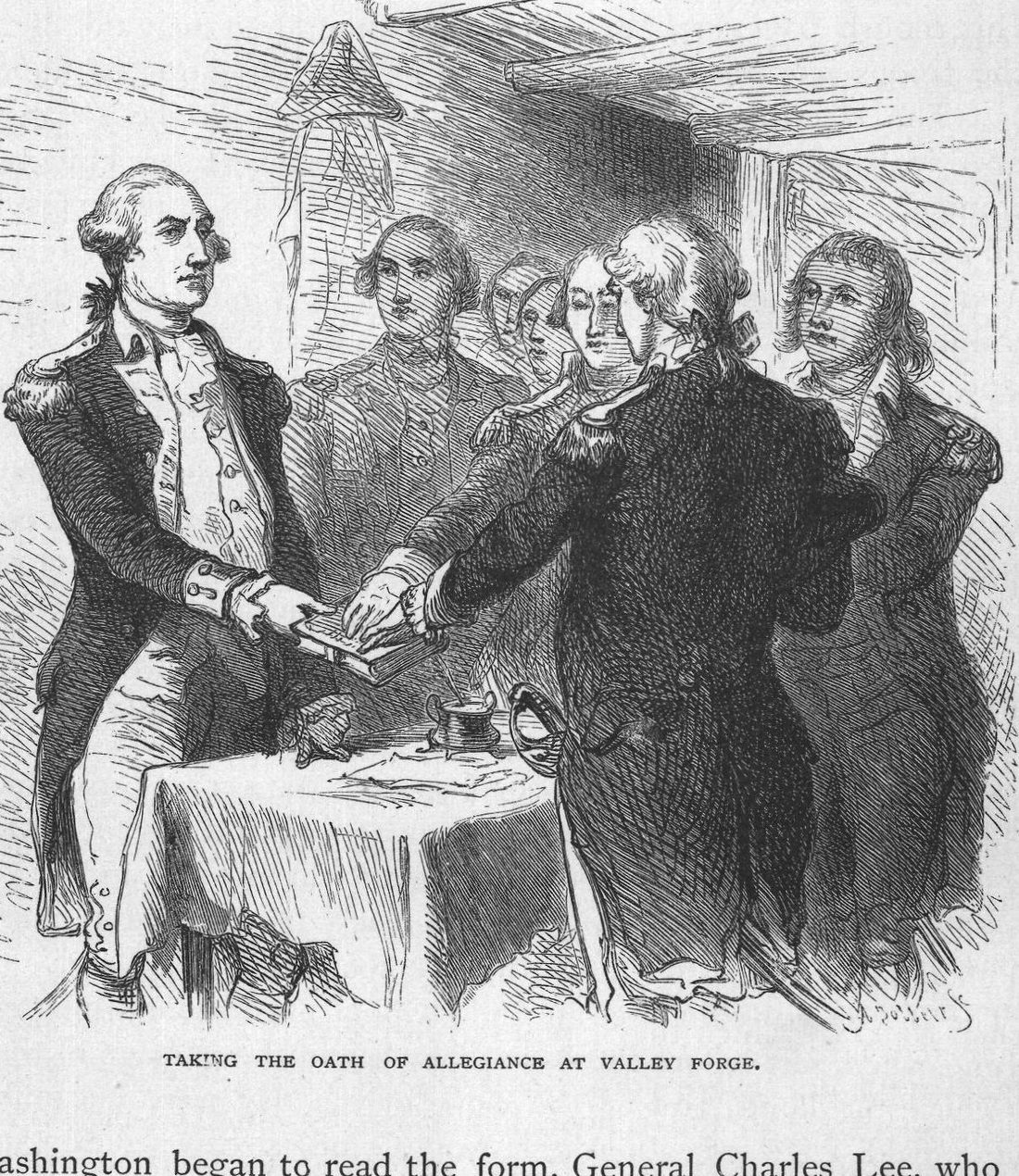
The Congress ordered an oath of allegiance to be administered to all the officers of the army at Valley Forge, before the opening of the campaign. This ceremony took place on the 12th of May. The commander-in-chief administered it to the general officers. In so doing, several of them placed their hands on the Bible at the same time, and so took the oath together.
When Washington began to read the form, General Charles Lee, who had been exchanged for General Prescott, captured on Rhode Island, withdrew his hand. This movement he repeated, when Washington demanded a reason for the strange conduct. Lee replied: "As to King George, I am ready enough to absolve myself from all allegiance to him; but I have some scruples about the Prince of Wales." This odd reply, which covered a deeper motive, excited much laughter. In the light of to-day, we may clearly see the real reason. Lee was then playing a desperate game of treason, and probably had some conscientious scruples about taking such an oath which he would probably violate. He did, however, subscribe to it.
We have already mentioned some movements of American detachments during the winter and spring of 1778. At the middle of May news reached Washington that the British were probably preparing to evacuate Philadelphia. It was premature, for the order for that movement had not then arrived. However, the vigilant commander-in-chief acted promptly. He detached Lafayette, with about twenty-one hundred men and five pieces of cannon, to restrain British foragers and marauders who were plundering the country, and had burned several American vessels in the Delaware River. He was instructed to cut off all communications between Philadelphia and the country; to obtain correct information concerning the enemy, and to be ready to follow the fugitives with a considerable force when they should leave the city. Lafayette crossed the Schuylkill and took post on Barren Hill, about half-way between Valley Forge and Philadelphia. The marquis made his quarters at the house of a Tory Quaker, who informed Howe of the fact. The latter immediately ordered General Grant to make a secret night march, with over five thousand men, to gain the rear of Lafayette, and prevent his recrossing the Schuylkill. This was done on the night of the 20th of May. Early the next morning Howe marched with almost six thousand men, commanded by Clinton and Knyphausen, to capture the young Frenchman and send him to England. Grant actually surprised the marquis, and held the ford over which he and his little army had crossed the Schuylkill; but by a deceptive, quick, and skillful movement Lafayette out-generaled his antagonist, and escaped across Matson's Ford-General Poor leading the advance, while Grant was making preparations for battle. Howe was sadly disappointed. He felt sure of closing his military career in America with a brilliant achievement, but was foiled; and he marched back to Philadelphia, where, on the 24th, he embarked for England.