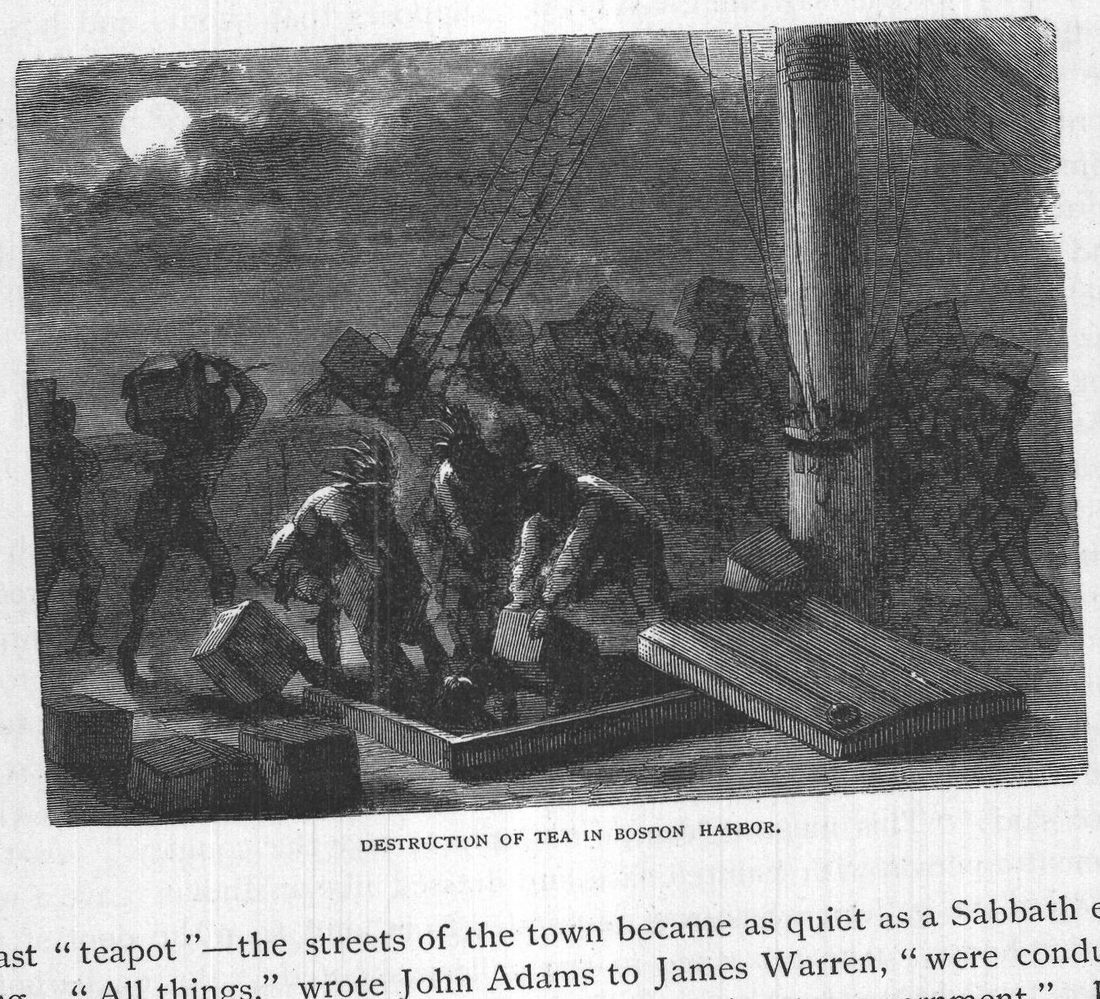
The "Boston Tea-Party": Custom-house
The excitement of the people was now at fever heat. The issues of every future hour were looked for with great anxiety. The air was full of rumors--some true, some false--and on the 16th of December (1773), the day to which the meeting was adjourned, the largest assembly then ever seen in Boston were gathered in the Old South Meeting-house, and its vicinity. Samuel P. Savage, of Weston, presided. Full two thousand men from the neighboring towns were there. Seven thousand men soon filled the great fane and overflowed into the street. It was reported that the Custom-house officers had refused to give Mr. Rotch a clearance for his vessel before the tea--the whole cargo--should be landed. "No vessel can pass the Castle without my permission, and I will not give it," thought the governor, as he rode out to his country-seat at Milton; and he believed he had secured a victory. Not so thought the people. When the great assembly heard of the refusal of the Custom-house officers to grant a clearance, they said to Mr. Rotch: "Go to the governor; protest against their action, and ask him for a permit for your vessel to sail." He hastened to the governor in the country, and the meeting adjourned until three o'clock. When they reassembled the merchant had not returned, and the question was put to the meeting: "In case the governor shall refuse his permission, will you abide by your former resolutions with respect to not suffering the tea to be landed?" Earnest men spoke to the question. Among the most earnest was young Josiah Quincy, a rising lawyer, with a feeble frame that was wasting with consumption, a firm will, patriotism of purest mold, and a burning zeal. He harangued the crowd with prophetic words eloquently spoken. Like a seer he perceived that a great crisis was at hand, where actions, and not words, would be required. "It is not," he said, "the spirit that reposes within these walls that must stand us in stead. The exertions of this day will call forth events which will make a very different spirit necessary for our salvation. Whoever supposes that shouts and hosannas will terminate the trials of this day, entertains a childish fancy. He must be grossly ignorant of the importance and value of the prize for which we contend; we must be equally ignorant of the power of those who have combined against us; we must be blind to that malice, inveterancy and insatiable revenge which actuate our enemies, public and private, abroad and in our bosoms, to hope that we shall end this controversy without the sharpest conflicts--to flatter ourselves that popular resolves, popular harangues, popular acclamations, and popular vapor will vanquish our foes. Let us consider the issue. Let us look to the end. Let us weigh and consider, before we advance to those measures which must bring on the most trying and terrible struggle this country ever saw."