Surrender of the Americans
The victory of the Constitution was followed by others. On the 18th of October the American sloop-of-war Wasp, Captain Jones, captured the British brig Frolic, Captain Whinyates, after a severe engagement of forty-five minutes, off the coast of North Carolina. The slaughter on board the Frolic was fearful. Only three officers and one seaman remained unhurt. Ninety were killed and wounded, while only ten were slain or disabled on board the Wasp. But she enjoyed her victory a very short time; for that very afternoon, the British 74-gun ship Poicters, Captain Beresford, appeared, and two hours after the gallant Jones had gained his triumph, he was compelled to surrender his prize and his own ship to another of superior force. Jones was honored for his bravery, by public entertainments, and Congress gave him a gold medal. They also voted $25,000 as prize-money for himself and his followers. Lieutenant Biddle, his second in command, was also honored with gifts and promotion.
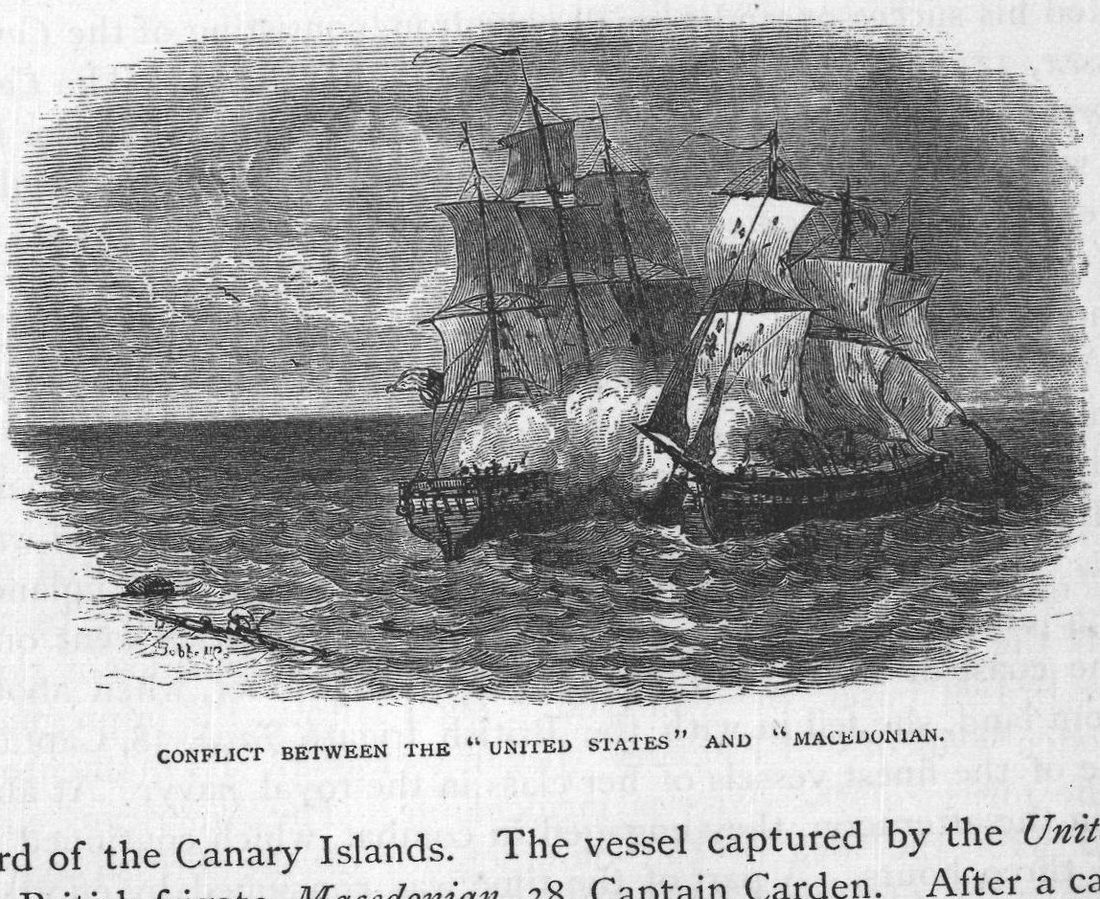
A week after Jones' contest, the frigate United States, 44, Captain Stephen Decatur, of the squadron of Commodore Rodgers, gained an important naval victory after a conflict of about two hours on the ocean westward of the Canary Islands. The vessel captured by the United States was the British frigate Macedonian, 38, Captain Carden. After a cannonade at a distance for about half an hour, they engaged in close contest. The United States displayed splendid gunnery. Very soon her balls cut the mizzen-mast of her antagonist, and it fell overboard. Soon afterward the main-yard of the Macedonian was seen hanging in two pieces, her main and fore top-masts were gone, her fore-mast was tottering, and her main-mast and bow-sprit were severely bruised. All this while the United States remained almost unhurt. Seeing the hopelessly crippled condition of his vessel, Carden surrendered her. She had received one hundred round shot in her hull, many of them between wind and water. Rigging her as a bark, with a prize-crew on board, Decatur sailed with his own ship and her captive for American waters; and on the first day of January, 1813, the Macedonian was anchored in the harbor of New York, where she was greeted with joy as a "New Year's Gift." "She comes with the compliments of the season from Old Neptune," said one of the newspapers of that city. Only three days before a public banquet had been given to Hull, Jones, and Decatur, by the corporation and citizens of New York. Decatur afterward received honors similar to those bestowed upon his brother victors, by banquets, gifts, and a gold medal from Congress.
Before the close of the year (1812) another naval victory was won that cheered the spirits of the Americans. Captain Hull had generously retired from the command of the Constitution after his victory, to give some brother officer a chance to win renown with her. Captain William Bainbridge was appointed his successor, and a small squadron, consisting of the Constitution, 44; Essex, 32; and Hornet, 18, were placed in his charge. The Constitution and Hornet were then in Boston harbor, and the Essex was in the Delaware. Orders were sent to the latter to cruise in the track of the English West Indiamen, and at a specified time to rendezvous at certain ports, where, if she did not fall in with the flag-ship, she would be at liberty to make an independent cruise. Not long afterward Porter was on a long cruise in the South Atlantic and Pacific Oceans, which will be considered hereafter.