New England and Great Britain
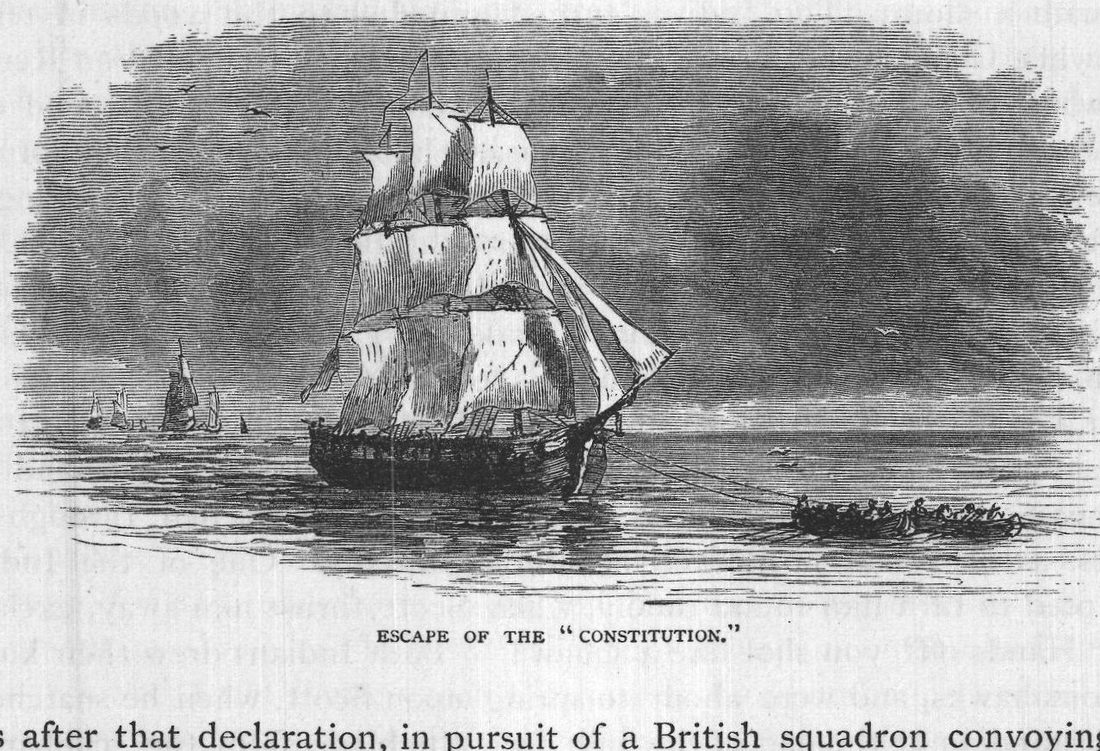
The Constitution did not long remain idle after her remarkable escape. She sailed from Boston (where she was built) on the 2d of August, and cruised eastward in search of British vessels. Hull was anxious to meet the Guerriere, whose commander had boastfully enjoined the Americans to remember that she was not the Little Belt. Hull sailed as far as the Bay of Fundy, and then cruised eastward of Nova Scotia, where he captured some British merchant-vessels making their way to the St. Lawrence. On the afternoon of the 19th of August, he fell in with the Guerriere, in latitude 41 deg 46', and longitude 55 deg 48'. Some firing began at long range; but at six o'clock, Hull, observing a willingness of his antagonist to have a fair yardarm and yard-arm fight, pressed all sail on the Constitution to get alongside of the Guerriere. He walked the quarter-deck, watching the movements of the enemy with keen interest. He was fat, and wore very tight white breeches. When the Guerriere began to pour shot into the Constitution, Lieutenant Morris, Hull's second in command, asked, "Shall I open fire?" The commander replied quietly, "Not yet." As the shots began to tell seriously on the Constitution, the question was repeated. "Not yet," Hull quietly answered. When the two vessels were very near each other, Hull, filled with intense excitement, bent himself twice to the deck and then shouted, "Now boys, pour it into them!" The command was instantly obeyed. When the smoke of the first broadside cleared away, it was discovered that the commander, in his energetic movements, had split his breeches from waistband to knee; but he did not stop to change them during the action.
The guns of the Constitution were double-shotted with round and grape, and their execution was terrible. The vessels were within pistol-shot of each other. Fifteen minutes after the contest commenced, the mizzen-mast of the Guerriere was shot away, her main-yard was in slings, and her hull, spars, sails, and rigging were torn in pieces. Very soon, by a skillful movement, the Constitution fell foul of her foe, her bowsprit running into the larboard quarter of her antagonist. In that situation the cabin of the Constitution was set on fire by the explosion of the forward guns of the Guerriere, but the flames were soon extinguished. Both parties now attempted to board, while the roar of the great guns was terrific. There were fierce volleys of musketry; but the heavy sea would not allow a safe passage from one vessel to the other. At length the Constitution became disengaged from the Guerriere and shot ahead, when the main-mast of the latter, shattered into weakness, fell into the sea. The hapless vessel, shivered and shorn, rolled like a log in the trough of the waves, entirely at the mercy of the billows. A jack that had been kept flying on the stump of the mizzenmast of the Guerriere was now lowered; and the late Commodore George C. Read, then third lieutenant, was sent on board of her. "Captain Hull's compliments," said Read to Captain Dacres, "and wishes to know if you have struck your flag?" Dacres, who was a "jolly tar," looking up and down, coolly and dryly said: "Well, I don't know; our mizzen-mast is gone, our main-mast is gone, and, upon the whole, you may say we have struck our flag." The Guerriere was too much damaged to be saved. So, after removing her people and their effects to the Constitution, she was set on fire and soon blew up. So ended the career of the vessel that was "not the Little Belt." A rhymer at the time wrote:
That the decks of Captain Dacre
Were in such a woful pickle
As if death, with scythe and sickle,
With his sling or with his shaft,
Had cut his harvest fore and aft.
Thus in thirty minutes ended
Mischief that could not be on ended;
Masts and yards, and ship descended
All to-David Jones' locker-
Such a ship in such a pocker!
The Constitution bore the news of her own victory into Boston. There was a burst of joy over the land. The name of Hull was soon upon every lip. The people of Boston gave him and his officers a sumpituous public banquet, at which six hundred citizens sat. The authorities of New York voted him the freedom of that city in a gold box. The citizens of Philadelphia presented to him an elegant piece of plate; and Congress awarded him a gold medal, and appropriated $50,000 to be distributed as prize-money among the officers and crew of the Constitution. We cannot now appreciate the feeling which the victory created on both sides of the Atlantic. The British public were amazed. Their faith in the impregnability of the "wooden walls of Old England" began to waver. Its momentous bearing on the future of the war was incalculable. The Americans, no longer impressed with the idea of the omnipotence of the British navy, were stimulated to the performance of great achievements. The London Times regarded the victory as a serious blow at the British supremacy on the sea. "It is not merely that one English frigate has been taken," said that journal, "but that it has been taken by a new enemy, an enemy unaccustomed to such triumphs, and likely to be rendered insolent and confident by them."