Surrender of Cornwallis
On the night of the 11th the allies began the second parallel within three hundred yards of the British works. This labor was not discovered by the enemy until daylight, when they brought heavy guns to bear upon the diggers. It took them days to complete this second parallel. Two redoubts that commanded the trenches and greatly annoyed the diggers were breeched by the cannon-balls of the besiegers on the 14th, when it was determined to attempt to take them by storm. One on the right, near the York River, was garrisoned by forty-five men; the one on the left was manned by about one hundred and twenty men. The capture of the former was intrusted to Americans led by Lieutenant-Colonel Alexander Hamilton, and that of the latter to French grenadiers led by Count Deuxponts. At a given signal Hamilton advanced in two columns--one led by Major Fish, the other by Lieutenant-Colonel Gimat, Lafayette's aid, while Lieutenant-Colonel John Laurens, with eighty men, turned the redoubt to intercept a retreat. The assailants leaped the abatis and the palisades with so much celerity, and attacked the garrison so furiously, that the redoubt was captured in a few minutes with little loss on either side. Laurens was among the first to enter the work and make the commander, Major Campbell, a prisoner. The life of every man who ceased to resist was spared. In the meantime the French, after a severe struggle with ball and bayonet (in which they lost about a hundred men in killed and wounded), captured the other redoubt in a similar manner. As they charged the garrison with the bayonet, Deuxponts, their leader, shouted "Vive le Roi!" and the cry was echoed by his followers. Washington, with Knox and some others, had watched these movements with intense anxiety; and when he saw both redoubts in possession of his troops, he turned to Knox and said, "The work is done, and well done." Then calling to his favorite body-servant, he said: "Billy, hand me my horse." That night both redoubts were included in the second parallel.
The situation of Cornwallis was now becoming desperate. A superior force environed him, and his works were crumbling; and he knew that when the second parallel of the besiegers should be completed, his post would be untenable. He resolved to make an effort to escape by abandoning his baggage and sick, crossing the river with his troops to Gloucester, cutting up or dispersing the allies who were imprisoning the British garrison there, and by rapid marches gaining the forks of the Rappahannock and Potomac, and, forcing his way through Maryland and Pennsylvania, join Clinton at New York. Boats for the passage of the York were prepared, and on the evening of the 16th a part of the troops were carried over to Gloucester, when a furious storm of wind and rain, as sudden as a summer tornado, arose and made any further attempt to pass the river too hazardous to be undertaken. The troops were brought back. The earl lost hope. The bombardment of his lines was very severe and destructive, and on the 17th he proposed to surrender. On the following day Lieutenant-Colonel Laurens and Viscount de Noailles (a relative of Lafayette's wife), as commissioners on the part of the allies, met Lieutenant-Colonel Dundas and Major Ross of the British army, and drafted a capitulation. The terms were similar to those demanded of Lincoln at Charleston. All the troops were to be prisoners of war, and all public property was to be surrendered. All slaves and plunder found in possession of the British might be reclaimed by their owners; otherwise, private property was to be respected. The loyalists were abandoned to the mercies or resentments of their countrymen. Such were the general terms; but by the packet which carried his despatches to Sir Henry Clinton, Cornwallis managed to send away persons who were most obnoxious to the Americans.
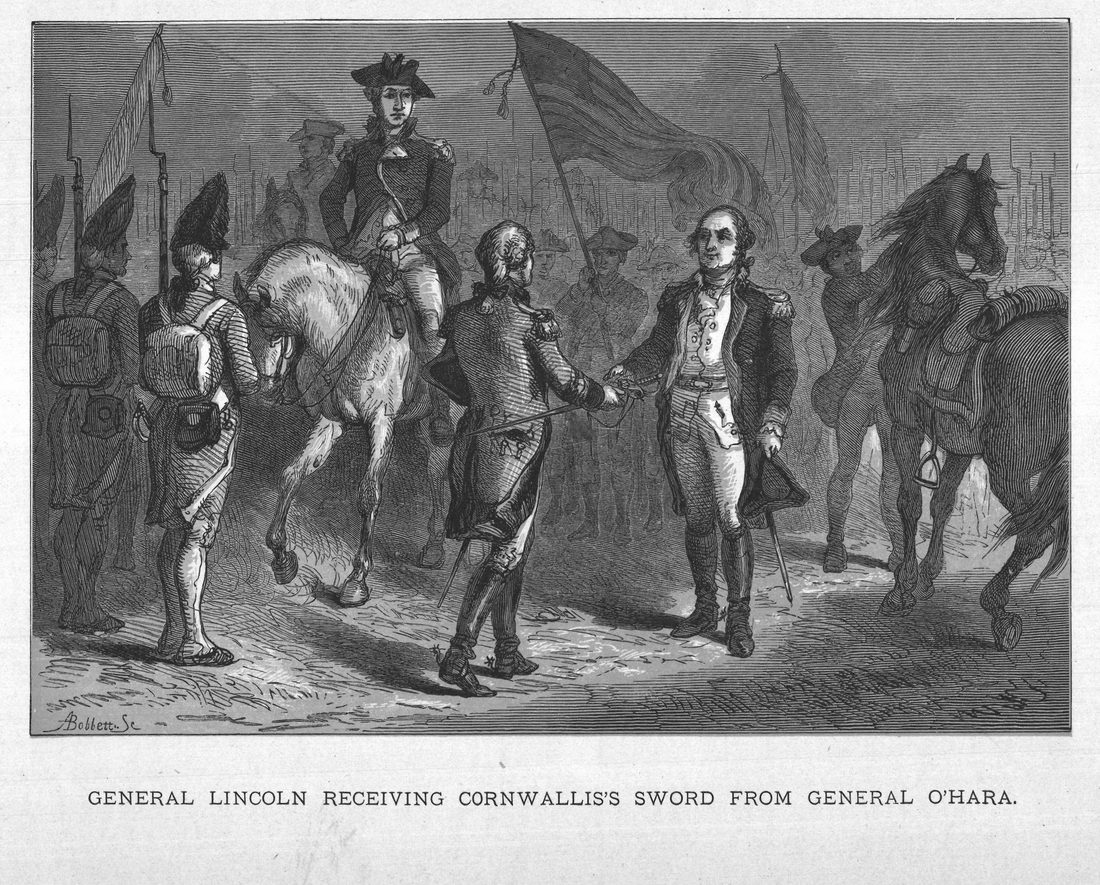
Late in the afternoon of the 19th of October, 1781, the surrender of Cornwallis and his army took place. The allied troops were drawn up in two columns. Washington on his white charger was at the head of the Americans; and Rochambeau on a powerful bay horse at the head of the French columns. A vast concourse of people from the surrounding country were spectators of the impressive scene. Cornwallis, feigning sickness, sent General O'Hara with his sword, as his representative. That officer led the vanquished troops out of their intrenchments with their colors cased, and marched them between the victorious columns. When he arrived at their head he approached Washington to hand him the earl's sword, when the commander-in-chief directed him to General Lincoln as his representative. It was a proud moment for Lincoln. Only the year before he had been compelled to make a humiliating surrender to royal troops at Charleston. He led the subdued army to the field where they were to lay down their arms, and then received from O'Hara the sword of Cornwallis, which he politely returned to be given back to the earl. The standards, twenty-eight in number, were then given up, and the royal army laid down their arms.
The whole number of troops surrendered was about seven thousand. To these must be added two thousand sailors, eighteen hundred negroes, and fifteen hundred Tories, making the total number of prisoners over twelve thousand. Besides these, the British lost in killed, wounded and missing during the siege, about five hundred and fifty men; the loss of the Americans was about three hundred. The spoils of victory were nearly eight thousand muskets; seventy-five brass and one hundred and sixty iron cannon, and a large quantity of munitions of war and stores. To accomplish this great victory, the French had provided thirty-seven ships-of-the-line and seven thousand men; and the Americans furnished nine thousand troops, of which number five thousand five hundred were regulars.