Arnold's Raid into Connecticut
Neither Clinton's threats nor Arnold's atrocities stayed the onward march of the allied troops. It was intended to transport them by water from the head of Elk (now Elkton, in Maryland), but there were not sufficient vessels there for the purpose, and a greater portion of them made their way to Annapolis by land. Afterward the whole of the allies were carried by water to the James River by transports from the squadron of De Barras. From Baltimore, where he arrived on the 8th of September, Washington, accompanied by Rochambeau and the Marquis de Chastellux, journeyed to his home at Mount Vernon, from which he had been absent since July, 1775. There they remained two days, when they departed for Williams-burgh, and arrived there on the 14th. Washington immediately repaired to the Ville de Paris, De Grasse's flag-ship, lying off Cape Henry, to meet the admiral, and to congratulate him on his victory over Graves on the 5th. There satisfactory arrangements were made for a combined attack upon Yorktown by land and water, as soon as the troops should reach Williamsburgh. While waiting for the slowly approaching forces, word came that the British fleet at New York had been reinforced. De Grasse proposed to leave some frigates to blockade the York River, and go out in his great ships in quest of the enemy. There would be great danger in such a movement. The British fleet might enter Chesapeake Bay, and assist Cornwallis in making his escape. Washington perceived the peril, and persuaded De Grasse to remain. The last division of the allied forces reached Williamsburgh on the 25th of September, when preparations for the siege were immediately begun.
Cornwallis had solicited aid from Clinton. On the 17th he wrote: "This place is in no state of defence. If you cannot relieve me very soon, you must be prepared to hear the worst." On the same day a council of Clinton's officers in New York decided that Cornwallis must be relieved "before the end of October"-- and so he was, but not by their aid.
On the 28th the allied armies marched from Williamsburgh, about twelve thousand in number, to begin the siege of Yorktown, twelve miles distant, driving in the British outposts on the way. Some of the allies took possession of outworks which the British had abandoned, and then sent out covering parties for the diggers of trenches and builders of redoubts. The line of the allies extended in a semicircle about two miles from the British works, each wing resting on the York River, and on the 30th the place was completely invested. On account of the possession of the abandoned outworks, the allies were in an advantageous position to command the British lines and carry on the siege by opening trenches. The enemy at Gloucester were imprisoned by the French dragoons under the Duke De Lauzun, Virginia militia under General Weedon, and eight hundred French marines. Only once did the British attempt offensive operations from that point. Tarleton and his legion once sallied out, but were soon driven back by Lauzun's cavalry, who took Tarleton's horse a prisoner and came near capturing its owner.
In the besieging line the French troops occupied the left, the West India troops of St. Simon on the extreme flank. The Americans were on the right, and the French artillery, with the quarters of the two commanders, occupied the centre. The American artillery under General Knox were on the right. De Grasse remained in Lynn Haven Bay to beat off any British fleet that might attempt to relieve Cornwallis.
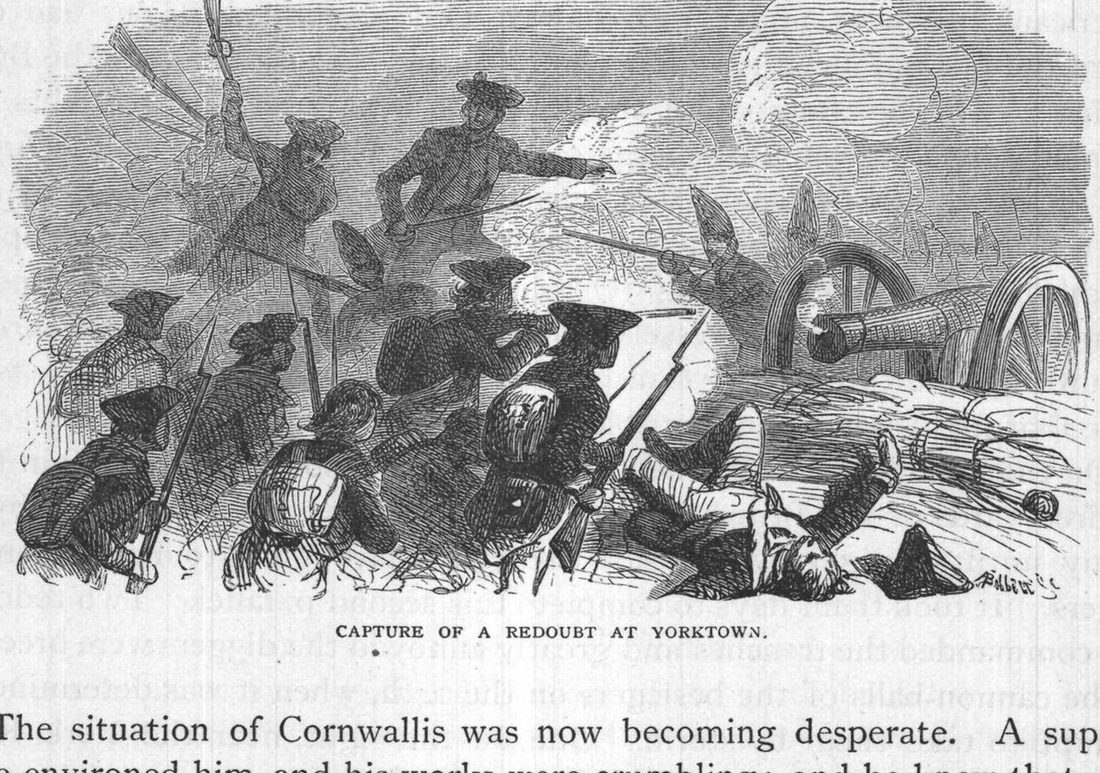
On the night of the 6th of October, the heavy ordnance had been brought from the vessels, and trenches were begun at a distance of six hundred yards from the British works. The night was dark and stormy, and at dawn the Americans, working under the command of General Lincoln, had completed the first parallel, their labors being entirely unsuspected by the British sentinels. On the afternoon of the 9th several batteries and redoubts were completed, and a general discharge of heavy guns was begun by the Americans on the right. All night long cannon thundered, and the roar of artillery was increased early in the morning when the French on the left opened several batteries. At evening (October 10) the French hurled red-hot cannon-ball upon British vessels in the river, which fired the Charon, a 44-gun ship, and three heavy transports, and all were consumed. The whole scene that night was one of terrible grandeur.