Seizure of the "Liberty"
"'You had better let the vessel be at the wharf,' said Malcom. 'I shall not,' said Hallowell, and gave directions to cut the fasts. 'Stop, at least, till the owner comes,' said the people who crowded round. 'No, damn you,' cried Hallowell, 'cast her off.' 'I'll split out the brains of any man that offers to receive a fast or stop the vessel,' said the master of the Romney; and he shouted to the marines to fire. 'What rascal is that who dares to tell the marines to fire?' cried a Bostoneer; and turning to Harrison, the collector, a well-meaning man, who disapproved the violent manner of the seizure, he added: 'The owner is sent for; you had better let her lie at the wharf till he comes down.' 'No, she shall go,' insisted the controller; 'show me the man who dares oppose it.' 'Kill the damned scoundrel,' cried the master. 'We will throw the people from the Romney overboard,' said Malcom, stung with anger. 'By God she shall go,' repeated the master, and he more than once called to the marines, 'Why don't you fire?' and bade them fire. So they cut her moorings, and with ropes in the barges the sloop was towed away to the Romney."
This act excited the hot indignation of the people. A mob, led by Malcom, followed the custom-house officers, pelted them with stones and other missiles, and broke the windows of their offices. The mob seized a pleasure-boat belonging to the collector, and after dragging it through the town, burned it on the Common. Then they quietly dispersed. The commissioners were unhurt, but greatly alarmed. They applied to the governor for protection, but he, as much frightened as they, told them he was powerless. They finally fled to the Romney, and thence to Castle William, nearly three miles southeast of the city, where a company of British artillery were stationed. They were in no real danger in the city, but they were playing a deep game to deceive the ministry.
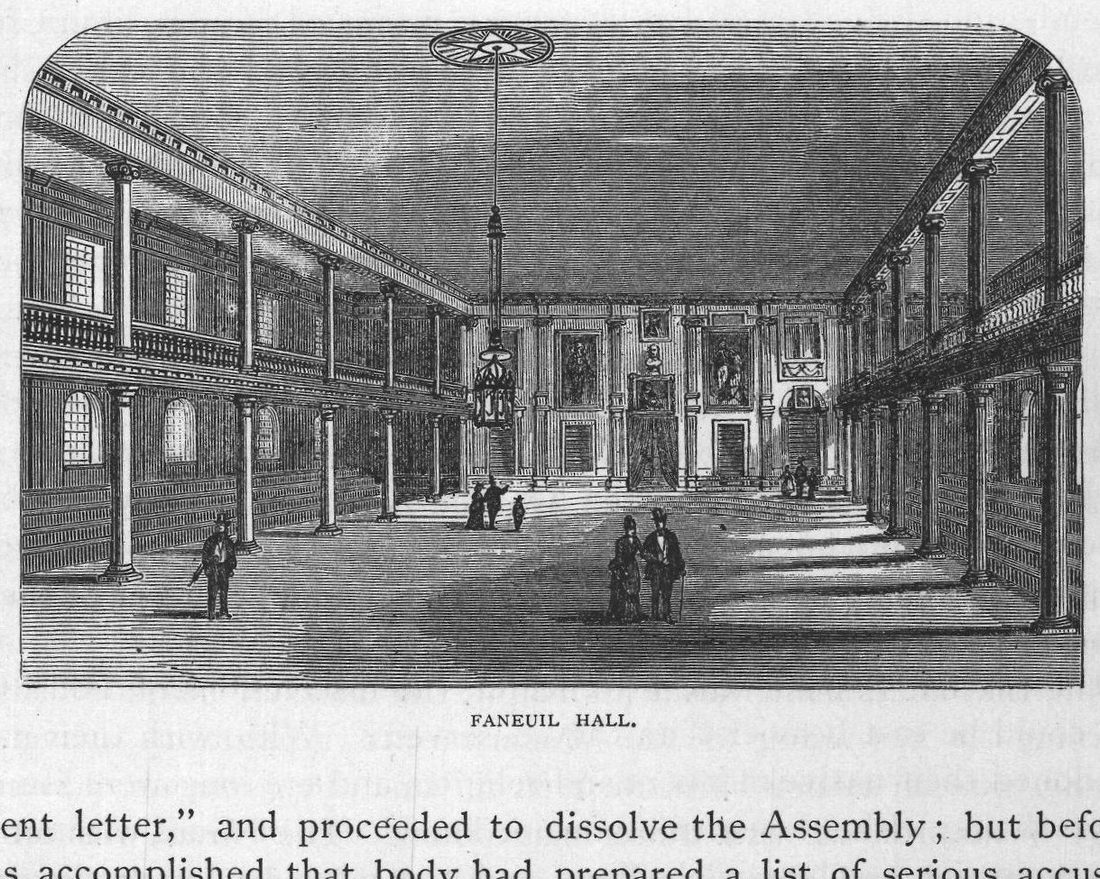
The "Sons of Liberty" now called a meeting of the citizens at Faneuil Hall, in a large building erected by Peter Faneuil in 1742 for the use of the town. They assembled in great numbers on the 13th of June, 1768. Citizens and yeomen from the surrounding country commingled there, all animated by a spirit of patriotic defiance. James Otis was appointed chairman. A committee of twenty-one citizens were requested to convey to the governor an address adopted by the assemblage, asking him to order the Romney to leave the harbor, and to restrain further violent proceedings on the part of the crown officers. At that meeting the people plainly told the crown that its oppressions must cease. So was Faneuil Hall consecrated as The Cradle of Liberty.
In eleven chaises the committee went in procession to the governor's house in the country. Bernard received them courteously, and the next day he sent a reply to the address, in which he promised to stop impressments, and said: "I shall think myself most highly honored if I can be, in the lowest degree, an instrument in preserving a perfect conciliation between you and the parent state." At that very time, the dissimulating governor was using his utmost endeavors to get troops into Boston, either from New York or England, and had written to his superiors that the events of the 10th of June constituted "an insurrection rather than a riot." The crown officers all reported that "a general spirit of insurrection was prevailing throughout the province," hoping to induce the ministry to use vigorous measures immediately for subjugating the Americans. Meanwhile the town of Boston declared in words written by John Adams, a rising young lawyer, that "every person who shall solicit or promote the importation of troops at this time is an enemy to the town and province, and a disturber of the peace and good order of both."
While the excitement was at its height, the instructions of Hillsborough concerning the rescinding of the Massachusetts resolutions arrived. The Assembly were in session. On the 21st of June the governor delivered his message in accordance with those instructions. The House was composed of one hundred and nine members - much the largest legislative body in America. The message was received with calmness, and discussed with moderation but firmness. James Otis and Samuel Adams were the chief speakers. The latter was grave in demeanor and philosophical in his utterance. The former was fiery, and more declamatory. The friends of the king and Parliament declared that his harangue was "the most violent, insolent, abusive and treasonable declaration that perhaps ever was delivered." "When Lord Hillsborough knows," said Otis, "that we will not rescind our acts, he should apply to Parliament to rescind theirs. Let Britons rescind their measures, or they are lost forever!"