Hillsborough's Instructions
When, at the middle of April, the Circular and the misrepresentations of Bernard and other crown officers reached Hillsborough, he sent instructions to the governor to call upon the General Assembly of Massachusetts to rescind their resolutions, the substance of which was embodied in their Circular, and in case of refusal to dissolve them. Meanwhile responses to the Circular had come to Boston from the other assemblies, expressing cordial approbation of its sentiments. Individuals also sent approving letters, and patriots issued appeals to the people through the medium of newspapers and pamphlets. "Courage, Americans!" wrote William Livingston (it is supposed, an eminent Presbyterian lawyer in New York), in the American Whig, No. V. "Liberty, religion, and science are on the wing to these shores. The finger of God points out a mighty empire to your sons. The savages of the wilderness were never expelled to make room for idolaters and slaves. The land we possess is the gift of Heaven to our fathers, and Divine Providence seems to have decreed it to our latest posterity. So legible is this munificent and celestial deed in past events, that we need not be discouraged by the bickerings between us and the parent country. The angry cloud will soon be dispersed, and America advance to felicity and glory with redoubled activity and vigor. The day dawns in which the foundations of this mighty empire is to be laid by the establishment of a regular American constitution. All that has hitherto been done seems to be little beside the collection of materials for the construction of this glorious fabric. 'Tis time to put them together. The transfer of the European part of the great family is so swift, and our growth so vast, that before seven years roll over our heads the first stone must be laid. Peace or war, famine or plenty, poverty or affluence-in a word, no circumstance, whether prosperous or adverse, can happen to our parent-nay, no conduct of hers, whether wise or imprudent-no possible temper on her part, will put a stop to this building." So ran the prophecy in 1768. At the end of seven years its fulfillment began in earnest.
With his instructions to Bernard, Hillsborough sent a letter to the other royal governors, describing the Massachusetts Circular as "of a most dangerous and factious tendency," and directing them to use their influence to induce their respective assemblies to treat it "with the contempt it deserved." The governors were also instructed, in case the assemblies gave "any countenance to the seditious paper," to immediately dissolve them. By these means the Secretary hoped to induce the other assemblies to oppose the bold measure proposed by Massachusetts, and so isolate that province. The result did not justify his hopes. By this attempt to control their action, the assemblies were irritated, and their zeal in the cause in which Massachusetts was leading was increased. Meanwhile orders had been given to General Gage at New York to hold a regiment in readiness there to send to Boston, for the assistance of the crown officers in executing the laws. The admiralty was also directed to send a frigate and four smaller vessels-of-war to Boston harbor for the same purpose, and directions were given for the repairing and occupancy of Castle William on an island in that harbor. This measure was regarded by the Americans as a virtual declaration of war, yet they resolved to keep the sword of resistance in the scabbard as long as possible.
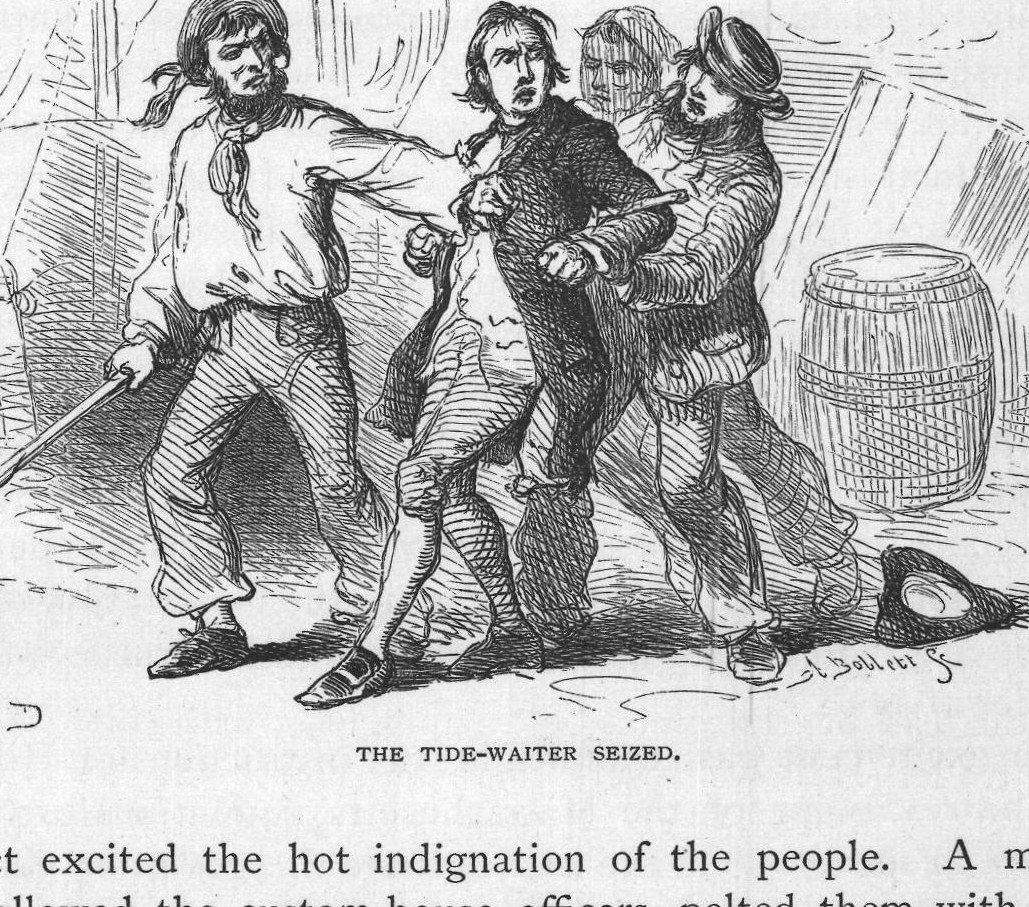
The commissioners of customs and the master of a sloop-of-war which, at their request, had come to Boston from Halifax, now assumed the utmost insolence of manner and speech toward the people. New England men were impressed into the British naval service, and in June, the sloop Liberty, belonging to John Hancock, whom the crown officers cordially hated because of his opposition to them, was seized under peculiar circumstances. She had come into the harbor with a cargo of Madeira wine. Just at sunset, the "tide-waiter" in the employ of the commissioners went on board, and took his seat in the cabin, as usual, to drink punch with the master until the sailors should land the cargo of dutiable goods. Hancock had resolved to resist the obnoxious revenue laws; and at about nine o'clock in the evening, his captain and others in his employ entered the cabin, confined the tidewaiter, and proceeded to land the wine without entering it at the custom-house or observing any other formula. So great were the exertions of the master of the Liberty that night, that he died from their effects before morning.
The sloop was now seized by the officers of the customs for a violation of the revenue laws. A crowd of citizens quickly gathered at the wharf, and as the proceedings went on, a part of them, of the lower order, became a mob under the lead of Malcom, a bold smuggler. The collector (Harrison) and the controller (Hallowell) were there to enforce the law. The former thought the sloop might remain at Hancock's wharf with the broad arrow upon her (a mark designating her legal position); but the latter had determined to have her moored under the guns of the war-vessel (Romney, of sixty guns), and had sent for her boats to come ashore. An exciting scene now occurred, which Mr. Bancroft has described as follows: