Reception of the Declaration of Independence
THE far-reaching results of the Declaration of Independence were not appreciated, at the time, by the great body of the people. There was general joy, because there was a vague idea in the public mind that something beneficial might immediately ensue. A Whig newspaper in the city of New York announced the great act of the Congress "on Thursday last," without a word of comment, and in only six lines. But there were seers and sages in every community whose discernment penetrated the veil of the future, and beheld glorious visions beyond of a great and free nation on the soil of America.
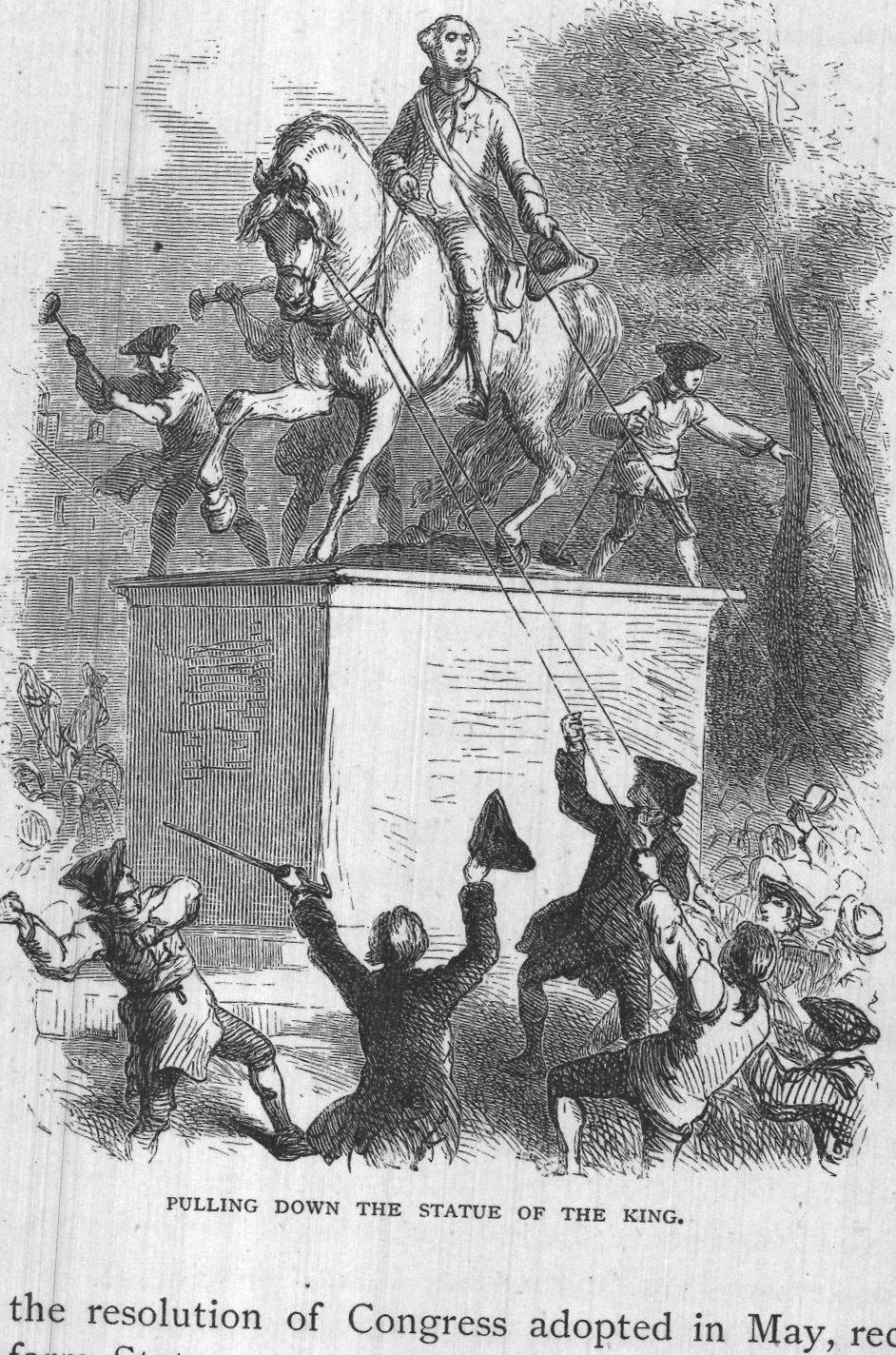
These were the men who led in public demonstrations of joy all over the country on that occasion. When the Declaration was read in public from Rittenhouse's Observatory on the Walnut-street front of the State-house in Philadelphia, on the 8th of July, it was greeted with loud huzzas by the people. These thoughtful men testified their belief that the great act had ended royal rule in the United States, by taking down the king's arms that were over the seat of justice in the State-house, and burning them in the street, with other symbols of royalty. The same kind of men, with similar prescience, after the Declaration had been read to the republican army in New York, toward the evening of the 9th of July, led the excited populace, composed of citizens and soldiers, at early twilight, to the Bowling Green at the foot of Broadway, where stood aloft an equestrian statue of the reigning monarch, which had been set up by grateful Americans after the repeal of the Stamp Act, ten years before. They put ropes around the necks of the man and horse, pulled them from the pedestal, and broke them in pieces. The statue was made of lead, and gilded. The pieces were carried away, and the metal was cast into forty thousand bullets by patriotic women wherewith to fight the royal troops. "So," said a contemporary writer, "they had melted majesty hurled at them." Everywhere in America multitudes of men and women perceived the full significance of the act, and these led in chanting the great song of deliverance that filled the hearts of republicans and found expression from their lips. In Europe the act gave hope to tens of thousands of aspirants for freedom, and thrones began to tremble.
Meanwhile the resolution of Congress adopted in May, recommending the colonies to form State governments, had been acted upon by several of them. New Hampshire had prepared for a State government, in January, 1776. The royal charters of Rhode Island and Connecticut were considered sufficiently democratic; and that of the latter remained the fundamental law of the State until 1842. New Jersey adopted a State constitution on the 2d of July; Virginia adopted one on the 5th, and Pennsylvania on the 15th. On the 14th of August, Maryland followed their example; Delaware on the 20th of September, and North Carolina on the 18th of December. Georgia adopted a State constitution on the 5th of February, 1777, and New York on the 20th of April following; but South Carolina did not follow the example until the 19th of March, 1778. Massachusetts, the most eager champion for local self-government, deferred the important measure that secured it, until the 2d of March, 1780. Within a year after the Declaration of Independence was made, most of the States had organized settled governments, but no national government was established until the armed struggle had been going on for six years, as we shall observe hereafter.
We left Washington and his main army in and around the city of New York, in the summer of 1776. General Howe arrived at Sandy Hook from Halifax at the close of June, and on the 8th of July-four days after independence was declared-he landed nine thousand men on Staten Island, that lies between New York harbor and the sea. There he awaited the arrival of his brother, Admiral Howe, with his fleet bearing British regulars and German hirelings. These, and the broken forces of Clinton and Parker from the Carolinas, soon joined General Howe; and by the middle of August, the British, land and naval, numbering almost thirty thousand men, prepared to fall upon the American forces. With this great force the British commanders, who counted largely upon the moral strength of the Tories in favor of the crown, felt confident that they would soon bring the rebellion to an end, either by negotiations or by crushing it under the heel of military power. Lord Howe had said, at Halifax, "Peace will be made within ten days after my arrival." Like the ministry who sent them, the commissioners were profoundly ignorant of the spirit of the people they were to deal with. The powers with which they were vested were very limited. They could grant pardons to individuals on their return to allegiance, and grant amnesty to insurgent communities which should lay down their arms and dissolve their governments. They might converse with individuals in America on the public grievances and report their opinions, but they might not be judges of their complaints nor promise redress; and they were not allowed to treat with any Congress, either provincial or continental, nor with any civil or military officer commissioned by such bodies.