Provisions for War
General Brock had joined Proctor at Malden, where he held a conference with Tecumtha and his thousand followers on the morning of the 14th of August. His troops took possession of Sandwich, and constructed a battery there that commanded Fort Detroit and the town. At a little past noon on the 15th he sent a note to Hull demanding the instant surrender of the post. It conveyed a covert threat that in case of refusal and its ultimate capture, the blood-thirsty savages would be let loose upon the inhabitants and the garrison. Hull was perplexed. The fort was thronged with trembling women and children, and decrepit old men who had fled to it for protection from the savages. For full two hours he kept the flag waiting while considering what he should do. His whole effective force there did not exceed a thousand men--too few to withstand the enemy in open battle, but sufficient, his officers thought, to endure a long siege, for there was an ample store of provisions. They urged him to stand firm. His pride of character and his patriotism bade him fight; his prudence and humanity bade him surrender. His officers clamored for an opportunity to show their prowess and skill, and he sent the flag back with a refusal to surrender.
At four o'clock in the afternoon the battery of five guns at Sandwich opened a cannonade and bombardment upon the fort and town, which was kept up until near midnight, and in the morning twilight of the 16th--a calm and beautiful Sabbath morning--a large body of the British and Indians crossed the river below Detroit, and soon afterward marched upon the town and fort. Soldiers outside of the fort waited impatiently for orders to fire upon the approaching foe, confident that they could repulse the invaders. They received, instead, orders to retreat into the fort. It was obeyed with reluctance; and the place was crowded to excess with exasperated men, who gave vent to their feelings in loud expressions of indignation and distrust of their commander. Some of them were mutinous at first, but were restrained by more prudent officers.
In the midst of this excitement, a cannon-ball came bounding over the wall of the fort from the Canada shore, spreading death in its path. A group standing by the door of the officers' quarters were almost annihilated. Many women and children were in the house where the officers were slain; among them General Hull's daughter and her little children. Some of the women, made senseless by fright, were carried to the bomb-proof vault for safety. The general saw the effects of the ball from a distance, and did not know but his own child was among the slain. He paced the parade backward and forward with great agitation of mind, until informed that the enemy were preparing to storm the fort; then he directed his son, Captain Hull, to hoist a white flag over the wall in token of surrender. The firing ceased, terms of capitulation were soon agreed upon; and at noon the same day, the surrender was completed.
In less than two months after the declaration of war, a strong military post, a spirited army of about two thousand men, and a magnificent territory with all its inhabitants, were given up to the British. Hull had not asked the advice of a single man concerning a surrender, but took the whole responsibility upon his own shoulders, and bore the heavy load nearly all his life afterward. His young officers made serious charges against him. He was accused of treason, cowardice, and neglect of duty. A court-martial sentenced him to be shot, but the President of the Republic pardoned him. Truth and justice have since vindicated his character. To the neglect and inefficiency of his superiors--the Secretary of War and the commander-in-chief--was due chiefly the great disaster. The blundering administration--blundering in ignorance--made him a scape-goat to bear away the sins of others--a conductor to avert from their own heads the lightning of the people's wrath. The verdict of impartial history to-day acquits General Hull of all wrong in the surrender of Detroit, unless it be wrong to allow humanity to overbear expediency.
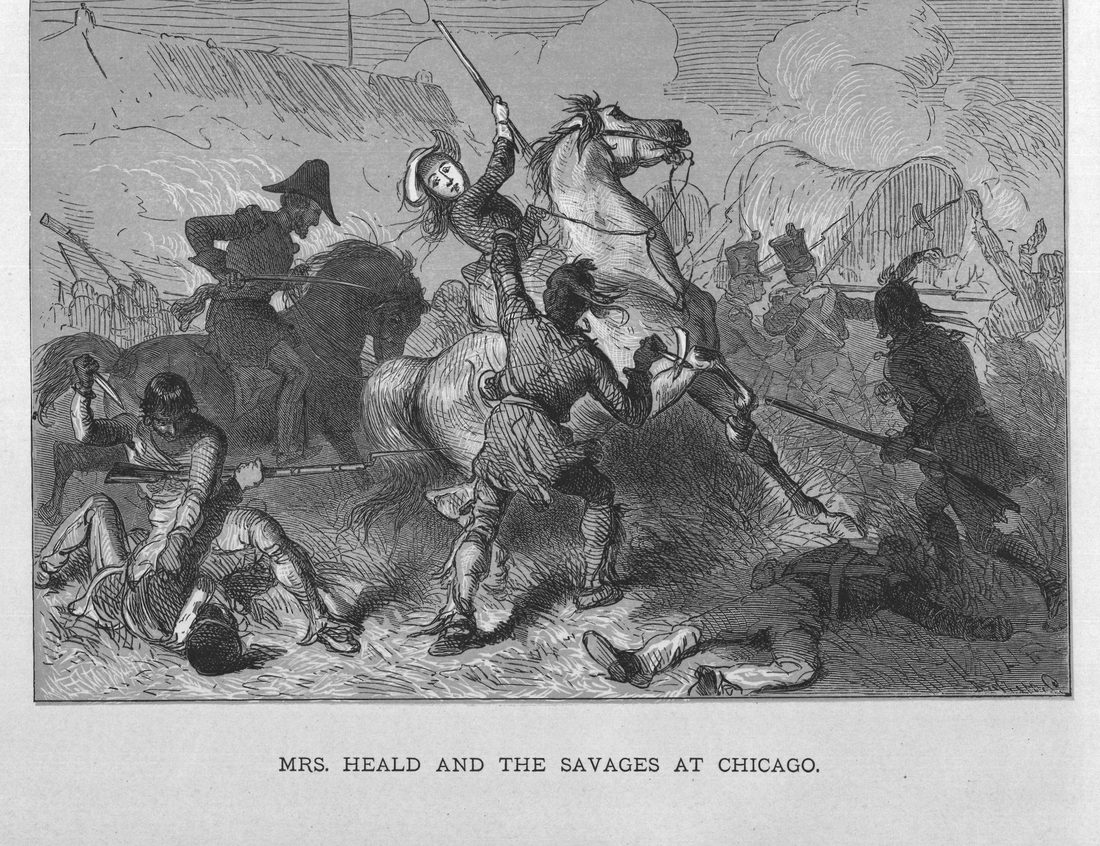
We have observed that Fort Dearborn, at Chicago, was invested by savages at the time of the trouble at Detroit. On the site of that marvelous inland city of over three hundred thousand inhabitants were then only the fort, the dwelling of Mr. Kinzie, a trader, and the huts of a few settlers. The garrison was commanded by Captain N. Heald, assisted by Lieutenant Helm; and the young wives of both officers were inmates of the fort. The garrison and the family of Mr. Kinzie, the trader, were on friendly terms with the surrounding Indians until the spring of 1812, when the hostile feelings created by British emissaries were first made slightly manifest. One day a chief, at the fort, seeing the two young women playing at battledore, said to the interpreter: "The white chiefs' wives are amusing themselves very much; it will not be long before they will be living in our cornfields." The terrible significance of these mysterious words was made apparent a few weeks afterward.