Mackinaw Captured
Early in April a scalping party of Winnebagoes made a raid upon a settlement near Chicago. The inhabitants near Fort Dearborn took refuge with its garrison, and saw with anxiety the continual gathering of the Indians in the neighborhood during the summer. Finally, on the 7th of August, a friendly Pottawatomie chief arrived with a letter for Captain Heald from General Hull, telling the former of the declaration of war and the fall of Mackinaw, and ordering him, if possible, to evacuate Fort Dearborn and distribute all the United States property there among the Indians, to conciliate them. Heald was advised by the friendly Indian and by Kinzie, who knew the savage character well, not to let them know his intention to evacuate the fort by making the distribution. "Leave the fort," said the chief, "and let them distribute the property themselves; while they are doing this, you and the white people may reach Fort Wayne in safety."
Heald, contrary to the advice of everybody, resolved to obey his orders strictly. He called a council of the Indians on the 12th, and told them to come the next day and receive the property. He had such confidence in the sincerity of their professions of friendship, notwithstanding repeated warnings to beware of treachery, that he accepted their offer to escort the white people through the wilderness to Fort Wayne. That very night Black Partridge, a friendly chief, delivered to Heald a medal which had been given him by the Americans, saying he could not restrain his young men who were resolved to imbrue their hands in the blood of the white people, and he would no longer wear that token of friendship. The warning was unheeded. The goods were distributed the next day; and that evening the Black Partridge said to the interpreter: "Linden birds have been singing in my ears to-day; be careful on the march you are going to take." This warning, too, was unheeded.
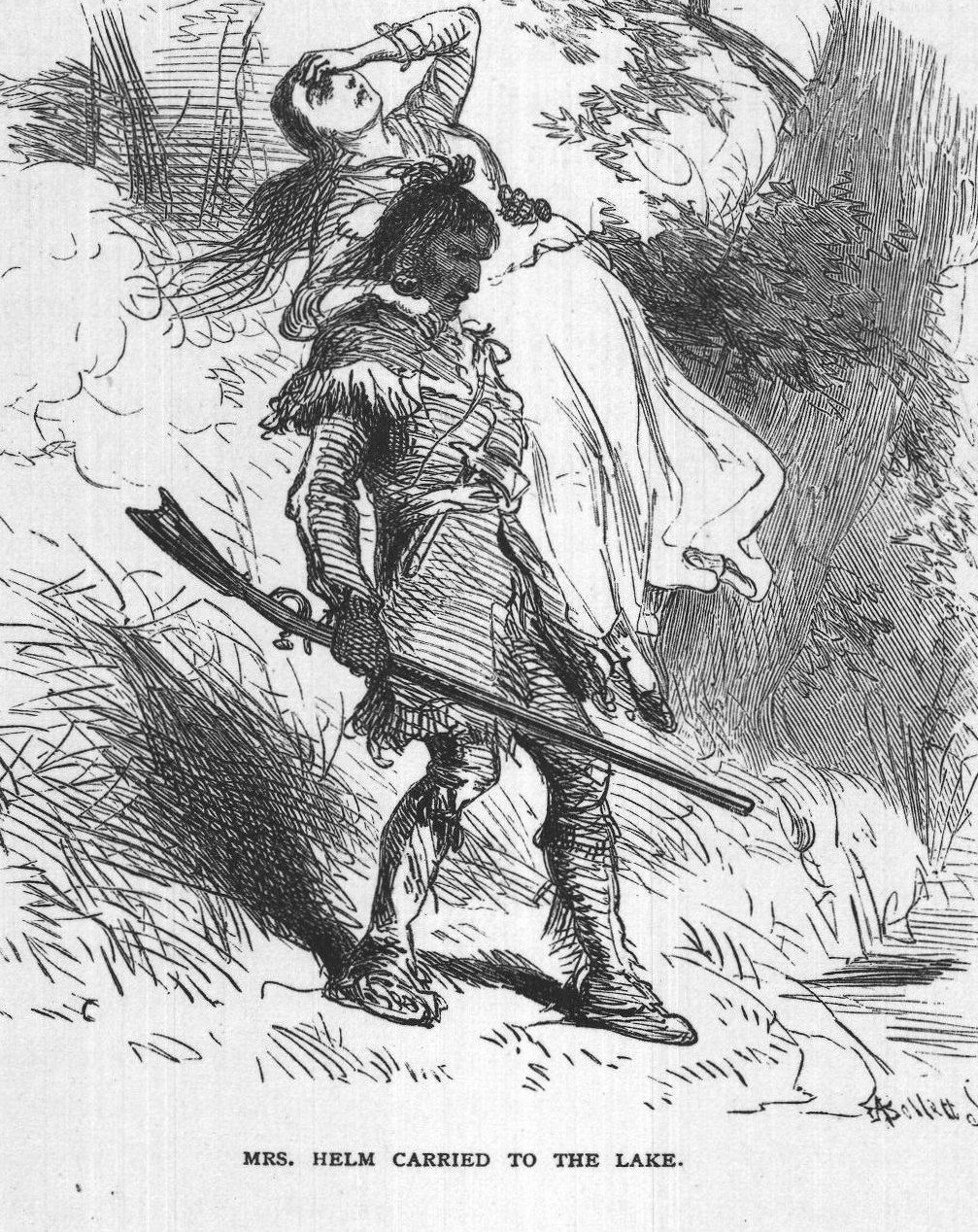
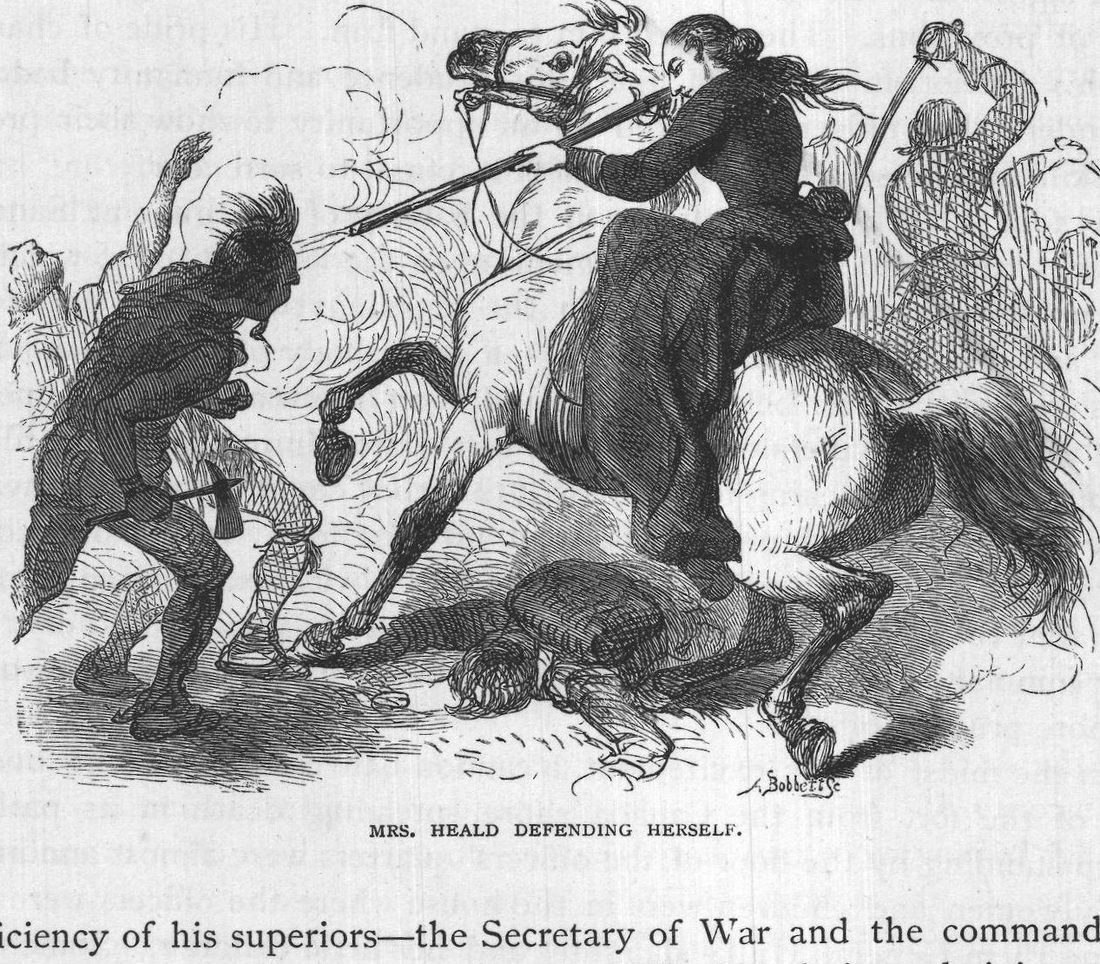
On the morning of the 15th, the evacuation of the fort took place. There were positive indications that the savages intended to massacre the white people. When the gate of the fort was thrown open and the procession moved, it was like a funeral march. The band struck up the Dead March in Saul. The wives of Heald and Helm rode by the side of their husbands. Mrs. Heald, who was a good shot, was well armed with a rifle. They had not gone far when the savage escort, five hundred strong, fell upon them. A sharp and bloody conflict ensued. Rebecca Heald deported herself bravely. She received several wounds, but, though bleeding and faint, she kept her saddle. A savage raised his tomahawk to slay her, when she said, in a sweet voice in his own language, and with a half smile, "Surely you will not kill a squaw!" The appeal was effectual, and she lived until the year 1860. A stalwart young savage attempted to tomahawk Mrs. Helm, who was dismounted. She sprang to one side, received the blow on her shoulder, and at the same instant seized the savage around his neck, and endeavored to get hold of his scalping-knife. While thus struggling, she was dragged from her antagonist by another Indian, who bore her to the shore of the lake and plunged her in, at the same time preserving her from drowning. The friendly hand that saved her, was that of the good Black Partridge. There were other cases of the grand heroism of women displayed on that bloody field. Meanwhile Heald had made terms for surrender, and the contest ended. The prisoners were distributed among their captors, and were finally reunited or restored to their friends or families. In this affair, twelve children, all the masculine civilians excepting Mr. Kinzie and his sons, and twenty-six private soldiers, were murdered. The fort was burned the next morning by the Indians.
On the spot where this massacre occurred, only about two generations ago, now stands a city whose growth is one of the marvels in the history of the progress of our country within the present century. It is at the centre of a railway system connecting the East with the West by full ten thousand miles of railroad, all tributary to Chicago; and that city, which was only the germ of a small village forty years ago, now contains more than three hundred thousand inhabitants. It is the most extensive grain mart on our continent. From it are annually shipped almost one hundred million bushels; and the commerce of that city is computed, in value, to be five hundred million dollars annually.