Position of the Belligerent Armies: West Point and Vulture
While these events were occurring, Washington was on his way from Hartford. On the morning of the 25th (September, 1780), he and his attendants left Fishkill before the dawn, and rode on with speed toward the Robinson house to breakfast with General and Mrs. Arnold. When near there, the chief turned down a lane to view a battery on the brink of the river, and told his young companions to go forward and he would soon join them. While they were at the table with the general, a messenger brought a letter to him from Jameson; but instead of announcing, as he expected it would, that a British armament was ascending the river, it told him of the arrest of Major Andre. His presence of mind did not forsake him. He told his guests that business of importance demanded his presence at West Point immediately. He ascended to his wife's chamber and sent for her. There, in brief and hurried words, he told her that they must instantly part, perhaps forever, for his life depended upon his reaching the British lines as quickly as possible. Horror-stricken, the poor young creature, one year a mother but not two a bridge, swooned and sank senseless upon the floor. Arnold dared not call for help, but kissing with lips blasted by words of guilt and treason, his boy then sweetly sleeping, he rushed from the room, mounted a horse belonging to one of his guests, and hastened to the river along a byway yet known as Arnold's Path. Then he entered his barge, and directed his six oarsmen to push out into the middle of the river and pull for Teller's Point. They were ignorant of his errand, and having their muscles stimulated by a promise of two gallons of rum, they rowed the little vessel swiftly down the stream to the Vulture. Having made himself known to the commander. Arnold rewarded his faithful men with the fate of prisoners instead of the promised beverage. Clinton, despising the traitor's meanness, set them at liberty when the Vulture arrived at New York.
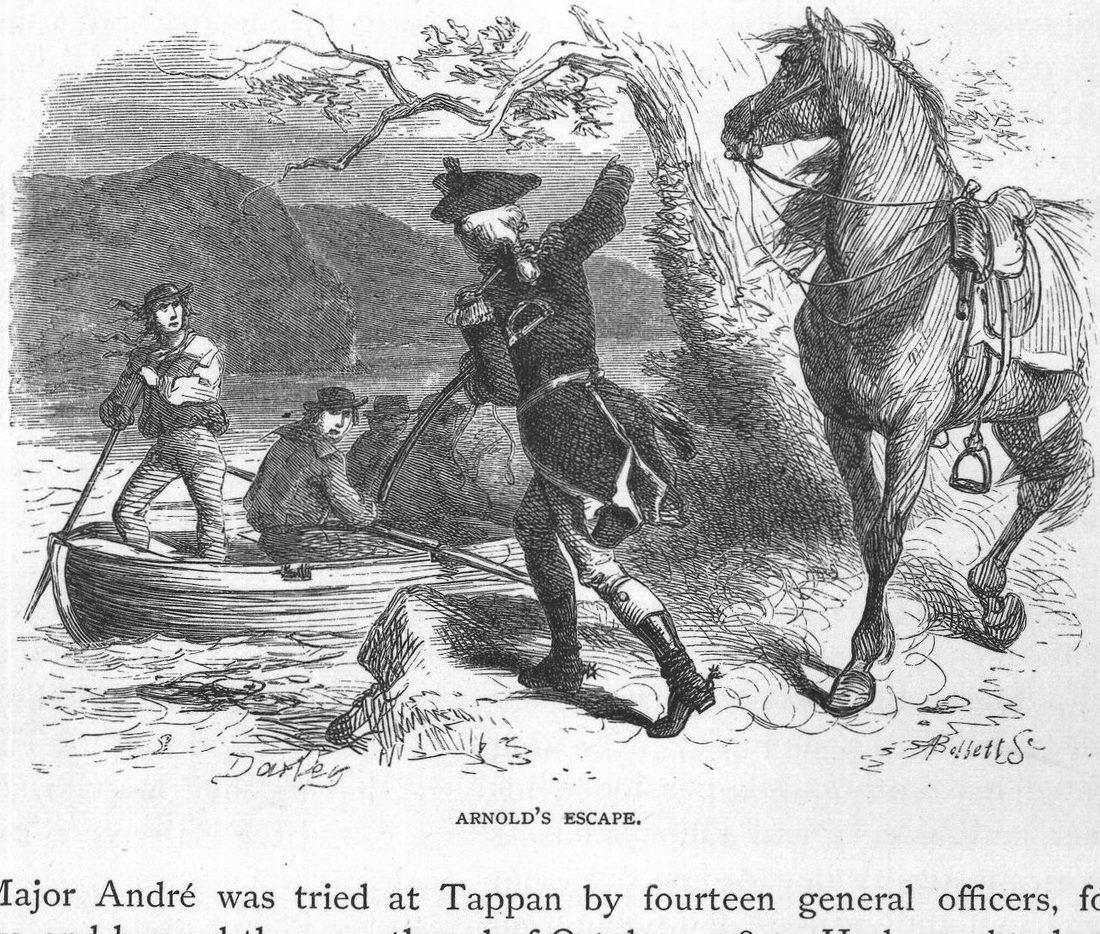
Washington arrived at Robinson's house just after Arnold had left. No one there, excepting Mrs. Arnold in her chamber, knew of the traitor's flight. Supposing he had gone over to West Point, the chief crossed the river, and did not return until near noon. He was met near the landing-place by Hamilton, into whose hand a messenger from Jameson had placed the proof of Arnold's guilt--the papers taken from Andre's boots, and the major's letter to Washington. Efforts were immediately made to overtake the traitor, but he had four hours the start, and escaped, as we have observed. The fugitive's wife was crazed by the shock for several hours, and her condition excited the warmest sympathy of the chief and his attendants. She pressed her infant to her bosom and lamented his fate because of the conduct of his father. "All the sweetness of beauty, all the loveliness of innocence, all the tenderness of a wife, and all the fondness of a mother," wrote Colonel Hamilton, "showed themselves in her appearance and conduct." They believed that she was entirely ignorant of his crime until it was revealed to her at the time of his flight.
Major Andre was tried at Tappan by fourteen general officers, found guilty, and hanged there on the 2d of October, 1780. He begged to be shot that he might die like a soldier and not as a spy. In a letter to Washington he pleaded with touching but manly earnestness for this boon. That letter has been thus paraphrased in verse, by Willis:
It is not for another breath, I ask thee now;
I can die with a lip unstirr'd, and a quiet heart--
Let but this prayer be heard ere I depart.
I can think of love--yet brook a death like this!
I can give up the young fame I burn'd to win;
All--but the spotless name I glory in.
Joy for the hour I live, calmness to die.
By all the brave should cherish, by my dying breath,
I ask that I may perish by a soldier's death."