Perfidy of Gage
GAGE now saw the real peril of his situation, surrounded as he was by an army of exasperated men outside of Boston, and deadly foes within it. Instead of relaxing his rigor, he increased it for a moment in order to secure an unfair advantage. He forbade all intercourse with the country, and no one was allowed to leave the town. Their supplies of food and fuel thus cut off, famine stared the people in the face. The worst horrors of civil war were impending; and at that moment of their agony of dread, Gage offered to give safe conduct out of Boston to all who wished to go, provided they would surrender their arms, and promise not to join in an attack on his troops or works. In their extremity they accepted his proposition, and delivered their arms at Faneuil Hall. The exodus immediately began, when the Tories interfered. They begged Gage to keep the patriotic citizens as hostages. He violated his solemn pledge, and kept many of the disarmed inhabitants there, some of them separated from portions of their families, and exposed to bitter insults.
The patriots now determined on aggressive movements to weaken the British power on the continent. It was believed that the ministry entertained a scheme for separating New England from the rest of the colonies by a military occupation of the Hudson Valley and Lake Champlain, the latter the Indian "door of the country" opening between the Hudson and the St. Lawrence. On Lake Champlain were the two powerful fortresses of Ticonderoga and Crown Point, which might be made most efficient in executing the proposed scheme, for they would secure free intercourse with Canada. Are the Canadians friendly to us? was then a question of great importance for the patriots. In March, Samuel Adams and Dr. Warren, members of the Committee of Correspondence, sent John Brown of western Massachusetts, as a secret agent of that province, to seek an intelligent answer. He sent word that the Canadians were lukewarm, at the best, and advised the seizure of Ticonderoga and Crown Point the moment the impending conflict should be commenced; and he assured them that the Green Mountain Boys, as the men of Vermont (then the New Hampshire Grants) were called, whose leader was sturdy, patriotic, honest Ethan Allen, were ready to undertake the enterprise.
When the blow was struck on the 19th of April, it was resolved to secure the lake fortresses at once. Samuel Adams and John Hancock conferred personally on the subject with the governor of Connecticut, at Hartford, when funds were appropriated from the public treasury for the expedition, and powers delegated to two citizens as a committee to superintend the expedition. An express was sent to Allen, asking him to hold his "Boys" in readiness. The whole movement was done in secret, yet hints of it reached the ears of Benedict Arnold, who was about to leave for Cambridge with a Connecticut company of which he was captain.
The committee gathered sixteen men at Salisbury, and marched to Pittsfield, where they were joined by Brown and Colonel Easton, with a small force of Berkshire volunteers. Pushing on to Bennington, they were joined by Allen and his men; and on Sunday, the 7th of May, 1775, they rendezvoused at Castleton. There they were joined by Arnold. On his arrival at Cambridge he had proposed to the Provincial Congress an expedition against the forts, and received from them a commission of colonel, and authority to raise and lead not more than four hundred men against the lake fortresses. By virtue of this commission, he claimed the leadership, though he came with only one man. The militiamen chose Allen as their leader, and Arnold accompanied the expedition as a volunteer.
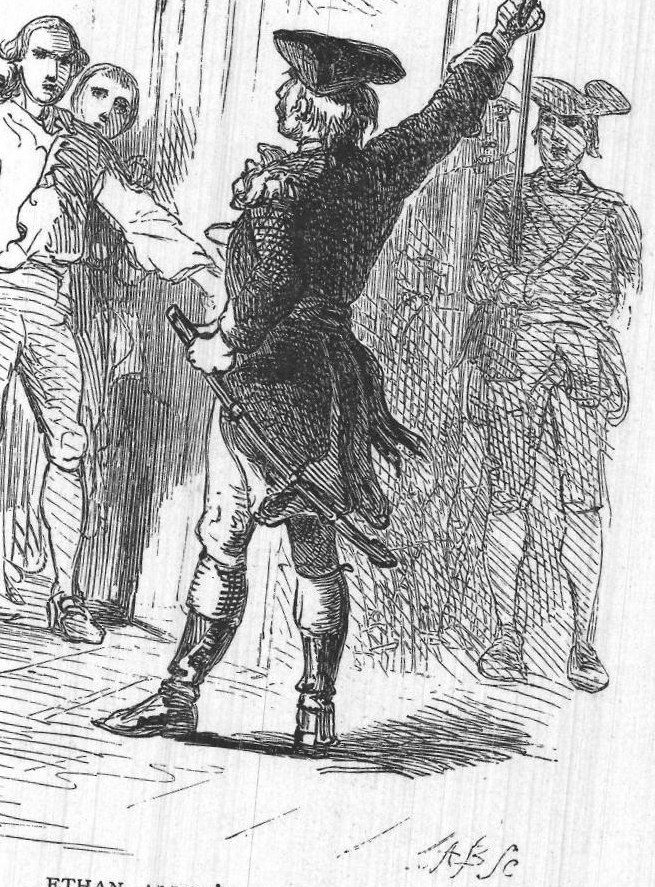
On the evening of the 9th of May, the expedition was at Shoreham, opposite Ticonderoga. Only a few boats could be found there. In these, eighty-three men, with Allen at their head and accompanied by Arnold, passed over. The boats were sent back for more men under Colonel Seth Warner; but as a surprise of the garrison was necessary, and the day was dawning, the intrepid leader resolved not to wait. "It is a desperate attempt," said Allen to his men, in a low voice: "I don't urge it contrary to will; you that will undertake voluntarily, poise your firelocks." Every musket was poised. The men followed Allen up the bank to the sally-port, led by a lad familiar with the fort. The sentry snapped his fuzee, and ran into the fortress through a covered way, closely followed by Allen and his men. As they rushed into the parade they gave a tremendous shout, and ranged themselves in two lines against opposite walls. The aroused garrison leaped from their beds, seized their arms, and hastened to the parade, only to be made prisoners by the New Englanders.