Perfidy of Gage: Bunker's Hill and Charlestown
At about the middle of June, the British officers in Boston waked to the consciousness that "rebel" batteries at Dorchester Heights on the south, or on Charlestown Heights-Bunker's or Breed's Hills-on the north, might make the situation of the troops in the town not only disagreeable but perilous. They resolved to sally out and fortify these heights themselves, Dorchester on the 18th of June, and Bunker's Hill a few days later. Rumors of this intention reached the Committee of Safety, to whom the Provincial Congress had delegated all discretionary powers to regulate the movements of troops, and they proposed the immediate fortification of Bunker's Hill before their enemy should come out.
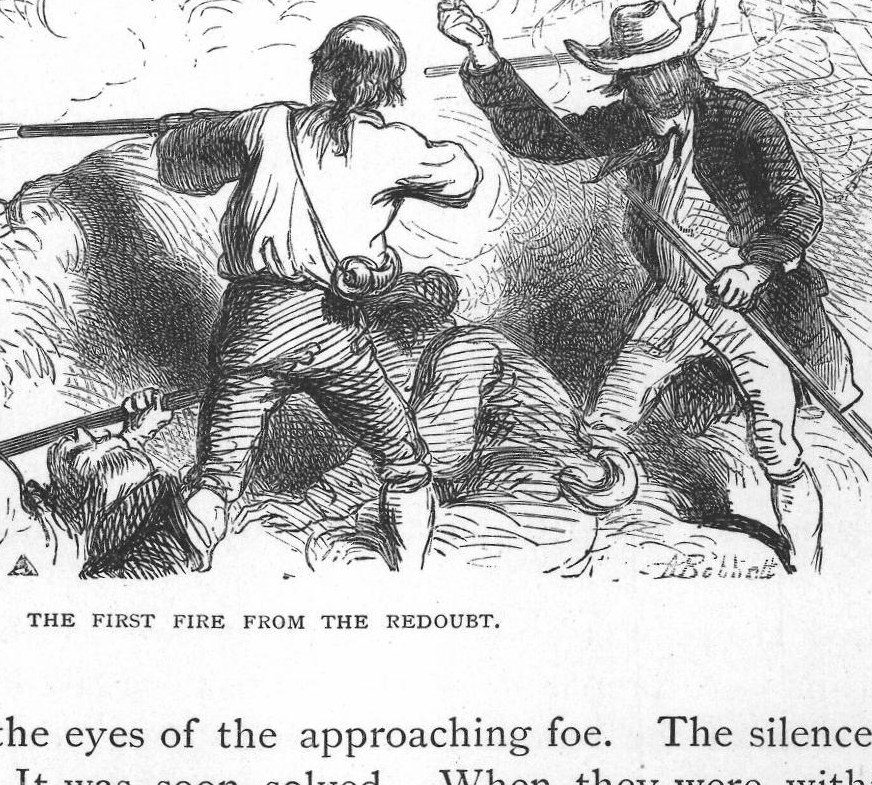
On the 16th of June, an order was issued for the regiments of Colonels Frye, Bridges and Prescott, Samuel Gridley's company of artillery,and a fatigue party of Connecticut troops, under Captain Thomas Knowlton, of Putnam's regiment, to parade in the camp at Cambridge at six o'clock in the evening, with intrenching tools. The whole were placed under the command of Colonel William Prescott of Pepperell, who received written order from General Ward to proceed to and fortify Bunker's Hill on the Charlestown peninsula. At nine o'clock in the evening, after a prayer by Dr. Langdon, President of Harvard College, a larger portion of these regiments, accompanied by General Putnam, marched over Charlestown Neck and along the road to Bunker's Hill. The whole force numbered about thirteen hundred men. They proceeded silently in the darkness. A council was held in the gloom, when it was decided that Breed's Hill, nearer Boston, would be the most effective point for a fortification. They accordingly proceeded to that eminence overlooking Charlestown on the edge of the water, and there, in the star-light, a thousand men began the work with pick and spade. The waning moon rose at midnight, and in its pale light they worked in such silence until dawn, that they were not discovered by the sentinels on the ships-of-war that lay in sight below them, and whose voices, crying out hourly "All's well!" they could distinctly hear. There lay the Lively, Glasgow, Somerset, and Cerberus, with floating batteries, in fancied security, while the toilers piled the earth so vigorously, that a redoubt rose six feet above the earth at daybreak on Saturday, the 17th of June. Then they were discovered by the sentinel on the Lively. The captain beheld the strange apparition with wonder and alarm, and without waiting for orders from the admiral, he put springs on his cable and opened a sharp fire on the unfinished work. Other vessels opened broadsides upon that seeming creation of magic, while the Americans within the redoubt, unhurt by the shots, worked steadily on.
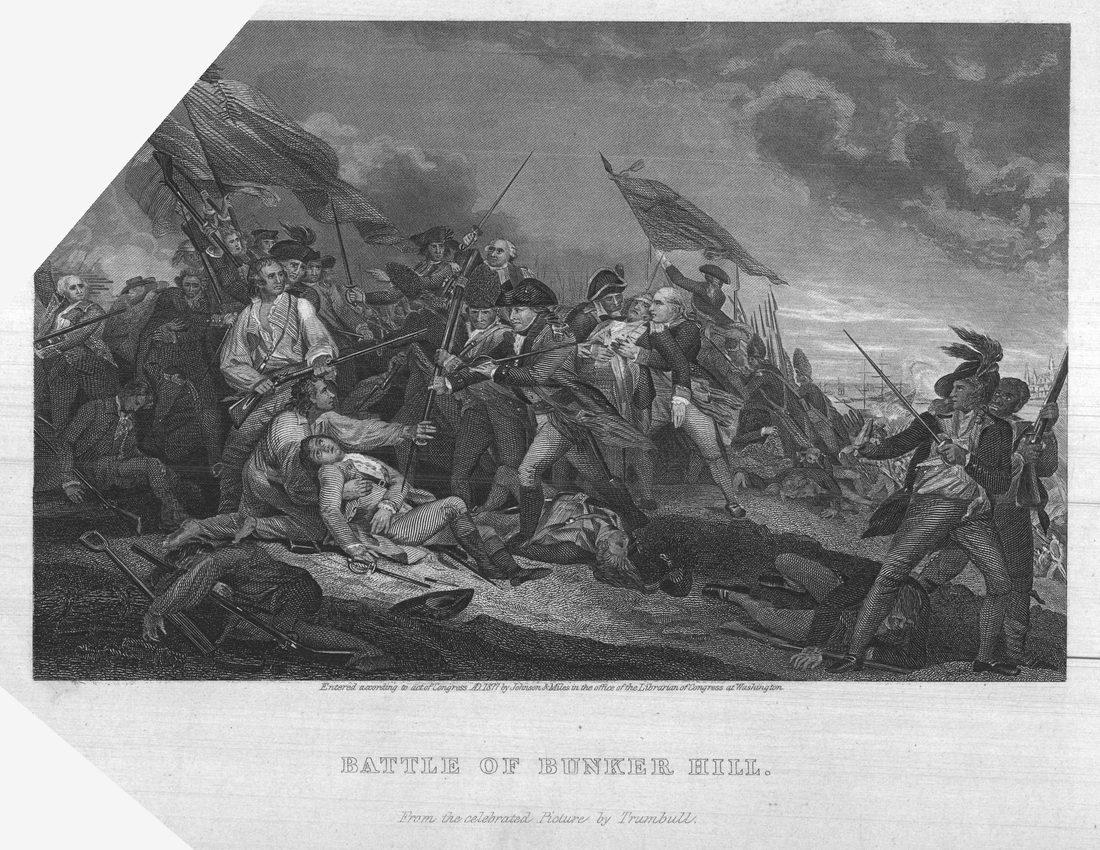
That cannonade at dawn on a beautiful summer morning, broke the slumber of the troops and citizens in Boston, and filled both with astonishment. Very soon roofs, balconies, and steeples were alive with gazers upon the strange scene. Gage summoned his principal officers to a council, when it was decided that the Americans must be dislodged, at all hazards. The newly-arrived generals proposed to land troops on Charlestown Neck, and taking the "rebels" in reverse, cut off their retreat and prevent their reinforce ment. Gage decided to attack them in front; and about twenty-five hundred troops, composed of infantry, grenadiers, and artillery, with twelve pieces of cannon, crossed the Charles River in boats, at a little past noon, under cover of a tremendous cannonade from the shipping and Copp's Hill, and landed toward the eastern extremity of the Charlestown peninsula, at the head of the present Chelsea Bridge. There Howe reconnoitred the American position, ordered his men to dine, and sent back to Boston for reinforcements. The men at the redoubt had toiled all the forenoon, completed their work, and at meridian exchanged the pick and spade for the accountrements of war. Almost twelve hours had they labored, with little rest and food. They had cast up a redoubt about eight rods square, and an embankment on its left extending about a hundred yards toward the Mystic River; also a similar line on the right. The troops, wearied with work and want of food and sleep, asked for relief, but their leader said "No;" you have cast up the redoubt, and you shall have the honor of defending it." They asked for reinforcements, which he at first declined calling for, supposing the British would not attack him. At length there were indications in the city that they were coming out, and Prescott sent to General Ward for reinforcements. That officer tardily complied with the request, and sent the New Hampshire regiments of Stark and Reed; also some small field pieces.Some other detachments joined Prescott, and Dr. Joseph Warren, who had just received a commission as major-general, arrived with the cheering news that other reinforcements were coming. Putnam was there, flying from point to point to make dispositions for securing a victory, and urging Ward, who was afraid of an attack upon Cambridge, to send on reinforcements.
When Howe was about to move at three o'clock in the afternoon, the Americans were prepared for the contest. Prescott, with Warren, and the constructors of the redoubt, were within that work, excepting the Connecticut troops, who, with the New Hampshire forces, were at a rail fence and breastworks on the west of the redoubt. The artillery companies were between the breastwork and a rail fence on the eastern side, and three companies were stationed in Charlestown at the foot of Breed's Hill.