Battle of Bunker's Hill
Just as the fight was about to begin, reinforcements came for Howe and landed at the present entrance to the Navy Yard. They consisted of a regiment, some companies of light infantry and grenadiers, and a marine battalion led by Major Pitcairn of Lexington fame. The entire British force now confronting the Americans on the peninsula numbered more than three thousand.
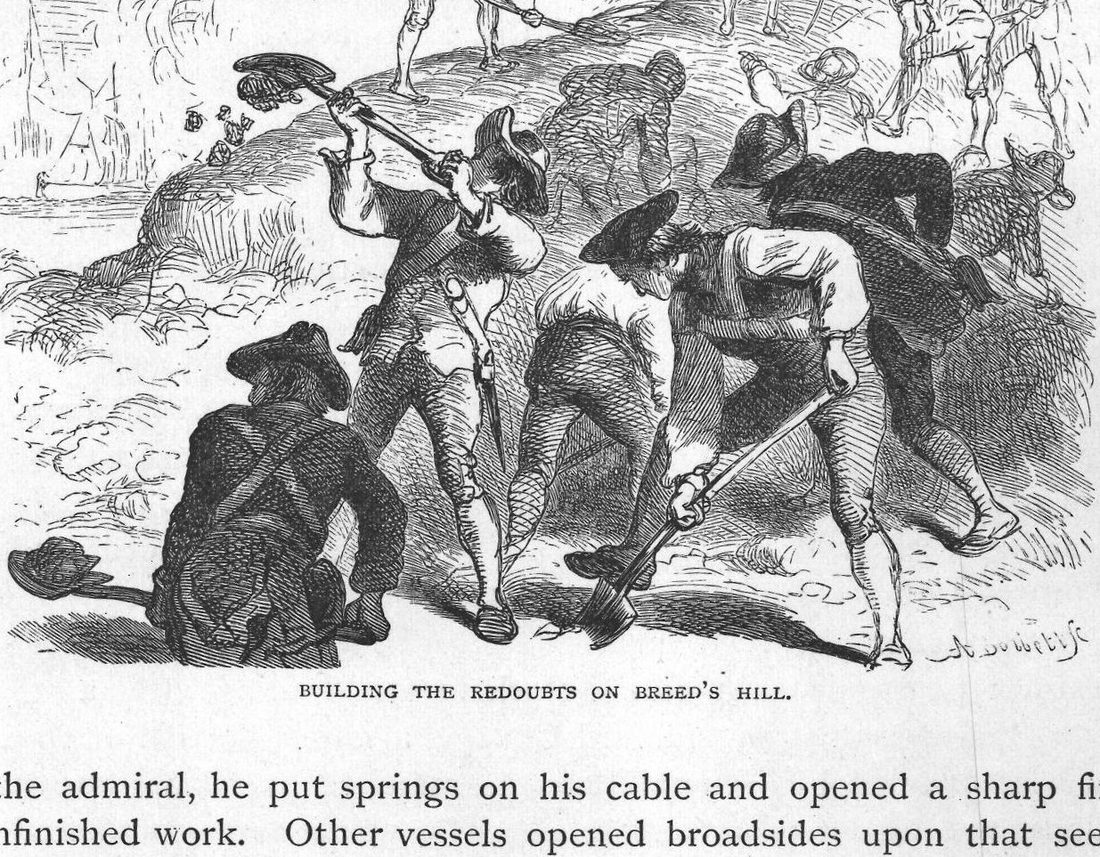
At half-past three o'clock, Howe's great guns moved toward the redoubt, and opened fire upon the works. They were followed by the troops in two columns, commanded respectively by Generals Howe and Pigot, the infantry and grenadiers assailing the outworks. At the same time the guns on the ships and the battery on Copp's Hill hurled random shot in abundance upon the little earthwork. In the midst of the roaring thunder, the Americans were silent in the redoubt, and mostly so along the lines of intrenchments and fences, for their leader had ordered them not to fire until they could see the whites of the eyes of the approaching foe. The silence was a riddle to the English. It was soon solved. When they were within the prescribed distance, up rose the concealed host, fifteen hundred strong, at the word Fire! and poured such a tremendous and destructive storm of bullets upon the climbers of the green slope, that whole platoons and even companies were prostrated as a scythe would have mown down the long grass through which they were wading. Flags fell to the ground like the tall lilies in a mown meadow, and the shattered army was horror-struck for a moment. The bugles sounded, and they fell back to the shore, when a shout of triumph went up from the crest of Breed's Hill. Howe soon rallied his men, and repeated the attack with a similar result.
The British were greatly annoyed by shots from houses in Charlestown, and, at the request of Howe, shells were thrown into it from Copp's Hill, and set the village on fire. Very soon almost two hundred wooden buildings--dwellings and churches--were in flames, and Breed's Hill was shrouded in black smoke for awhile, until a gentle breeze that suddenly sprang up blew it away. At the same time General Clinton, who, from Copp's Hill, had seen the second recoil of the British troops, hastened across the river, and at the head of some broken battalions shared in the perils and success of a third attack, for Howe had again rallied his troops, and was pressing toward the Americans. The British had been ordered to march at quick step, and use only their bayonets. These and the artillery soon drove the defenders of the breastworks into the redoubt. Again from that flaming centre went out dreadful volleys that shattered the head of the British column. The powder of the Americans was now almost exhausted. Their fire became more feeble. The British pushed up to and over the ramparts; and after a hand-to-hand struggle in the redoubt with bayonets and clubbed muskets, the Americans were driven out. They fled toward Charlestown Neck, where reinforcements had been arrested by a severe enfilading fire from the British vessels. The retreat of the main body was covered by the prolonged fighting of Stark, Reed, and Knowlton at the outworks, with some reinforcements. Warren was the last to leave the redoubt, and was hurrying toward Bunker's Hill, where Putnam was trying to rally the fugitives, and was shot dead by a bullet that pierced his brain. The British loss in this battle--killed, wounded, and prisoners--was ten hundred and fifty-four. Among the officers slain was Major Pitcairn. His pistols are now in the possession of descendants of General Putnam. The Americans lost in killed, wounded, and missing, four hundred and fifty.
This conflict, known as the Battle of Bunker's Hill, though fought on Breed's Hill, lasted almost two hours. It was gazed upon by anxious thousands who were on the neighboring hills and the roofs, and steeples in Boston, deeply interested spectators of a terrible scene in which dear kindred were engaged. When the redoubt was carried and the Americans retreated, the whole body of troops on the peninsula were compelled to run the gauntlet of cannon-balls from the British vessels, as they fled across Charlestown Neck. Many were slain there. The survivors encamped that night on Prospect Hill, and the British reposed on their arms on the field of battle until the next morning, when they passed over the water to Boston never again to appear on the main land of Massachusetts.