National Rule in the Southwest
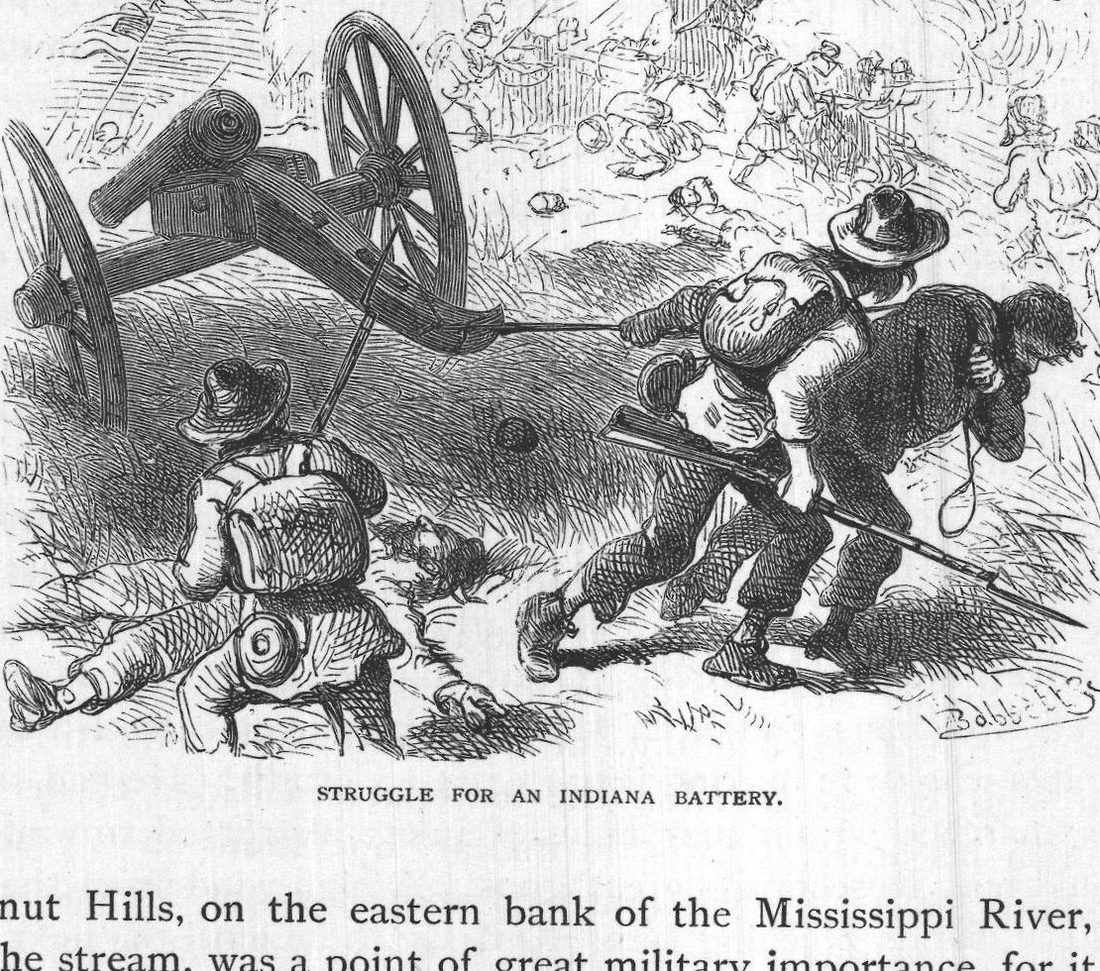
Rosecrans was at Tuscumbia when General Grant informed him that danger was gathering westward of him; and when he moved toward Corinth, Price advanced toward Iuka Springs, a summer watering-place in northern Mississippi, to meet him. Near the village of that name, Rosecrans and Price met on the 19th of September, and fought a most severe battle. The disparity in numbers was very great. Price had full eleven thousand men, while Rosecrans did not have more than three thousand men actually engaged in the struggle. During the battle, which was extremely fierce, there was desperate contest for the possession of an Indiana battery which the Confederates had seized after all the horses belonging to it, and seventy-two of its artillerymen, were killed. It was fought for hand-to-hand. Charges and counter-charges were made; until, at length, the Confederate soldiers dragged the cannon off the field, with ropes. But the Confederates were so badly beaten in the battle, that they fled southward in great haste and confusion. The National loss was nearly eight hundred; that of the Confederates over fourteen hundred. Meanwhile General Ord, whom Grant had sent to aid Rosecrans, had been watching the movements of a body of the Confederates who were making feints against Corinth. He had, according to orders, marched within four miles of Iuka; instructed to wait there until he should hear Rosecrans's great guns. A high wind from the north prevented their sounds reaching him. Ord lay there until the next morning, when he pushed on toward Iuka and found Rosecrans a victor and his foe departed. Then Ord retired to Bolivar, between Corinth and Memphis, while Rosecrans concentrated his troops at Corinth and prepared to meet an impending attack by the combined force of Van Dorn and Price. These, about forty thousand in number, were united at Ripley, and at the close of September they moved on Corinth. At that place the opposing armies battled fiercely on the 3d and 4th of October, when the result was the repulse of the Confederates, the pursuit of them to Ripley, and a loss on the part of the Nationals of more than twenty-three hundred men. The Confederates lost about nine thousand men, including prisoners. On their retreat a part of Van Dorn's troops fought the forces of Ord at the Hatchee River, where the latter was severely wounded. For awhile after this event there was comparative repose in General Grant's department.
The only obstructions to the free navigation of the Mississippi River, in the spring of 1862, were at Vicksburg and at Port Hudson below. Vicksburg, city of Mississippi, situated on a group of high eminences known as the Walnut Hills, on the eastern bank of the Mississippi River, at a bold turn in the stream, was a point of great military importance, for it had been fortified by the Confederates and was daily growing stronger. It promised to become impregnable for those who were opposing the grand scheme of the National Government for gaining the absolute control of that great stream, and thus securing important portions of the Confederacy. Toward the seizure of that point, operations in the southwest were soon tending. To remove these obstructions, Farragut, in command of National vessels, bent his energies. So early as the 7th of May (1862), Baton Rouge, the capital of Louisiana, had been captured by the National force by land and water, when Farragut went up the river to Vicksburg and there held communication with the commanders of gun-boats above. Finally, he attacked the batteries there (June 26); and he also attempted to cut a canal across a peninsula in front of Vicksburg, so as to avoid the Confederate guns at the city altogether; but he failed in his undertakings, and descended the river with his vessels. This movement was followed, early in August, by an attack upon Baton Rouge, by a Confederate force led by General J.C. Breckenridge. The post was then in command of General Thomas Williams. There was a desperate struggle for about two hours, in which the Twenty-first Indiana Regiment was conspicuous. It lost all of its field-officers before the end of the action. Seeing this, General Williams placed himself at its head, exclaiming, "Boys, your field-officers are all gone; I will lead you!" They gave him three hearty cheers, when a bullet passed through his breast and he fell dead. He had just issued orders for the line to fall back, which it did, in good order, with Colonel Cahill of the Ninth Connecticut in chief command. The Confederates, dreadfully smitten, also fell back, and then retreated.
The insurgents had constructed a formidable "ram," which they named Arkansas. With it they expected to sweep every National vessel from the Mississippi, and "drive the Yankees from New Orleans." It did not arrive at Baton Rouge in time to engage in the attack upon the National forces there; but on the morning after the battle, Commodore Porter, with the gun-boat Essex, accompanied by the Cayuga and Sumter, went up the river to meet her. They found her five miles above Baton Rouge. After a short and sharp fight, she became unmanageable, and was headed toward the river bank and set on fire. Just as she touched the shore her magazine exploded, and the monster was blown into fragments.