Mineral Wealth
On the same acreage of unimproved farm lands there were, in 1870, not less than 7,200,000 horses; 1,125,000 mules; 9,000,000 cows; 1,320,000 working oxen; 13,570,000 other cattle; 29,000,000 sheep, and more than 25,000,000 swine. These animals are now far superior in every way to those on the farms a hundred years ago. In 1768, Washington recorded in his diary, that with one hundred and one cows on his Mount Vernon estate, he was compelled to buy butter for his family. Now, the dairy products of our cows, annually, are 514,000,000 pounds of butter; 54,000,000 pounds of cheese, and 236,000,000 gallons of milk, not used in the manufacture of butter and cheese. This gives more than twelve pounds of butter (besides cheese and milk) to every man, woman and child in the land. In 1790, when the first census was taken and the population was about 4,000,000, the value of the agricultural products of our country was about $150,000,000; in 1870, the value including crops, live-stock, "betterments," forest, garden and orchard products, was estimated at almost $3,000,000,000.
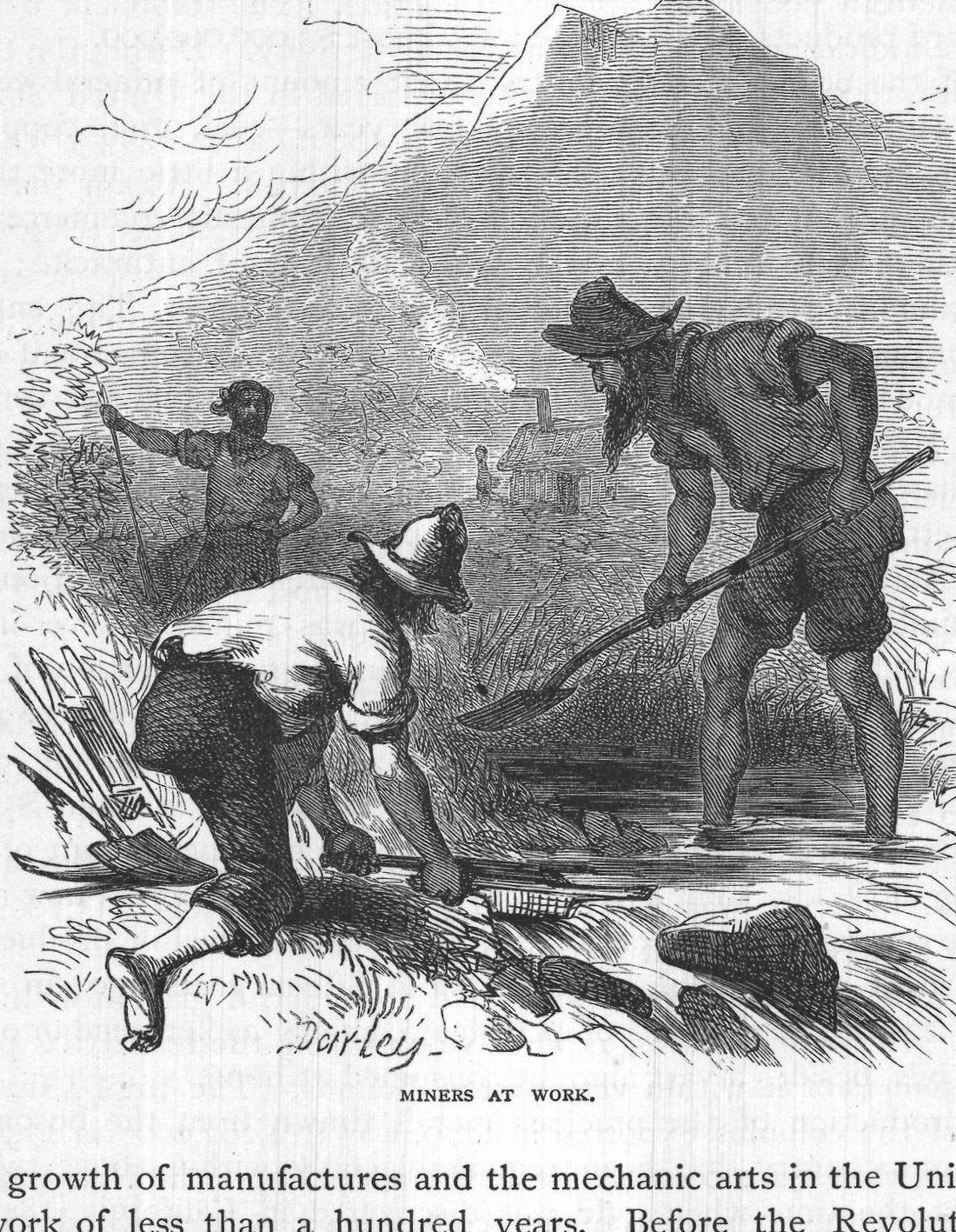
Out of the bosom of our country a vast amount of mineral wealth has been drawn within a comparatively few years--coal, iron, copper, lead, petroleum and the precious metals. Only within a little more than fifty years, mineral coal has become an article of domestic commerce with us. In 1820, there were sent to market only 365 tons of anthracite; now the average annual production is about 25,000,000 tons. The entire coal product of our country annually, is over 50,000,000 tons, one-half of which is bituminous. Pennsylvania alone produces seventy-two per cent of the amount.
Iron has been known to exist in abundance, in our country, ever since the first settlements; but the restrictive commercial policy of Great Britain caused it to be left almost untouched until after the Revolution. Then, with manufactures freed from restraint, it was mined in ever-increasing quantities, until now the product is enormous, a greater portion of which is used in the manufactures of our own country. Copper is not very abundant in the United States. In 1870, there were forty copper-mining establishments here, and the value of their annual product was about $5,200,000. Our lead mines seem to be decreasing in their yield, the amount of production being now less than 20,000 tons a year. Petroleum, a new article of commerce among our mineral wealth, has been a marvel of production. It was first made a marketable product about fifteen years ago; in 1875, we exported 220,000,000 gallons of petroleum, chiefly as kerosene or other illuminating oils, besides a vast amount consumed at home.
The production of the precious metals drawn from the bosom of the earth in our country, has been remarkable only within about twenty-five years. At the time when gold was discovered in California (1848) only a small amount of that metal had found its way to our Mint, and that chiefly from the Southern States. The value of the total amount of that metal mined in those States, from the time of its first discovery until 1873, was only $20,500,000. From 1848 to 1873, the total value of the gold product of our country, was $1,241,000,000. Very little silver had been found here until after gold had been discovered in California. Our country was not known as a silver-producing region; but the gold miners of California, who became numerous and ambitious when "prospecting," discovered rich deposits of silver. Now the United States contains the greatest silver-producing regions on the globe, the average annual yield being not less in value than $100,000,000, and is continually increasing.