Military Movements in Northern New York
After many perils on land and water, and being closely pursued by the enemy in boats and on the shore, under the general command of Lieutenant-Colonel Morrison, the flotilla lay anchored a few miles above the head of Long Rapids, on the 10th of November. Many of the troops under Generals Boyd and Brown were on the northern shores of the St. Lawrence, and Brown had pushed forward to dislodge the enemy posted at the foot of the Long Rapids to attack the flotilla when it should descend the stream. Brown was successful, and the next day (November 11, 1813) General Boyd pushed forward and met the enemy face to face, in battle array, on the farm of John Chrysler, a few miles below Williamsburg, in Canada. There a severe battie was fought in cold, snow and sleet, which lasted about five hours. Boyd was ably supported by Generals Swartwout and Covington, Colonels Coles, Ripley and Swift, and Adjutant-General Walbadh at the head of cavalry. The Americans were driven from the field with a total loss in killed and wounded of three hundred and thirty-nine. Among the mortally wounded was General Covington. Under cover of the night, the American troops withdrew to the boats, and the next morning the fotilla passed the Long Rapids in safety. General Wilkinson was very ill, and word came from General Hampton that he could not form the ordered junction, but would return to Lake Champlain and co-operate in the attack on Montreal. He would not serve under Wilkinson. The officers of the little invading army did not deem it prudent to follow Wilkinson (who was then weak in body and mind) any further in the way of invasion, and a council determined that the troops should be put into winter-quarters at French Mills, on the Salmon River, which was done. So ended in disaster and disgrace the expedition for another invasion of Canada. And the campaign of 1813, in the north, closed with distressing events on the Niagara frontier in December. General McClure, considering Fort George untenable with his little garrson of only forty effective men, resolved to abandon it, cross the river, and leaving Fort Niagara in charge of a subaltern, march to Buffalo. Before leaving, he ordered the beautiful village of Newark, on the Canada side, to be set on fire. One hundred and fifty houses were laid in ashes. Many of the tenants--tender women and children--were turned into the keen winter air (it was the 10th of December) houseless wanderers. This wanton savageism created fiery indignation. The British seized Fort Niagara, and massacred a part of the garrison. Free rein was given to the Indians for plunder and destruction; and every village and hamlet on the New York side of the river between the lake and Buffalo, was despoiled and burnt. Black Rock and Buffalo did not escape. The exasperated enemy took possession of the latter village, containing about fifteen hundred inhabitants, and laid it in ruins. Only four buildings were left. That event occurred a little more than sixty years ago; now, on the site of that village, is a stately commercial city with full 125,000 inhabitants.
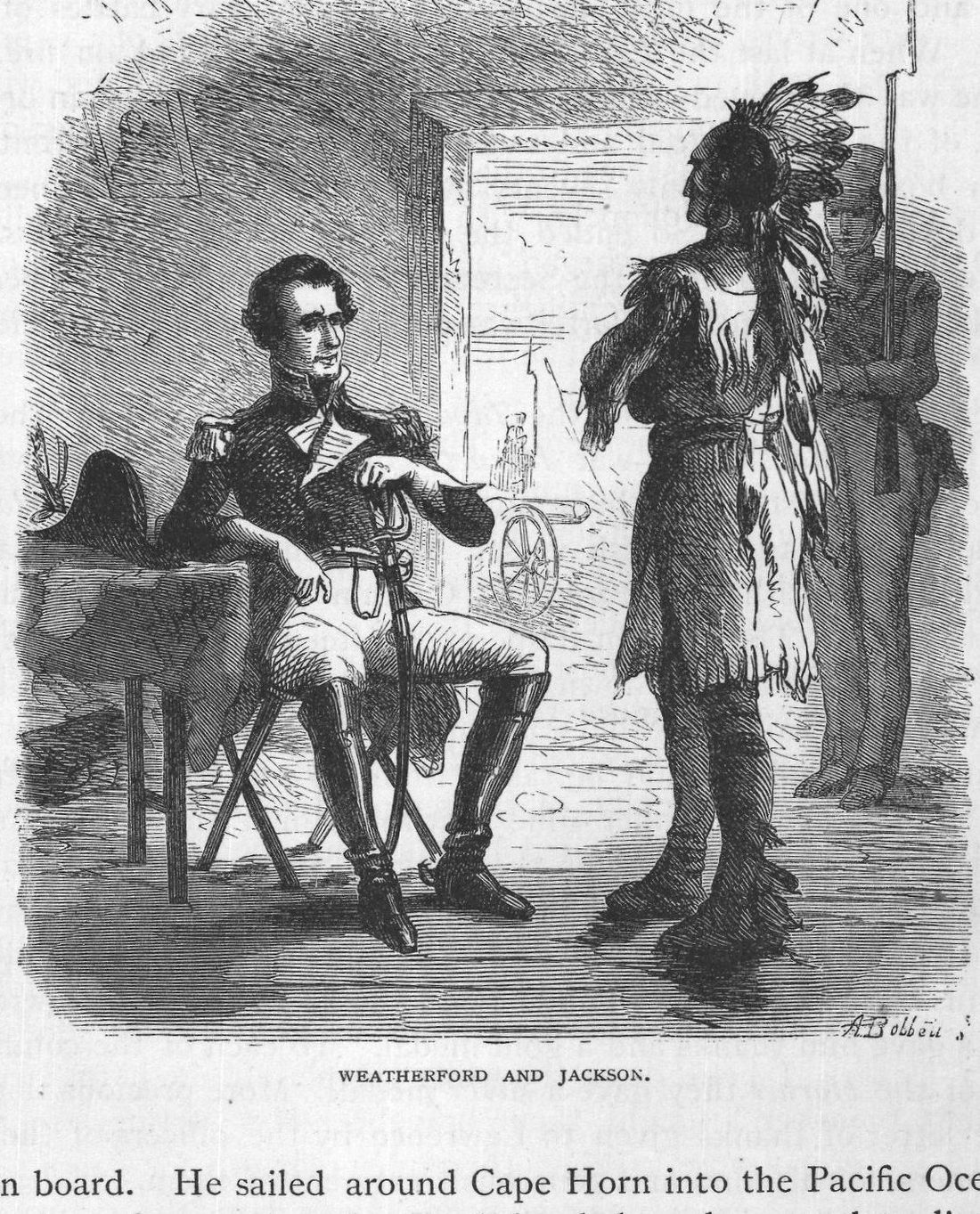
In the region of the Gulf of Mexico, affairs assumed a serious aspect in the summer of 1813. The ever-restless Tecumtha had been among the southern Indian tribes in the early spring, stirring them up to make war on the white people. The powerful Creeks, inhabiting Alabama and western Georgia, yielded to his influence and persuasions; and at the close of August, a large party of them, led by the noted chief Weatherford, surprised and captured Fort Mimms, on the east side of the Alabama River, about ten miles above its junction with the Tombigbee. Flaming arrows set the fort on fire, and by the flames and the gleaming tomahawk, almost three hundred men, women, and children perished. The British agent at Pensacola had offered five dollars apiece for scalps, and many a savage pagan bore away the locks of men and the long tresses of women as marketable commodities in a Christian market.
This event aroused the whole southwest. A cry for help went northward, but it took a month to reach New York. Meanwhile the Tennesseeans flew to the relief of their suffering neighbors. General Andrew Jackson commanding that region, was then disabled by a wound received in a duel with the late Senator. Thomas H. Benton; but he issued a stirring appeal to the men of his division. The Tennessee legislature provided for calling to the field over three thousand men, and immediate preparations were made for chastising the savages. Late in September Colonel John Coffee, at the head of five hundred cavalry, pressed on toward the frontier of Creek country, and everywhere volunteers flocked to his standard. The appointed place of rendezvous for all the troops was at Fayetteville, eighty miles south of Nashville, and at that point Jackson arrived early in October, with his arm in a sling. He soon joined Coffee below the Tennessee, and with twenty-five hundred foot soldiers and thirteen hundred mounted men, he was encamped on the banks of the Coosa River at the beginning of November.