Events on the Niagara Frontier: Tallapoosa and East Tennesseeans
The campaign against the savages was opened with vigor. On the 3d of November, Coffee (who had lately been commissioned brigadier-general) surrounded an Indian force, with nine hundred men, at Tallashatchee (near the present town of Jacksonville, in Benton county, Alabama), and killed two hundred of the savages. Not a warrior escaped. Tallashatchee was wiped from the face of the earth. Hearing of the approach of General Cocke with East Tennesseeans, Jackson pushed on to Talladega, east of the Coosa in Talladega county, to relieve the settler there. On the 8th of November he had a sanguinary battle with the Indians at Talladega, and defeated them with great slaughter. Among the trophies which he carried back to his camp on the Coosa, was a coarse banner on which were the Spanish arms, an evidence of the complicity of the Spaniards at Pensacola with the savages.
Late in November the Creek country was invaded from the east by Georgians under General John Floyd, nine hundred strong, accompanied by four hundred friendly Indians. Floyd pushed westward to the Tallapoosa River, and fell upon the Indians at Autossee, twenty miles above the confluence of that stream with the Coosa, at dawn on the 29th. The place was called "holy ground," and the prophets had taught the Indians that no white man could set his foot there and live. This fallacy was soon fearfully dispelled by Floyd and his followers. He assailed the warriors there with cannon, bullet, and bayonet. After a brief struggle the affrighted savages fled to the wooods, closely pursued by the victors, who cruelly butchered every one they overtook.
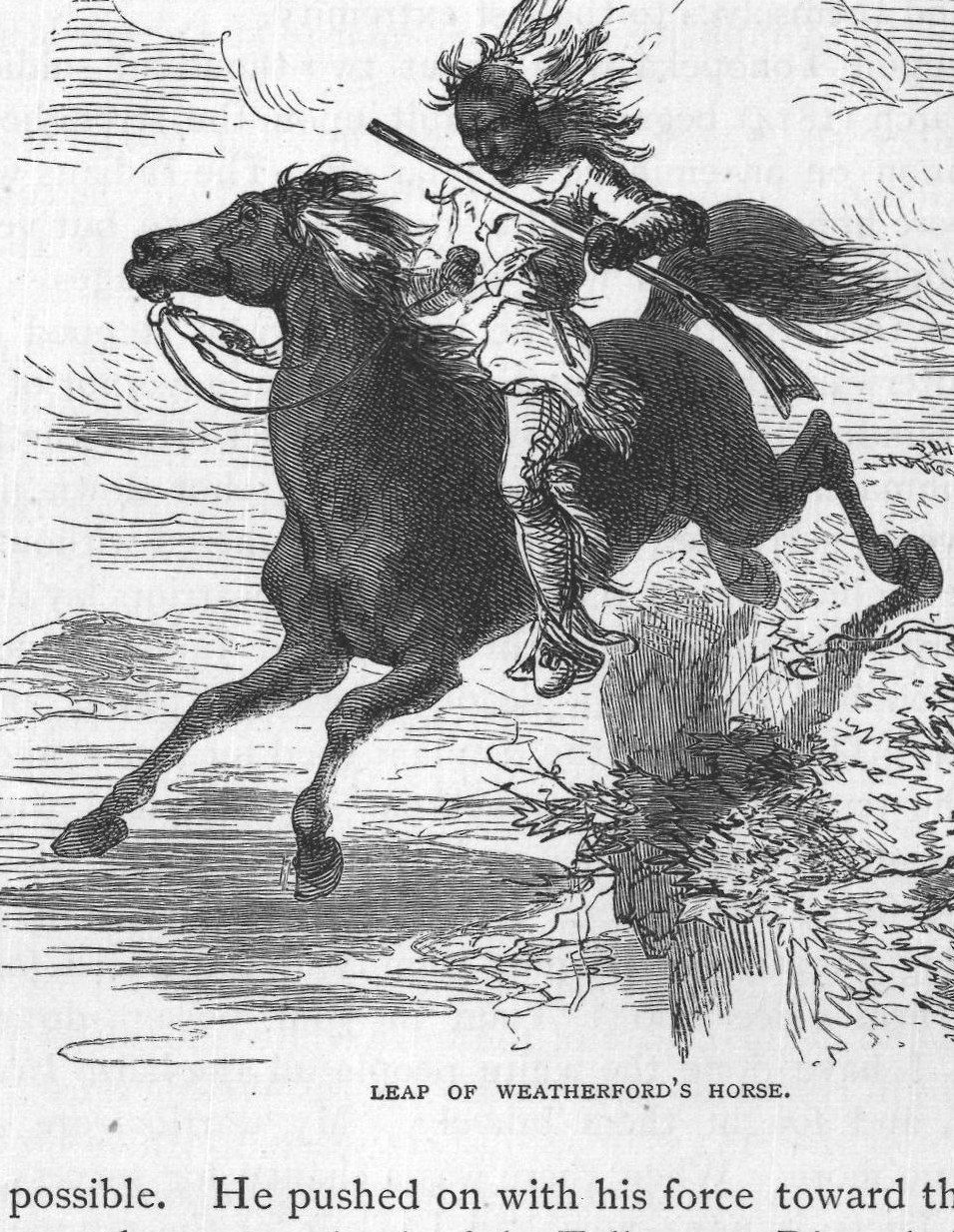
In the meantime, General Claiborne had penetrated the Creek country from the west with a thousand men, to aid Jackson in subduing the savages. He fought the Indians who were under the immediate command of Weather-ford, and on the morning of the 23d of November, he assailed them at Econachaca, another "holy" place at a bluff on the left bank of the Alabama River, in Lowndes county. There Tecumtha had left "prophets" to inflame the Creeks, and in the centre of the town white and dusky prisoners had been frightfully tortured at the stake. It was Weatherford's favorite resort, for he had built the village in an obscure place, to which no trail led. But Claiborne found it. Very soon after he closed upon it with three columns, the Indians fled in dismay, and in canoes and by swimming many escaped to the opposite shore. Weatherford, finding himself deserted by his warriors, fled swiftly on a powerful gray horse hotly pursued, to the verge of a perpendicular bluff, having a ravine on each side. There he paused a moment, when his steed made a mighty leap, and horse and rider disappeared under the flood. They immediately rose, and Weatherford, with his rifle in his hand, was borne by the noble animal to the opposite shore, and escaped.
Jackson's army was literally disbanded at the close of 1813, but he was soon at the head of a thousand raw recruits and some friendly Indians, attended by General Coffee. His forced inactivity for awhile had encouraged the Indians to be aggressive, and he resolved to renew the war with as much vigor as possible. He pushed on with his force toward the Indian village of Emucfau, on the western bank of the Tallapoosa River, in Tallapoosa county, and encamped near there on the evening of the 21st of January, 1814. At daybreak the next morning he was fiercely attacked by the savages, and a very hard struggle ensured. The courage of the Creeks was astonishing, and though they were repulsed, jackson thought it prudent to withdraw and return to Fort Strother, from which he had marched.
During the winter there was skirmishing in the Creek country; and early in February, Jackson was gratified by news that two thousand East Tennesseeans were near Lookout Mountain, coming to join him. The Choctaw Indians openly espoused the cause of the Americans, and at the beginning of March, he was at the head of about five thousand men, prepared to strike the savages a crushing blow. The Creeks, aware of this, gathered in large numbers at the Horse-shoe Bend of the Tallapoosa, to avert it. They called the place Tohopeka, and by the aid of white men at Pensacola, they had built a very strong breastwork of logs across the neck of the peninsula. The Indians had gathered there an ample supply of food, and with their women and children, numbering in all about twelve hundred persons, they determined to defend themselves to the last extremity.