Marauding Warfare
DURING the spring and summer of 1813, a most distressing warfare was carried on by a small British squadron and some soldiers, under the command of Admiral Cockburn, upon the coast between Delaware Bay and Charleston Harbor. The chief object of the marauding movements appears to have been to draw American troops from the northern frontier to the defence of the seaboard, and thus lessen the danger from invasion by which Canada was continually threatened. It was a sort of amphibious warfare, carried on upon land or water as circumstances seemed to require, and it was marked by many acts of wanton cruelty and barbarity on the part of the aggressors. "Chastise the Americans into submission" was the fiat that went out from the British Cabinet toward the close of 1812, and it was determined to send out a land and naval force sufficient to do it. An order in council in December declared the ports and harbors of the Chesapeake and Delaware bays in a state of blockade. The first hostile squadron entered the capes of Virginia early in February, 1813, commanded by Sir George Cockburn, whose flag-ship was the Marlborough, 74. His vessels bore a land force of about eighteen hundred men, a part of them captive Frenchmen from English prisons, who preferred active life in the British service to indefinite confinement in jails. The appearance of this force alarmed all lower Virginia, and the militia of the peninsula and the region about Norfolk were soon in motion after the squadron had anchored in Hampton Roads. An order went out from the Secretary of the Treasury for the extinguishment of all the beacon-lights on the Chesapeake coast, and at Old Point Comfort a host of armed men defied the invaders. At the same time the frigate Constellation, 38, lying near Norfolk, was making ready to attack the British vessels, when the latter withdrew and engaged in the destruction of merchant-vessels in Chesapeake Bay.
A part of the squadron went into Delaware Bay to demand the submission of the inhabitants along its shores. When the commander sent a note to the "first magistrate" of the little town of Lewis, demanding bullocks, provender and vegetables, and threatening the destruction of the town in case of refusal, he was astonished by the answer, "We solemnly refuse to commit legal or moral treason; do your worst." The inhabitants had prepared for the invaders, and the latter found prudence to be the "better part of valor." All along the Delaware coast the militia, forewarned, were out with experienced leaders. Newcastle and Wilmington were alive with enthusiasm. At the latter place the venerable Allen McLane, of the Continental Army, took the direction of military affairs; and for some weeks the thunders of the British squadron were held back. Finally, early in April, cannon of the enemy opened on Lewis, and hurled full eight hundred shot and shell upon the town, without doing much damage. The invaders were repulsed by the militia.
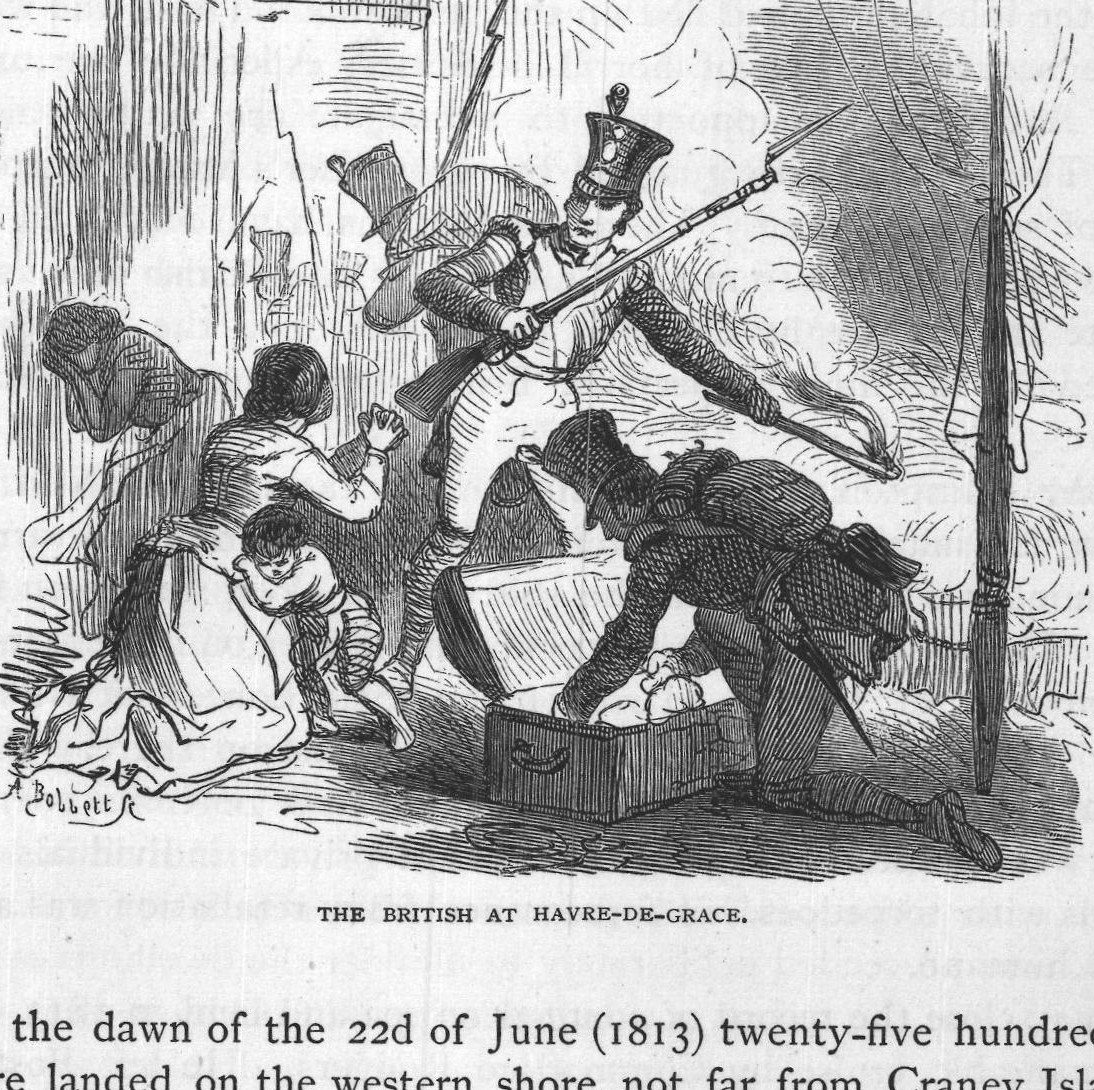
Meanwhile Cockburn, who had been plundering and distressing the inhabitants along the coasts of the Chesapeake Bay, concluted to undertake more ambitious adventures. He thought of attacking Annapolis, Baltimore, and even the national capital; but the experience of the squadron in the Delaware caused him to listen to the warnings of prudence, and he only made warfare upon the little villages of Frenchtown, Georgetown, Frederick and Havre-de-Grace, on the banks of the Chesapeake, which he plundered and burned. At the latter place, situated at the mouth of the Susquehanna River, he opened a cannonade in the night, at the beginning of May, while the inhabitants were slumbering, and with his shot and shell he sent blazing Congreve rockets that set buildings on fire. Then he sent four hundred men on shore, who proceeded deliberately to plunder the dwellings and lay them in ashes. When the village was half destroyed, Cockburn went ashore himself and was met by a deputation of ladies, who had taken refuge in a large brick house some distance from the town. They entreated him to spare the remainder of the village, and he reluctantly consented to do so. When the marauders left Havre-de-Grace, the town was at least sixty thousand dollars poorer than when they came.
On the first day of June (1813), Admiral Warren entered the Chesapeake with a naval reinforcement for the marauders, bearing a large number of troops under General Sir Sidney Beckwith. The British naval force then within the capes of Virginia consisted of eight ships-of-the-line, twelve frigates, and a considerable number of smaller vessels. Their proposed first point of attack was Norfolk, then defended by the frigate Constellation, twenty gun-boats and four forts, besides an outpost of strong fortifications on Craney Island, a few miles below Norfolk. The militia of that region were in the field or in garrison, under the chief command of General Robert B. Taylor; and the troops on Craney Island were led by Lieutenant Colonel Beattey. The artillery were under the charge of Major James Faulkner. The armed vessels were placed in a curved line from Craney Island to the eastern shore.