Cruise of Commodore Rodgers
Before the dawn of the 22d of June (1813) twenty-five hundred British troops were landed on the western shore, not far from Craney Island, and, in the early morning, they crept stealthily through the underbrush of the woods, to attack the Americans. At the same time fifty large barges filled with fifteen hundred sailors and marines, were seen approaching from the ships of the enemy. They were led by Admiral Warren's beautiful barge, and made for the narrow strait between Craney Island and the main. Faulkner had his artillery well in hand, and when the enemy were within proper distance, the great guns opened a terrible storm upon them. The invaders were repulsed, and retreated in haste to their ships. Warren's barge, which had a small swivel-gun at the bow, with four others, was sunk in the shallow water, when some American seamen waded out, seized the elegant little vessel and dragged it ashore, taking with them several men as prisoners. The British now abandoned all hope of seizing Norfolk, the Constellation and the navy-yard, and never attempted it afterward.
Exasperated by this repulse, the enemy fell upon the village of Hampton with fury. Early on the morning of the 25th of June, twenty-five hundred soldiers, including the French captives, landed near the village. Major Crutchfield, with a small force, fought the invaders gallantly, until the pressure of a superior number compelled him to retreat, when the British entered the village and Admiral Cockburn gave it up to pillage and rapine. Many of the inhabitants had fied up the peninsula. Those who were unable, to escape became victims of horrid atrocities, especially the unprotected women. A commission appointed to investigate the matter said, in their report, "The sex, hitherto guarded by the soldier's honor, escaped not the assaults of superior force." These transactions have consigned the name of Sir George Cockburn to merited dishonor. The British officers who tried to palliate the offence by charging the crimes upon the Frenchmen, were denounced by the most respectable British writers as responsible for the shame.
Leaving Hampton, Cockburn sailed down the coast of North Carolina, plundering the inhabitants wherever opportunity offered, and carrying away a large number of slaves whom he sold in the West Indies on his private account. In pleasing contrast to Cockburn's career on our coasts, was that of Commodore Sir Thomas Hardy on the ocean borders of New England, while he was in command of a blockading squadron there. His conduct was always that of a high-minded gentleman and generous enemy. Even when he was exasperated by the attempts of private individuals to blow up his vessels with torpedoes, his forbearance from retaliation was as generous as it was humane.
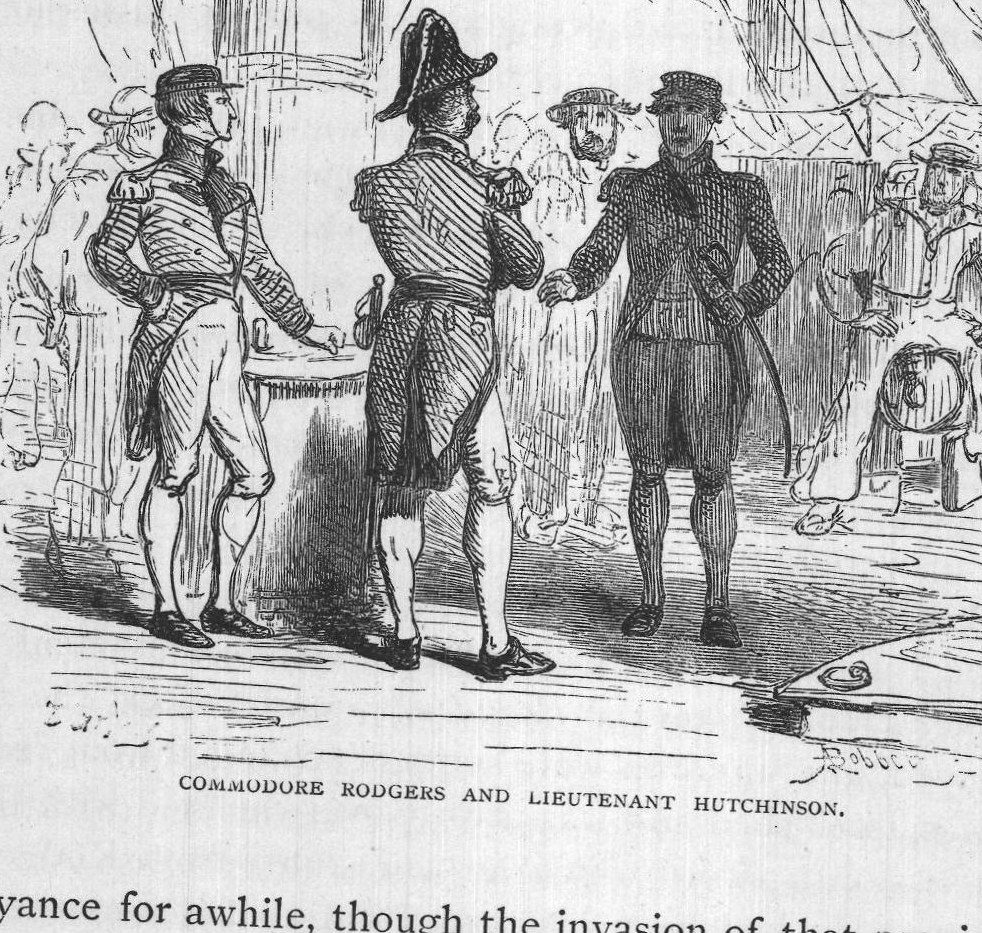
We may close the record of contests on sea and land in 1813, by a notice of a remarkable cruise by Commodore Rodgers. He left Boston late in April, in the President, 44, accompanied by the Congress, 38, and sailed to the northeast in search of British vessels. For weeks he was singularly unsuccessful, not meeting with a vessel of any kind. At length his presence in British waters became known, and produced much excitement among the English shipping. Many cruisers were sent out to capture or destroy the President (which had parted company with the Congress toward the Azores); and finally, on the 23d of September, Rodgers fell in with the British armed schooner Highflyer, the tender to Admiral Warren's flag-ship San Domingo, a stanch vessel and fast sailer and commanded by Lieutenant Hutchinson, one of Cockburn's subalterns when he plundered and burned Havre-de-Grace, the home of Rodgers. By stratagem the latter decoyed the Highflyer alongside the President, and captured her without firing a gun. He had obtained some British signal-books before leaving Boston, and he had caused some signals to be made on his ship. When he came in sight of the enemy he raised a British ensign, which was responded to, and a signal was also displayed from the mast-head of the Highflyer. Rodgers was delighted to find he possessed its complement, when he signalled that his vessel was the Sea-Horse, one of the largest of the British vessels of its class in American waters. The Highflyer bore down, hove to under the stern of the President and received one of Rodgers' lieutenants on board, who was dressed in the British naval uniform. He bore an order from Rodgers for Hutchinson to send his signal-books on board the Sea-Horse to be altered, as the Yankees, it was alleged (and truly), had obtained possession of some of them. Hutchinson obeyed, and Rodgers was put in possession of the whole correspondence of the British navy.