Invasion of Louisiana Contemplated
Real danger was imminent. The British troops that left Chesapeake Bay after their repulse at Baltimore had gone to the West Indies, where they were joined by about four thousand veterans under the brave Irish general Keane. The combined forces sailed in the direction of New Orleans late in November. The wives of many of the officers accompanied them, for not a man doubted that the speedy conquest of Louisiana would be the result of the expedition. The dullness of the voyage was enlivened by music and dancing, and all anticipated exquisite pleasures to be found in the paradise before them. The presence of Jackson allayed the fears of the people, and his vigorous measures inspired them with confidence. He established martial-law, and had so rigorously exercised it that before the British were ready for the invasion, he felt confident of success in defending the city against great odds.
The British forces halted at the entrance to Lake Borgne, between which and the Mississippi River New Orleans stands. On the bosom of that lake the Americans had a patrol of five gun-boats, commanded by Lieutenant (afterward Commodore) T. Ap Catesby Jones. Against these were sent twelve hundred men in about forty boats, who captured the American flotilla on the 14th of December, and so secured complete command of the lake. Meanwhile Jackson was carrying on his measures for defence most vigorously; and when he heard of the capture of the flotilla, he sent couriers to General Coffee and others at the head of Tennessee and Kentucky troops, urging them to hasten to New Orleans. His efforts were timely, for on the 22d of December, General Keane, with more than two thousand five hundred men, reached the banks of the Mississippi through a bayou nine miles below the city, and prepared to take New Orleans by surprise. Vigilant eyes were watching his movements; and a prisoner whom he had taken and who had escaped, hastened to New Orleans and gave General Jackson notice of the near approach of the foe. At the same time Coffee and Carroll arrived with Tennesseeans, and Jackson put a column in motion to meet the invaders. Early on the evening of the 23d they marched, eighteen hundred strong, led by Jackson in person, and at the same time the armed schooner Carolina dropped down the river to within musket range of the British camp. Shots from that vessel first revealed the fact to the British that their presence was known at New Orleans, and these missiles soon broke up their camp, when they were attacked in the dark by Jackson and his followers. The combat that ensued was indecisive, except in making the invaders more cautious and discreet. In this night-conflict the Americans lost about two hundred men, and the British lost four hundred.
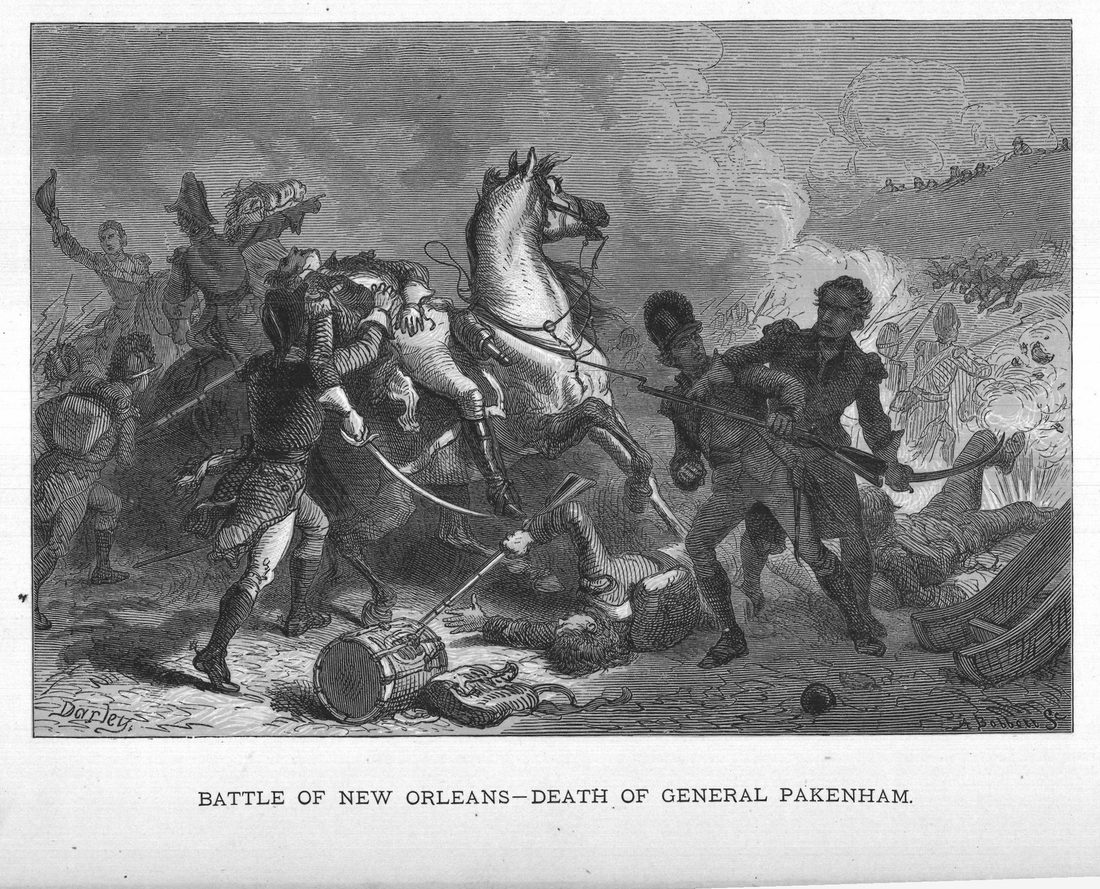
New Orleans was saved from capture by surprise; now it had to be saved from open invasion. The events of the 23d dispirited the British, and in this condition General Pakenham found the troops on his arrival on Christmas day, with reinforcements, to take the chief command. He was a veteran fresh from the Spanish peninsula, and was delighted to find under his control some of the best of Wellington's regiments. He immediately prepared to effect the capture of New Orleans and the subjugation of Louisiana without delay. With hot-shot the annoying Carolina was burned, and the Louisiana was the only American naval force left in the river. Meanwhile Jackson had been casting up a line of intrenchments from the banks of the Mississippi to an almost impregnable swamp in the rear, four miles below New Orleans. Near this line indecisive engagements occurred. Finally a battle was fought which, without the negotiations for peace that resulted in a treaty, would have ended the war.