Invasion of Kentucky
The war had now been going on for almost two years. It had been begun by the politicians of the slave-labor States for the purpose of perpetuating the slave-system, which gave to the Confederate cause the chief sinews of its strength. It nurtured a producing class that fed, by its labor, the armies arrayed against the life of the Republic; and only a very small proportion of that class were drawn from the pursuits of agriculture to the camps. Perceiving this, the President of the United States and the loyal people resolved to destroy the system by some method of abolition. The kind-hearted Lincoln proposed to give pecuniary aid to any State government which might provide for the abolition of slavery; but the interested friends of that system everywhere refused to listen. Congress proceeded to abolish slavery in the District of Columbia, over which that body had direct control; and, finally, they gave the President discretionary powers to declare the emancipation of the slaves in States wherein insurrection existed. Finally, late in September (1862), President Lincoln issued a proclamation, in which he gave public notice that it was his purpose to declare such emancipation on the first of January, 1863, to take effect immediately wherever a state of insurrection might then exist, unless the offenders should lay down their arms.
This friendly warning--this forbearance to strike the blow that was to remove the manacles from millions of bondsmen--was treated by the masters of the slaves with scorn. It was sneered at by them, as an act of sheer impuissance. It was compared to "the Pope's Bull against the comet;" and because of this menace, resistance to the Government was more rampant than ever. It was evident that the warning would be ineffectual. The President prepared a proclamation of emancipation. It was submitted to his cabinet and approved; and on the first of January, 1863, it was promulgated with the whole force of the Republic--its army, its navy, and its judiciary; its Executive and Legislative powers--back of it to enforce its provisions. The moral force of that proclamation was tremendous. By that act the shackles were taken from the personal freedom of over three million slaves. From the hour of the promulgation of the proclamation of emancipation, the power of the enemies of the Government began to wane, and the star of their own future prosperity arose with beams of promise.
Early in 1862, the Confederate government was changed from a "provisional" to a "permanent one." The "provisional congress," made up of delegates chosen by conventions of politicians and legislatures of States, had been in continuous session from the 18th of November, 1861, until the 18th of February, 1862, when its term expired by limitation. On the same day a congress, professedly elected by the people, commenced its session under the "permanent constitution of the Confederate States." I say "professedly elected by the people." The following was the method pursued in Virginia, as presented in an editorial article in a leading Richmond journal, in carrying on a popular election:
"It being necessary to from a ticket of electors, and the time being too short to call a convention of the people, it was suggested that the Richmond editors should prepare a ticket, thus relieving the people of the trouble of making selections. The ticket thus formed has been presented." Here several of the nominees were named. "Every district in the State," said the journal, "is embraced in this editorial report."
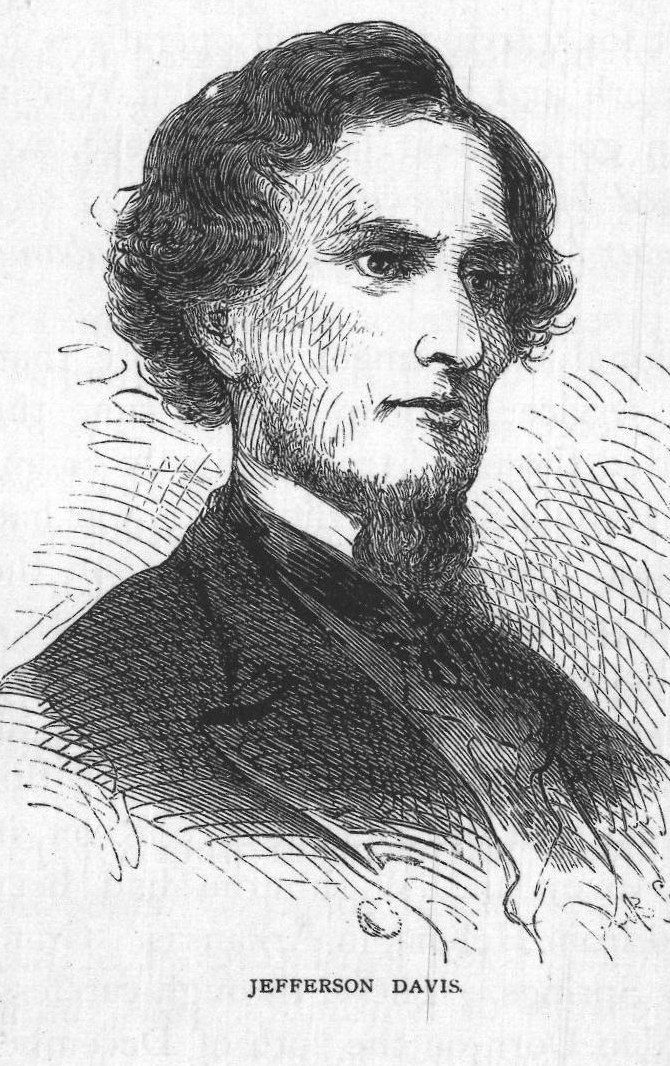
In the permanent Confederate congress, all of the slave-labor States were represented, excepting Maryland and Delaware. The oath to support the constitution of the Confederate States was administered to the senators by R. M. T. Hunter of Virginia, and to the representatives, by Howell Cobb of Georgia. Thomas Bocock, of Virginia, was elected Speaker of the House. On the following day (February 19) the votes for president of the Confederacy were counted, and were found to be one hundred and nine in number, all of which were cast for Jefferson Davis. Three days afterward Davis was inaugurated president for six years. He chose for his cabinet Judah P. Benjamin of Louisiana, secretary of state; George W. Randolph of Virginia, secretary of war; S. R. Mallory of Florida, secretary of the navy; Charles G. Memminger of South Carolina, secretary of the treasury, and Thomas H. Watts of Alabama, attorney-general. Randolph resigned, and James A. Seddon, a wealthy citizen of Richmond, who was conspicuous in the famous "Peace Convention" at Washington, was chosen to fill his place.
Measures were adopted by the Confederate Congress to prosecute the war against the Union with vigor. It was declared, by joint resolution, that it was the unalterable determination of the people of the Confederate States "to suffer all the calamities of the most protracted war;" and that they would never, "on any terms, politically affiliate with a people who were guilty of an invasion of their soil and the butchery of their citizens." With this spirit they prosecuted the war on land; and with the aid of the British aristocracy, ship-builders and merchants, and the tacit consent of the British government, they were enabled to keep afloat, on the ocean, some active vessels for plundering American commerce. The hoped-for and expected result was the driving of the carrying-trade between the United States and Europe into British bottoms, and so enriching the British shipping-merchants. This was the end to be accomplished, and it was effected.