Inaction of the Army of the Potomac
FOR the space of almost two months after the battle at Ball's Bluff, the ears of the loyal people were vexed with the unsatisfying announcement made every morning, "All is quiet along the Potomac!" The autumn was dry and the roads in Virginia were never in a better condition for the movement of troops, and particularly of heavy artillery. Washington seemed to be perfectly secure, and there was an ample supply of troops not only for its defence, but to make an easy conquest of Richmond. At the close of the year (1861) there were full two hundred thousand men in the Army of the Potomac, while the Confederates that opposed them were never more than sixty thousand strong. The politicians sneeringly called the latter a mob, and plain people naturally wondered how such a rabble could hold so large an army of disciplined soldiers, under a "young Napoleon" who had promised that the war should be "short, sharp, and decisive," so long and so tightly in and near the National capital. They were impatient because of the delay in the promised forward movement of the Army of the Potomac; and there was a sense of relief that amounted to joyfulness, when, at near Christmas, the monotony was broken for a moment by a fight at Drainsville between the brigade of Nationals under General O. C. Ord, and a smaller force of Confederate foragers led by Colonel J. E. B. Stuart, the famous cavalry leader. The excitement was only momentary. The Confederates, worsted in the sharp conflict, fled, and the people were again teased with the daily croon-"All quiet along the Potomac!" Their hearts were becoming sick with hopes deferred, when two events occurred which awakened the liveliest feelings of satisfaction in the public mind. These were the capture of two Confederate embassadors and leading conspirators, and the permanent lodgement of the National power on the coast of North Carolina.
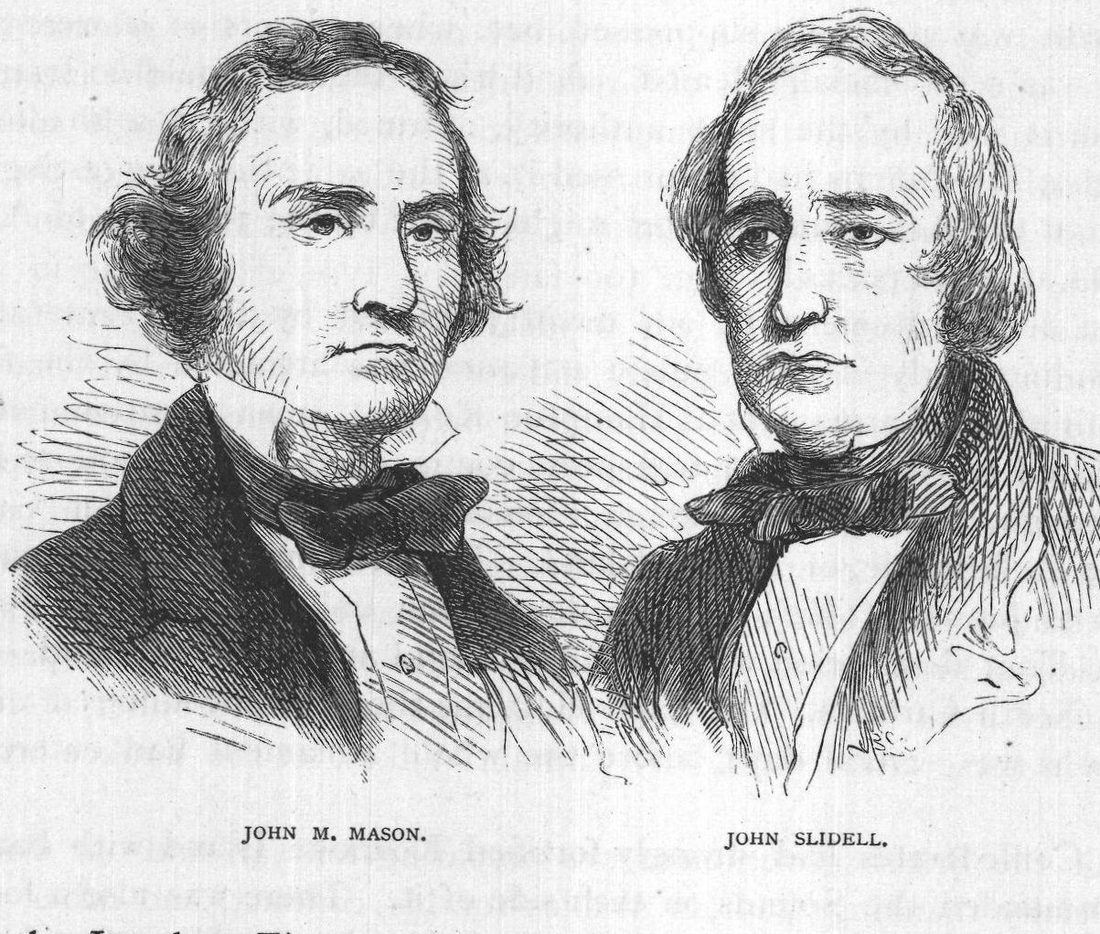
We have seen that the Confederates, at an early period in the contest, sent diplomatic agents to European courts. These proved to be incompetent, and the Confederate government undertook to correct the mistake by sending two of their ablest men to represent their cause at the courts of Great Britain and France, respectively. These were James M. Mason of Virginia, author of the Fugitive-Slave Act, and John Slidell, who was deeply interested in the scheme for opening the African slave-trade. The embassadors, each accompanied by a "secretary of legation," left Charleston harbor on a stormy night (the 12th of October, 1861), eluded the blockading squadron, and landed at Havana, Cuba, where they were cordially greeted by the British consul and other sympathizers. There they embarked for St. Thomas, in the British mail-steamer Trent, intending to go to England in the regular packet from the latter port. While the Trent was on her way to St. Thomas, and when off the northern coast of Cuba, she fell in with the American war-ship San Jacinto, Captain Wilkes, then on his way home from the coast of Africa. He touched at Havana, where he heard of the movements of the Confederate embassadors. Satisfied that the English rule concerning neutrals and belligerents would justify him in seizing these two men on board the Trent, and transferring them to his own vessel, he had gone out in search of that steamship. He found her on the 8th of November, and brought her to by a shell fired across her bow. Then he sent Lieutenant Fairfax, a kinsman of Mason, on board the Trent to demand the delivery of the embassadors and their secretaries to Captain Wilkes. The officers of the Trent protested, and the embassadors refused to leave the ship unless forced by physical power to do so. Lieutenant Greer and a few marines were sent to the aid of Fairfax, who then took Mason by the shoulder and placed him in a boat belonging to the San Jacinto. Then the lieutenant returned for Slidell. The passengers were greatly excited. They gathered around him, some making contemptuous allusions to the lieutenant, and some crying out, "Shoot him!" The daughter of Slidell slapped Fairfax in the face three times as she clung to the neck of her father. The marines were called, and Slidell and the two secretaries were compelled to go, when the Trent proceeded on her voyage to St. Thomas. The captive embassadors were conveyed to Boston and confined in Fort Warren, as prisoners of State.