General Jackson
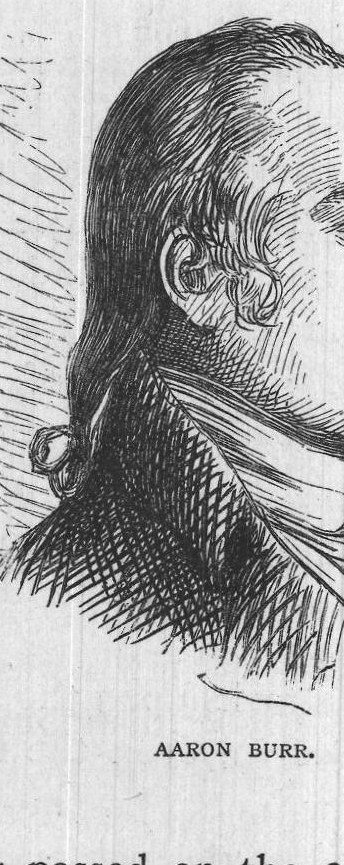
Burr, at first, gained the confidence of that stern patriot, Andrew Jackson, whom he visited at his log-dwelling at the "Hermitage," near Nashville. They corresponded for a time after Burr returned to the East in the fall of 1805, and so active were the schemer and his few partisans in the West in 1806, that a military organization was partly effected. He had overcome General Wilkinson with his wiles; and so strong was the confidence of Jackson in the integrity of Burr, that when the latter again visited the Hermitage early in the autumn of 1806, the former procured for him a public ball at Nashville, at which the tall hero, in military dress, led the little adventurer in his suit of black into the room, and introduced him to the ladies and gentlemen present. Circumstances soon afterward caused Jackson to suspect Burr's fidelity to his country, and he communicated his suspicions to Governor Claiborne at New Orleans. The national government received similar warnings, and took measures to crush the viper in its egg. Burr's arrest was ordered, and this was accomplished in February, 1807, near Fort Stoddart, in Alabama, by Lieutenant (afterward Major-General) E. P. Gaines. Burr was taken to Richmond, in Virginia, and there tried for treason. The evidence seemed to show that his probable design was an invasion of the Mexican provinces and not a disseverance of the Union, and he was acquitted.
With the acquisition of Louisiana, there grew up a powerful opposition to the administration, on the North and East. The idea was disseminated that the transaction was a scheme to strengthen the South, and with it the Southern Democracy, into whose hands the control of the government had fallen. In past times the prescription of disunion as a remedy for political evils had been a favorite one with that Democracy. The Opposition now approved it, or rather the very radical men of that party did. In the years 1803 and 1804, desires for a disseverance from the South were freely expressed in the States east and north of the Potomac and Susquehanna. A convention of leading Federalists to consult upon the measure, was called at Boston in 1804, to which Alexander Hamilton was invited; but his emphatic condemnation of such an unpatriotic course, only a short time before his death, disconcerted the leaders and dissipated their schemes. In the New York State Senate, in 1809, DeWitt Clinton, alluding to this act of Hamilton, said: "To his honor be it spoken, it was rejected by him with abhorrence and disdain."
At about the time when Burr conceived his schemes, trouble between Spain and the United States had occurred, and, for awhile, threatened to kindle a flame of war between the two governments. The United States had preferred a claim against Spain for indemnity for spoliations committed against the commerce of our country by Spanish cruisers under their own and the French flags. The liability on the part of those under the Spanish flag was admitted, and by an agreement negotiated in 1802, a commission to adjust the claims was authorized; but the acquisition of Louisiana by the United States, and questions growing out of that act, and claims to a portion of Florida, seemed to indicate a determination on the part of our government to take that portion of the Spanish domain by force of arms, if necessary. Spain, highly offended, refused to carry out the agreement concerning indemnity, and, for awhile, the political firmament appeared very lowering. But, as we have observed, the boundaries were amicably settled by satisfactory definitions, and the clouds passed away.
We must now look to events in Europe as the beginning of serious difficulties between our country and Great Britain, which finally led to war between them.