General Harrison in the West
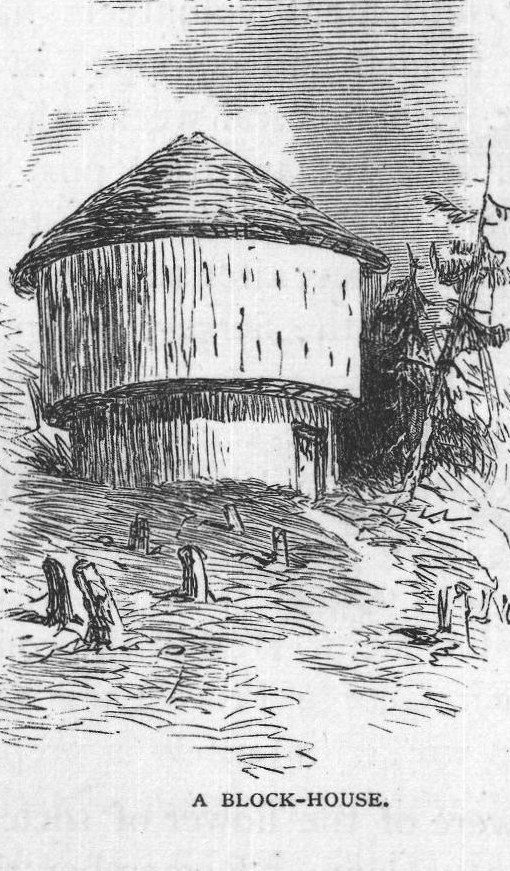
During the fall of 1812, the whole western country, incensed by Hall's surrender and the atrocities of the savage allies of the British, seemed to be filled with men animated by a zeal like that of the old Crusaders. It was there determined that Michigan must be recovered and Indian tribes be made quiet by severe chastisement. In every settlement volunteers had gathered under local leaders. Companies were formed and equipped in a single day, and were ready to march the next. For several weeks these volunteers found employment in driving the hostile Indians from post to post in Ohio, Indiana and Illinois, on the borders of the extreme western settlements. They desolated their villages and plantations after the manner of Sullivan in the Seneca country in 1779, and thereby the fiercest indignation against the white people was excited among the savages. This feeding stimulated by the British allies of the Indians, led to some terrible results. So eager were the people of the West for conflict with the British, that the snows of winter lying in the wilderness between them and Detroit did not keep them from the field, and the campaign of 1813 opened with the year. General William Henry Harrison had succeeded General Hull in the command of the Army of the West, and General Sir George Prevost was the military successor of Brock, in Canada. Harrison worked intensely in preparations for a winter campaign in the northwest, which the feelings of the people demanded. To do this he must march a crude and undisciplined army through a savage wilderness, in dark forests and across tangled swamps, wherein lurked wily enemies; and, at the same time, he had to defend a frontier several hundred miles in extent against the tomahawk and scalping-knife, at all hazards. Block-houses had to be built and garrisoned on the way, and magazines of provisions created and defended. But the good soldiers cheerfully undertook the difficult task. Brave and experienced leaders had rallied to his standard. Kentucky sent swarms of young men from every social rank, led by the veteran Isaac Shelby, whose exploits at King's Mountain in the Revolution were remembered with gratitude. The yeomanry of Ohio and its neighborhood had hastened to the field; and so numerous were the volunteers, that Harrison was compelled to issue orders against further enlistments. He made the vicinity of the Maumee Valley, near the western end of Lake Erie, the place of general rendezvous, whence he intended to fall upon Malden and Detroit; and he designated the brigades from Virginia and Pennsylvania, and one from Ohio, under General Simon Perkins, as the right wing of the army, and the Kentuckians under General Winchester, as the left wing. So arranged the army pressed forward.
Winchester, with eight hundred young Kentuckians, reached the Maumee Rapids in January, 1813, where he learned that a party of British and Indians were occupying Frenchtown (now Monroe, Michigan), on the River Raisin, twenty miles south of Detroit. He sent a detachment, under Colonels Allen and Lewis, to protect the inhabitants in that region, who drove the enemy out of the hamlet of about thirty families, and held it until the arrival of Winchester, on the 20th, with about three hundred men. At that time General Proctor was at Malden, eighteen miles distant, with a considerable body of British and Indians; and with fifteen hundred of these, he crossed the river and marched stealthily at night to attack the Americans.
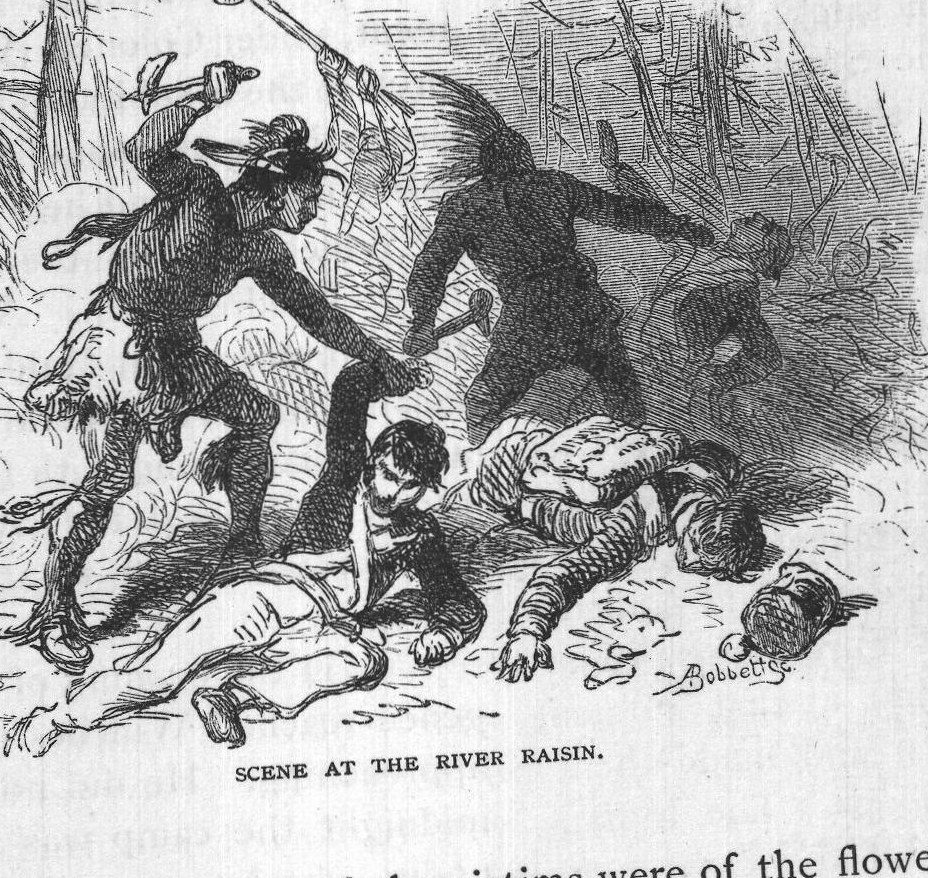
Late in the evening of the 21st, intelligence reached Winchester that a foe was approaching. He did not believe it. At midnight the camp was as reposed as if under absolute security from heaven. The sentinels were posted; but the weather being intensely cold, pickets were not sent out upon roads leading to the town. Just as the drummer-boy was beating the reveille in the gray of dawn on the 22d, the sharp crack of a rifle, followed by musketry, awoke the sleepers. Bombshells and canister-shot immediately succeeded in a shower upon the camp. The Americans seized their arms, and opposed force to force. Very soon the soldiers fled to the woods for shelter, where the savages, who swarmed there, hewed them down with gleaming hatchets. The allies made it a war of extermination on that morning.
Winchester was made a prisoner, and he concluded an agreement with Proctor to surrender his troops to that officer on condition that ample protection should be given to them against the fury of the savages. The promise was given and immediately violated. Proctor, knowing Harrison to be near, hastened toward Malden, leaving the sick and wounded Americans behind, without a guard. The Indians followed him awhile, when they turned back, murdered and scalped those who were unable to travel as captives, set fire to houses, and took many prisoners to Detroit to procure exorbitant prices for ransom. The indifference of Proctor and his troops on that occasion, and the dreadful suspicion that they encouraged the savages in their butchery of the defenceless, was keenly felt in all the West, and particularly in Kentucky, for most of the victims were of the flower of society in that State. After that the war-cry of Kentuckians--"Remember the River Raisin!" was often heard.