Formation of Political Parties: Democratic and Jay
Again the wisdom and prudence of Washington averted the national calamity of war. He proposed to send a special envoy to the British court to negotiate for an amicable settlement of existing disputes. Congress approved the measure, and on the 19th of April, 1994, John Jay was appointed to fulfill that delicate mission. He arrived in London in June, and was very courteously received by the British government. On the 19th of November following, a treaty was concluded which provided for the collection of debts here, by British creditors, contracted before the Revolution, but it did not procure indemnity for those who lost slaves. It secured indemnity for unlawful captures on the high seas, and also the evacuation of military posts on the frontiers yet held by the British. In order to secure some important points, Mr. Jay was compelled to yield others. The treaty was defective in some things, and objectionable in others, but it was the best that could be obtained at that time, and it averted war with Great Britain. It created intense hostility to Washington's administration, and to Jay personally, at home. The proposition to send an envoy to treat with Great Britain had been denounced by the Democratic societies and newspapers as pusillanimous. Now these societies and newspapers which had resolved to oppose it whatever might be its provisions, attacked the treaty, the President and Mr. Jay, with vehemence, on the strength of mere rumor as to its character.
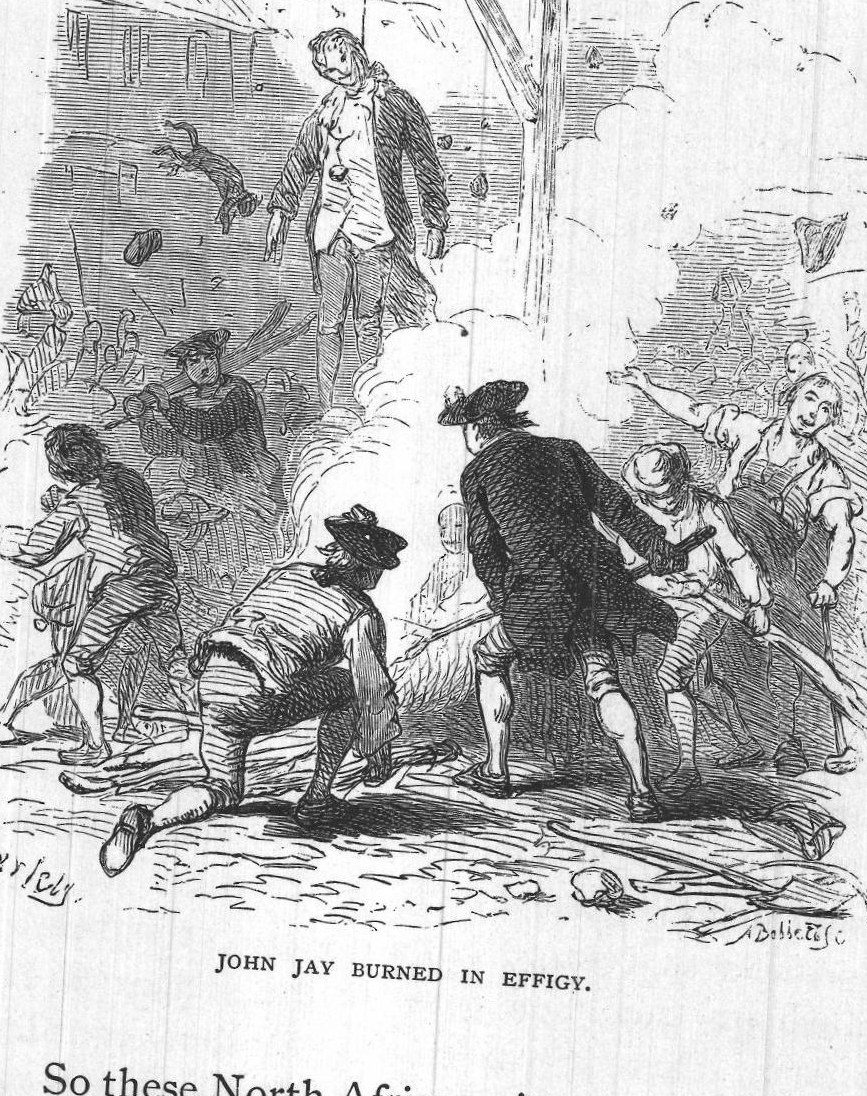
The treaty reached the President in March, 1795, but the Senate was not convened until June to consider it. Meanwhile an unfaithful member of the cabinet (Mr. Randolph of Virginia) revealed enough of its character to warrant attacks upon it. A mad, seditious cry went over the land from the Opposition. In several cities mobs threatened personal violence to the supporters of the treaty. Mr. Hamilton was stoned at a public meeting in New York, while speaking in the open air. "These are hard arguments," he said, when a stone grazed his forehead. The British minister at Philadelphia was insulted; and in Charleston, the British flag was trailed in the dust of the streets. Jay was denounced as a traitor; and in Virginia, disunion was recommended as a cure for existing political evils. "France is our national ally," shouted Democratic societies. "She has a government congenial to our own. Citizens, your security depends on France. Let us unite with France, and stand or fall together," cried factious orators at public meetings held throughout the country; and the Democrats adorned their hats with the French cockade, Jay was burned in effigy in many places, and longings for a guillotine were freely expressed. But the Senate ratified the treaty on the 24th of June, 1795, and removed the seal of secrecy, at the same time forbade the publication of the treaty for prudential reasons, for there were rumors of an important order having been issued by Great Britain. Thomson Mason, a senator from Virginia, in violation of the rules of the Senate, of official decorum, and of personal honor, sent a copy of it to a Democratic newspaper. A rhymer of the day addressed Mr. Mason on the subject, in the following manner:
With Democratic incense to the skies!
Long shall the world admire thy manly soul,
Which scorned the naughty Senate's base control;
Come boldly forward with thy mighty name
And gave the treaty up for public game!"
The ratification of this treaty was followed in October by the conclusion of one with Spain, by which the boundaries between the Spanish Territories of Louisiana and Florida were defined. This treaty also secured to the United States the free navigation of the Mississippi River, and the use of the port of New Orleans for ten years. Louisiana had been ceded to Spain by the French, in 1762.