Foreign Troops Hired by the British: Sullivan's Island and Long Island
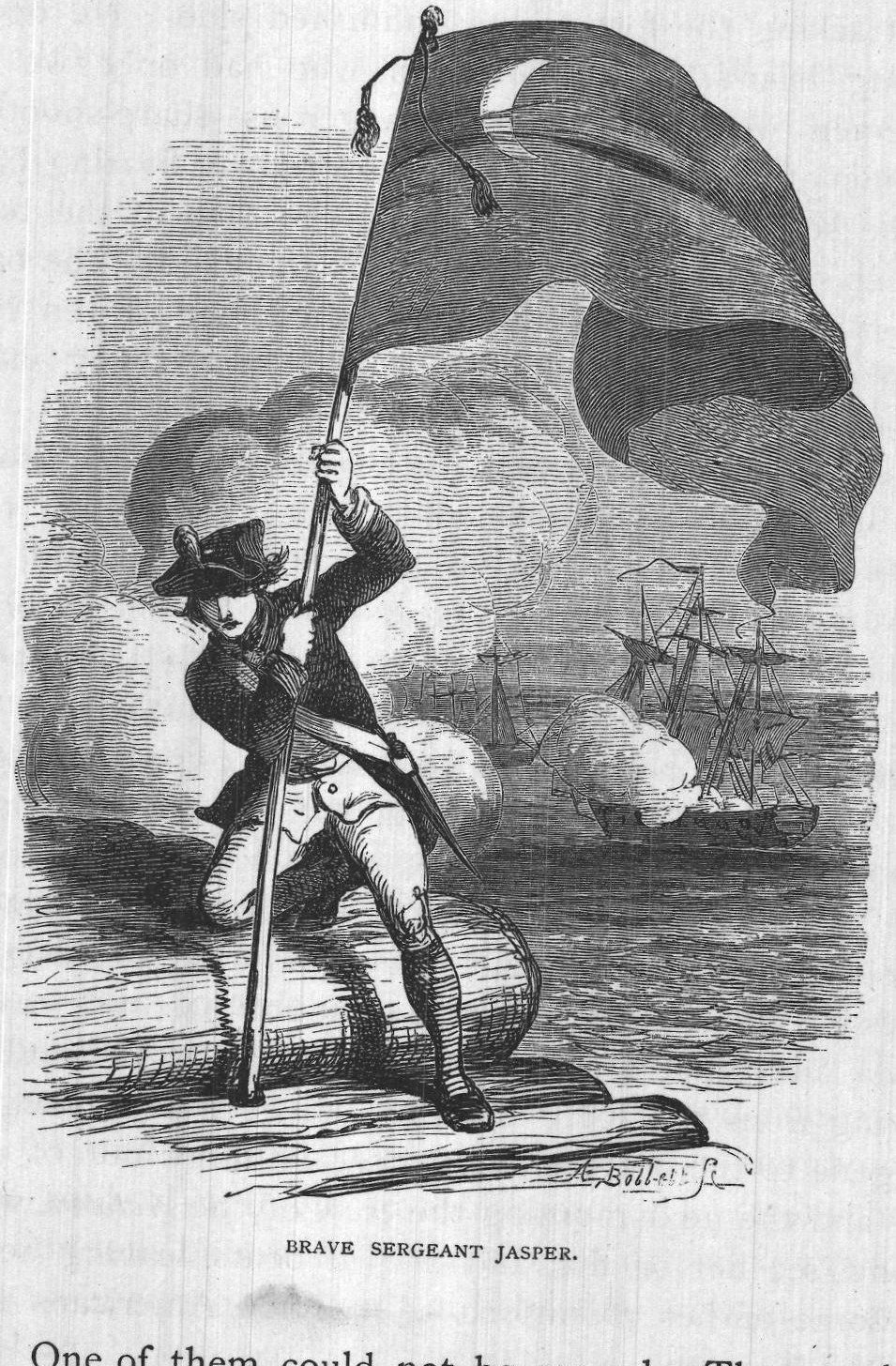
Clinton had landed soldiers on Long Island, a strip of sandy land separated from Sullivan's Island by a shallow creek. There he erected batteries to confront those of Thompson on Sullivan's Island, and awaited the pleasure of Admiral Parker. On the morning of the 28th of June, Sir Peter, from his flag-ship the Bristol, gave a signal for attack. The Thunder-bomb opened a bombardment on the fort; and between ten and eleven o'clock the flag-ship and Experiment, each carrying fifty guns, and the Active and Solebay, of twenty-eight guns each, moved forward and anchored within cannon-shot distance of the fort, with springs on their cables. Lord Campbell, the fugitive royal governor, was on board the Bristol, expecting to be reinstated in power the next day, for no officer of the fleet doubted the entire success of the British forces in demolishing the fort and seizing Charleston. It was supposed that two broadsides would end the fort and secure the garrison; but when these were delivered, Moultrie, who had not a tenth as many guns as were brought to bear upon him, returned the fire with spirit and effect. The broadsides of the British ships only jarred the fort. The spongy palmetto logs received the round-shot and were not fractured. The missiles were imbedded in the soft wood, and so gave increased strength to the fort; while Moultrie's guns, fired slowly and with precision, sent balls that shivered hulls and spars, and spread death over the decks. The roar of three hundred guns shook the city, where a multitude of anxious spectators beheld the terrible scene from windows, balconies, roofs, and steeples, and along the edges of the water. At length, perceiving the unfinished state of the fort on its western side, Parker ordered the Sphynx, Active, and Siren, each carrying twenty-eight guns, to take a position in the channel on that side, so as to enfilade the garrison--to fire on their flank. Had they done so, destruction or surrender would have been the fate of Moultrie and his men. But all three struck on a shoal called The Middle Ground, and could not be got off until they were severely battered by balls from the fort. One of them could not be moved. The people at Charleston, seeing this, sent up a shout of joy; but they were soon saddened. A few moments afterward the flag that waved over the fort suddenly disappeared. Had Moultrie surrendered? No! A cannon-shot from a British vessel had cut the flag-staff, and the blue banner of South Carolina, with its silver crescent, had fallen outside of the fort. Seeing this, Sergeant Jasper exclaimed: "Colonel, we mustn't fight without a flag!" and going quickly through an embrasure he picked up the precious piece of silk while cannon-balls were flying thickly around him re-entered the fort, fastened the banner to a sponge-handle, climbed to the parapet, fixed its new staff firmly there, and flung it to the breeze.
At this time, Clinton with his two thousand land troops and six hundred seamen, attempted to co-operate with the fleet by landing on Sullivan's Island and attacking the fort on its unfinished side. He opened his batteries on Long Island, upon Thompson, who had only two guns, but his Carolina riflemen were expert and dangerous sharp-shooters. Clinton embarked some of his troops in boats covered by floating batteries in the creek; but the soldiers could not land in the face of the terrible volleys from Thompson's men, and were speedily disembarked. The baronet accomplished almost nothing during the furious conflict of ten hours on that bright and hot June day. Thompson held him at bay until the battle ceased at evening.
Moultrie's powder was scarce at the beginning, and he used it sparingly. At length it was nearly exhausted, and he sent to Lee for more, notwithstanding that officer had written to him: "If you should, unfortunately, expend your ammunition without beating off the enemy or driving them aground, spike your guns and retreat." A little later, braver words were uttered and better deeds were done by President Rutledge. He wrote: "I send you five hundred pounds of powder. You know our collection is not very great. Honor and victory to you, and our worthy countrymen with you! Do not make too free use with your cannon. Be cool and do mischief." The powder was forwarded by Lee. Moultrie resumed his fire, and did such "mischief" that the British were glad to end the fight. The firing from their vessels slackened at sunset, and at half-past nine ceased altogether.
The Bristol and Experiment were nearly wrecks, so fatally accurate had been the firing from the fort. Had the sea been at all rough, the flag-ship must have gone to the bottom. The fleet withdrew out of reach of Moultrie's guns; and the next morning the crew of the Actaon, which was hopelessly aground, set her on fire, and fled in boats, leaving her colors flying. These and some of her munitions of war the Americans secured half an hour before she blew up.