Battle in Charleston Harbor
A fleet commanded by Sir Peter Parker, and designed to act under Clinton's orders, did not leave Ireland until February. Then the vessels were delayed by storms. Clinton, meanwhile, had been awaiting their arrival with impatience. It was May before he entered the Cape Fear River with some of them. From the Pallas he issued a proclamation (May 5, 1776) which declared North Carolina to be in a state of rebellion, ordered all Congresses to be dissolved, and offered pardon to all penitents excepting the arch-rebels Cornelius Harnett and Robert Howe. The latter was then a brigadier-general in the Continental army. The people laughed at the manifesto, and the irritated baronet vented his wrath upon the property of Whigs. Earl Cornwallis had come with troops in the transports convoyed by Parker's fleet, and he was sent, with nine hundred men, to ravage the plantation of General Howe at Brunswick. Governor Martin sent a party to burn the house of William Hooper, who was then a delegate in the Continental Congress; and some mills in the neighborhood were destroyed. Satisfied that the North Carolinians could not be coaxed nor frightened into submission, the British forces proceeded to attempt the reduction of Charleston, South Carolina, as a prelude to the fall of Savannah. General Lee, who had been ordered by Washington to watch the movements of Clinton, had made his way southward by land, and arrived at Charleston on the 4th of June.
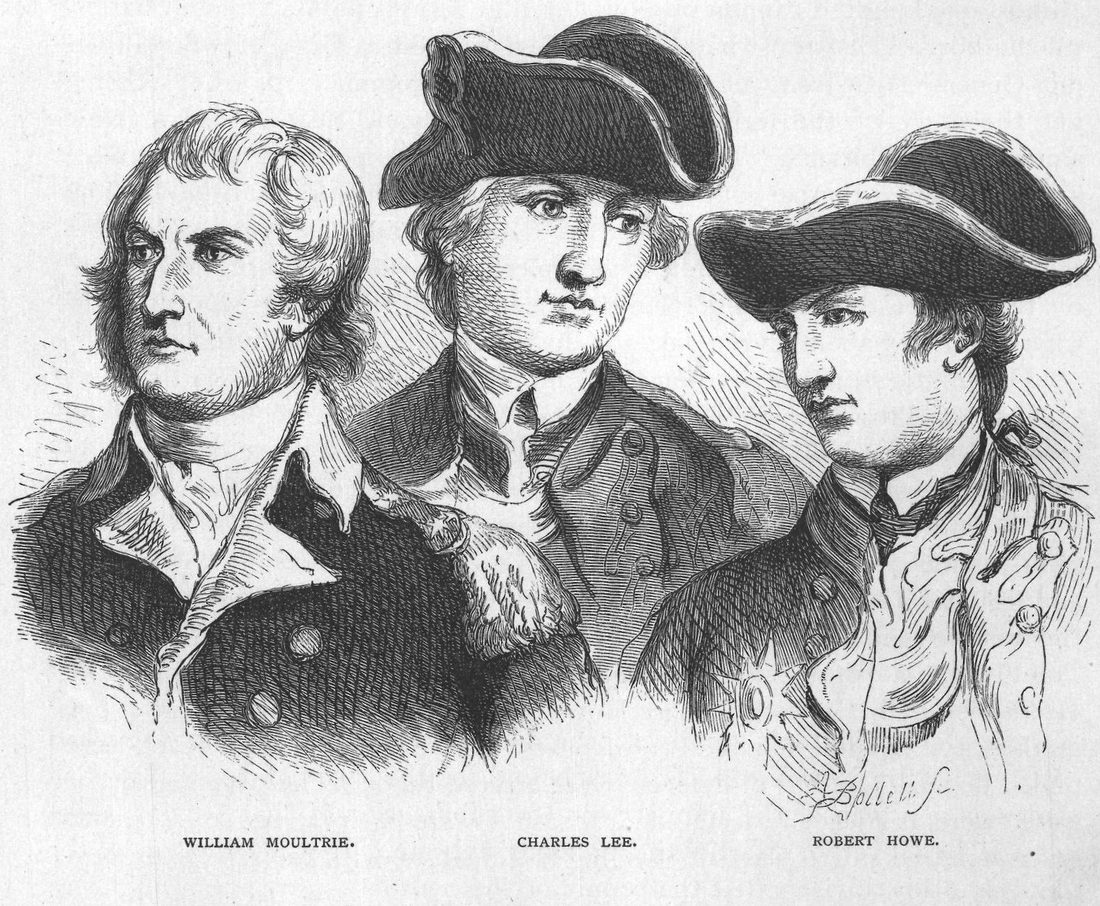
Lee's arrival was at an auspicious moment. Four days before, John Rutledge, President of the Provincial Congress of South Carolina, had been informed that a British fleet of armed vessels and transports filled with troops lay anchored off Dewee's Island, twenty miles north of Charleston bar. Rutledge had been industriously preparing for a defence of Charleston. Almost one hundred cannon were mounted at various points around Charleston harbor, and a strong battery had been erected at Georgetown. Brigadier-General Armstrong of Pennsylvania was in command of troops there; yet the story of the formidable British force being near, spread a panic among the inhabitants. The arrival of Lee, whose experience and skill were known, inspired the patriots with confidence, and the alarm subsided. The people worked cheerfully to perfect the defences; and the garrison of Fort Sullivan labored day and night to complete that work and arm it. When, on the day of the arrival of General Lee, the British forces appeared off Charleston bar, about thirty pieces of heavy cannon were mounted on it.
The militia from the surrounding country now flocked into Charleston at the call of President Rutledge. These, with Carolina regulars and the troops from the North brought by Armstrong and Lee, made an available force of almost six thousand men. Colonel Gadsden commanded the garrison in Fort Johnson, on James Island, three miles from the city. Colonel Moultrie was at the head of the troops in Fort Sullivan, on Sullivan's Island, and Colonel Thompson commanded riflemen from Orangeburg, stationed on the eastern end of that island. A considerable force were at Haddrell's Point on the northerly side of the harbor, under the immediate command of Lee, assisted by General Robert Howe. Rutledge proclaimed martial-law in the city. Some valuable store-houses on the edge of the water were pulled down, and a line of defences were erected there. The streets near the water were barricaded; lead window-sashes were melted into bullets, and seven hundred negro slaves belonging to Loyalists, with tools, were pressed into the service.
After long delay Clinton completed his arrangements for a combined attack of ships and troops upon Fort Sullivan, which was chosen to receive the first blow. It was garrisoned by about four hundred men, mostly South Carolina regulars, with a few volunteer militia; and its only aid was a sloop, with powder, anchored off Haddrell's Point. Lee had pronounced the fort absolutely untenable, and called it "a slaughter pen;" and he advised Rutledge to withdraw the garrison and abandon Sullivan's Island without striking a blow. Rutledge refused. Lee, with sharp words and angry tone, persisted in his views, and if he dared he would have withdrawn the troops in spite of the wiser President. He annoyed Moultrie by his orders looking to a flight from the fort, directing him to build bridges for retreat to the main; but Moultrie did not believe that he could be driven from his little fortress of soft palmetto logs for he knew, better than Lee, their resisting power. Lee tried to weaken his force by ordering detachments to be sent from the fort; and up to the last moment he wished to have Moultrie removed from the command. Had he been acting in favor of the enemy he could not have given better advice; and in view of his subsequent treason, which will be noticed hereafter, the historian cannot be sure that he was not, at that time, acting the part of a traitor. The vehemence of his language impressed others. The brave Captain Lempriere, while viewing the British vessels that had come over the bar, said to Moultrie: "Well, Colonel, what do you think of it now?" "We shall beat them," Moultrie said. "The men-of-war," answered the captain, "will knock your fort down in half an hour." "Then we will lie behind the ruins and prevent their men from landing," replied the imperturbable colonel.