Expedition to the Coast of North Carolina
When the excitement, in our country, caused by the "Trent affair," was subsiding, early in 1862, public attention was attracted by the fitting out of a third naval armament at Hampton Roads. It was composed of over one hundred war-vessels and transports commanded by Commodore L. M. Goldsborough, and bearing sixteen thousand land troops under General Ambrose E. Burnside, of Rhode Island. The armament left the Roads on the 11th of January (1862), with its destination unknown except to proper officers. That destination was Roanoke Island and Pamlico Sound, on the coast of North Carolina. Off Cape Hatteras the fleet encountered a heavy gale, and it was several days before the whole armament had entered the Inlet.
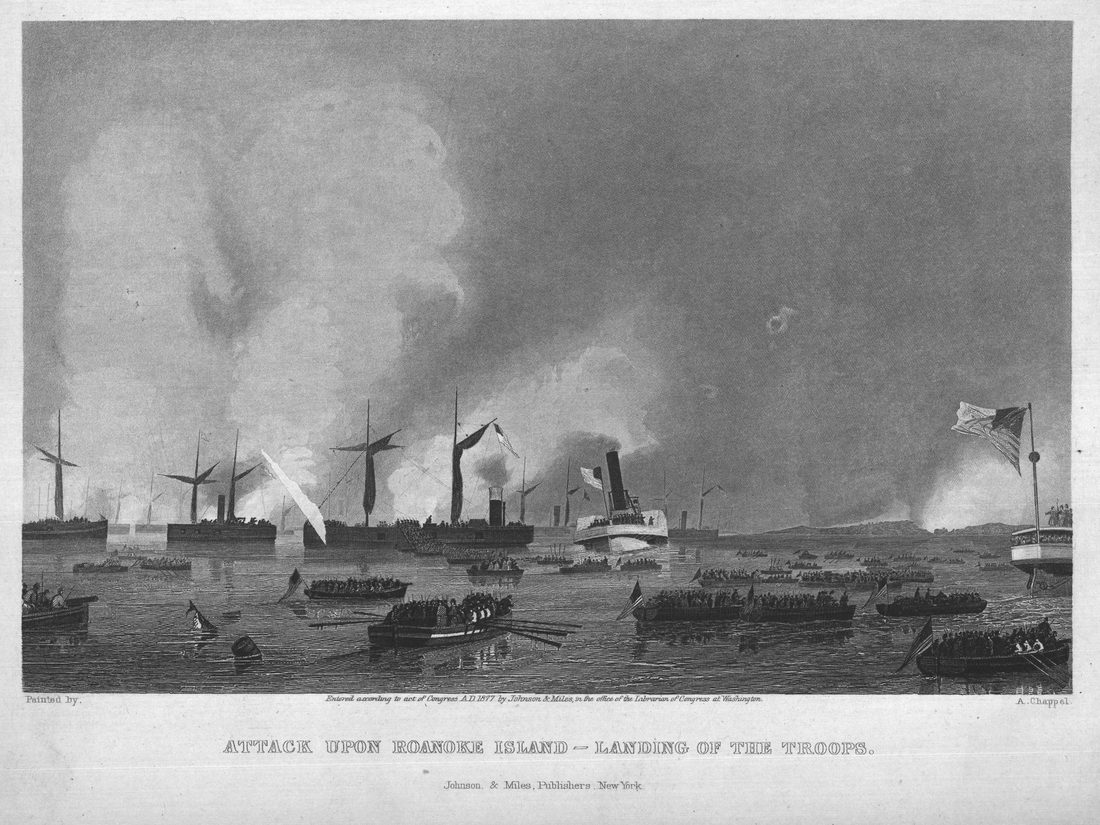
The Confederates had strongly fortified Roanoke Island with batteries that commanded the Sounds on each side of it. There was also a fortified camp that extended across a narrow part of the island. These fortifications were garrisoned by North Carolina troops then under the command of Colonel H. M. Shaw, and mounted about forty guns. They had also placed obstructions in the channel leading to the island; and above them, in Croatan Sound, was a flotilla of small gun-boats--a sort of "musquito fleet" like Tatnall's in Port Royal Sound-commanded by Lieutenant W. F. Lynch, late of the National navy. Preparations were made for an attack by land and sea, the first week in February. Goldsborough drew up his fleet of seventy vessels in Croatan Sound, and opened a bombardment upon the batteries. It was kept up all the afternoon, the flotilla and the batteries responding to Goldsborough's guns. At midnight, while a cold storm of wind and rain was sweeping over the land and water, about eleven thousand troops were landed on the island, many of them wading ashore. These were New England, New York, and New Jersey troops. They were without shelter, and were drenched. At dawn, led by General J. G. Foster (Burnside's lieutenant), they moved forward to attack the line of intrenchments that crossed the island. The Confederates, far inferior in number, made a gallant defence, going from redoubt to redoubt as one after another fell into the hands of the Nationals. They made a vigorous stand in a well-situated redoubt that was approached by a causeway. There was to be the last struggle in defence of the line. At the head of a part of Hawkins's Zouaves, Major Kimball (a veteran of the war with Mexico) undertook to take it by storm. Colonel Hawkins was then leading a flank movement with a part of his command. Seeing Major Kimball pushing forward, the Colonel joined him, when the whole battalion shouted, "Zou! Zou! Zou!" and pressed to the redoubt. The affrighted Confederates fled and were pursued by Foster five or six miles, when they surrendered, and Roanoke Island passed into the possession of the National forces, with three thousand prisoners and forty-two cannon. The Confederate flotilla went up Albemarle Sound, followed by National gun-boats under Commodore Rowan.
Near Elizabeth, not far from the Dismal Swamp, Rowan attacked the flotilla and some land batteries, driving the Confederates from both, when Lynch and his followers retired into the interior. Then the United States flag was placed upon a shore battery, and this was the first portion of the main of North Carolina that was "repossessed" by the Government. Other portions of the coast of that State were speedily recovered; and on the 18th of February, 1862, Burnside and Goldsborough issued a proclamation jointly to the inhabitants of eastern North Carolina, assuring them that the Government forces were there not as enemies but as friends, and inviting them to separate themselves from the Confederacy and to return to their allegiance. This disaster, worked by the National forces, produced great depression throughout the Confederacy, for it exposed nearly the whole of the North Carolina main, and opened a way by which Norfolk might be smitten in the rear.
Let us now return to the Mississippi Valley, where we left Fremont's disappointed army sullenly marching back to St. Louis.
Late in 1861, the Department of Missouri was enlarged, and General H. W. Halleck was appointed to the command of it. General Hunter was assigned to the Department of Kansas; General Don Carlos Buell to that of the Ohio, and General E. R. S. Canby to that of New Mexico. Halleck's headquarters were at St. Louis, and he restrained the Secessionists with a vigorous hand. Since the retrograde movement of Hunter, with Fremont's army, Price had been gathering a Confederate force in Missouri, and General John Pope was placed in command of a considerable body of troops to oppose him. Pope acted with great vigor and skill. He made a short, sharp, and effective campaign. Detachments from his army struck some blows here and there that were telling. One was inflicted by troops under General J. C. Davis, on the Blackwater, near Milford, which gave a stunning blow to the insurgents in that State. Davis found the enemy in a wooded bottom opposite his own forces. He carried a well-guarded bridge by storm, and struck the Confederates so hard that they fled in much confusion; and when they were closely pursued, they surrendered, in number about thirteen hundred, cavalry and infantry. The spoils of victory were eight hundred horses and mules, a thousand stand of arms, and over seventy wagons loaded with tents, baggage, ammunition, and supplies of every kind. In a brief space of time, the power of the insurgents in that quarter was paralyzed, and Halleck complimented Pope on his "brilliant campaign."