Effects of the Battle of Chippewa: Penobscot and Hardy
Hardy rejoined the blockading squadron of the mouth of the Thames and proceeded to execute Cochrane's terrible order, yet with reluctance on his part, for he was a humane officer. Great Britain had determined to make the war sharp and decisive, and this order to injure innocent people was a part of the plan. On the 9th of August, Hardy appeared before Stonington with three large vessels and a bomb-ship. He sent word to the magistrates of the borough that he intended to destroy the village, and gave the inhabitants one hour in which to leave it. He would grant no alternative, and the magistrates replied: "We shall defend the place to the last extremity; should it be destroyed, we will perish in its ruins." Nearly all the inhabitants incapable of bearing arms left the place, and that evening the bomb-ship Terror and some launches rained shells and rockets upon the village without doing serious damage.
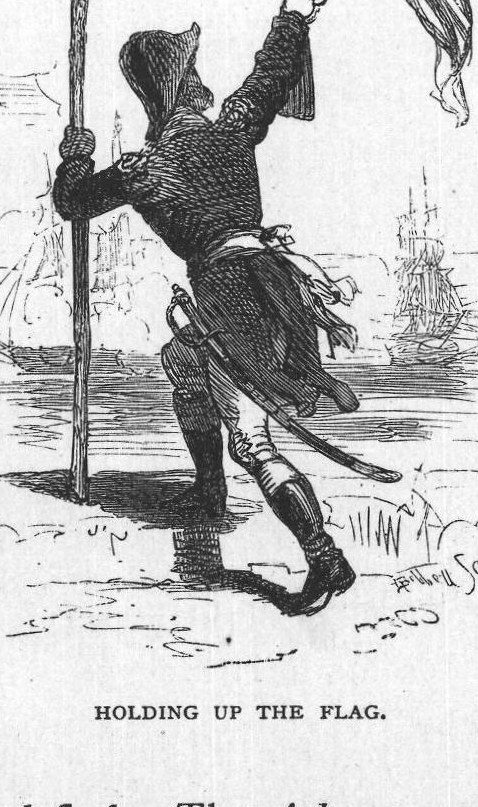
During that bombardment some bold spirits in Stonington cast up a sort of redoubt on the extremity of the peninsula on which the borough stands, and placed upon it, in battery, 6-pound and 18-pound iron cannon; and from these they hurled solid balls upon the assailants with so much effect, that the bomb-ship and her consorts withdrew to the larger vessels. Some men gathered at Stonington the next day, but they were of little service; but a few brave men from Mystic, led by Captain Jeremiah Holmes, flew to the aid of their neighbors, and did gallant service at the redoubt. Captain Holmes, who was a good gunner, took charge of the 18-pound, and with it he fought the ships of the enemy until his ammunition was exhausted and no more could be found. Then the borough seemed to be completely at the mercy of the invaders, and some timid citizens proposed to the captain to haul down the American flag that floated over the battery and surrender. "No!" shouted the captain, "that flag shall never come down while I am alive!" and it did not, in submission to a foe. When the wind died away and it hung drooping by the side of the staff, the brave captain held out the flag at the point of a bayonet, that the British might see it. While it was in that position, several shots passed through it. To prevent its being struck by some coward, the captain nailed it to the staff.
The old cannon was not long silent. Some powder was found in a place of concealment. Double-shotting his piece, the captain kept the enemy at bay until a competent force of militia, under General Isham, were collected to prevent the British landing; and on the 12th, after a sharp bombardment, the blockading squadron, discomfited, withdrew. Not a single life had been lost in the village during the assault, and but one person was mortally and fifty or sixty were slightly wounded. About forty buildings were more or less injured, and two or three were nearly ruined.
We have observed that the region between Passamaquoddy Bay and the Penobscot was seized and held by the British. That was after Hardy captured Eastport. A strong squadron under Admiral Griffith, bearing about four thousand troops led by Governor Sherbrooke of Nova Scotia, captured Castin on Penobscot Bay and also Belfast, and went up the Penobscot River to Hampden, a few miles below Bangor, to capture or destroy the American corvette John Adams, which, caught in that stream, had gone up so far to escape from the enemy. The militia along the Penobscot gathered at the call of General John Blake, who, with the cannon of the Adams posted on a hill, prepared to defend the vessel and the country. But when the British troops landed at Hampden, the militia broke and fled. The Adams was burned by her commander, Captain Morris, and the troops after taking possession of the village, pushed on to Bangor. There, in the course of a stay of about thirty hours, they destroyed several vessels, plundered the inhabitants of property valued at over $20,000, and retired to Hampden to repeat this conduct there. Then the troops and fleet descended the Penobscot and, after capturing Machias, returned to Halifax, leaving General Gosselin at Castin to hold the country, which he did with dignity and humanity.