Downfall of the Federal Party
This outrage--this practical application of the claims of the British government to the right of searching American vessels without leave and taking seamen from them without redress--lighted a flame of hot indignation throughout our republic. But, at that time, the American government, like that of England, was strongly influenced, if not controlled, by the mercantile interest which had become very potential. The trade between the United States and Great Britain was rapidly increasing, and was very profitable; and the American merchants, as a body, were willing to submit to almost any insult from the "Mistress of the Seas," rather than to endanger the foundations of their prosperity by provoking hostilities with Great Britain. The American cabinet in their obsequious deference to Great Britain had actually instructed the naval commanders not to molest the cruisers of any nation (the French excepted) on any account--not even to save a vessel of their own nation. The pusillanimity of this policy was now aggravated by an act of flagrant injustice and cowardice on the part of our government, that made the cheeks of true patriots crimson with shame. Captain Phillips was dismissed from the navy, without trial, because he had surrendered his vessel without making a show of resistance, and no notice was taken of the outrage by the British commander!
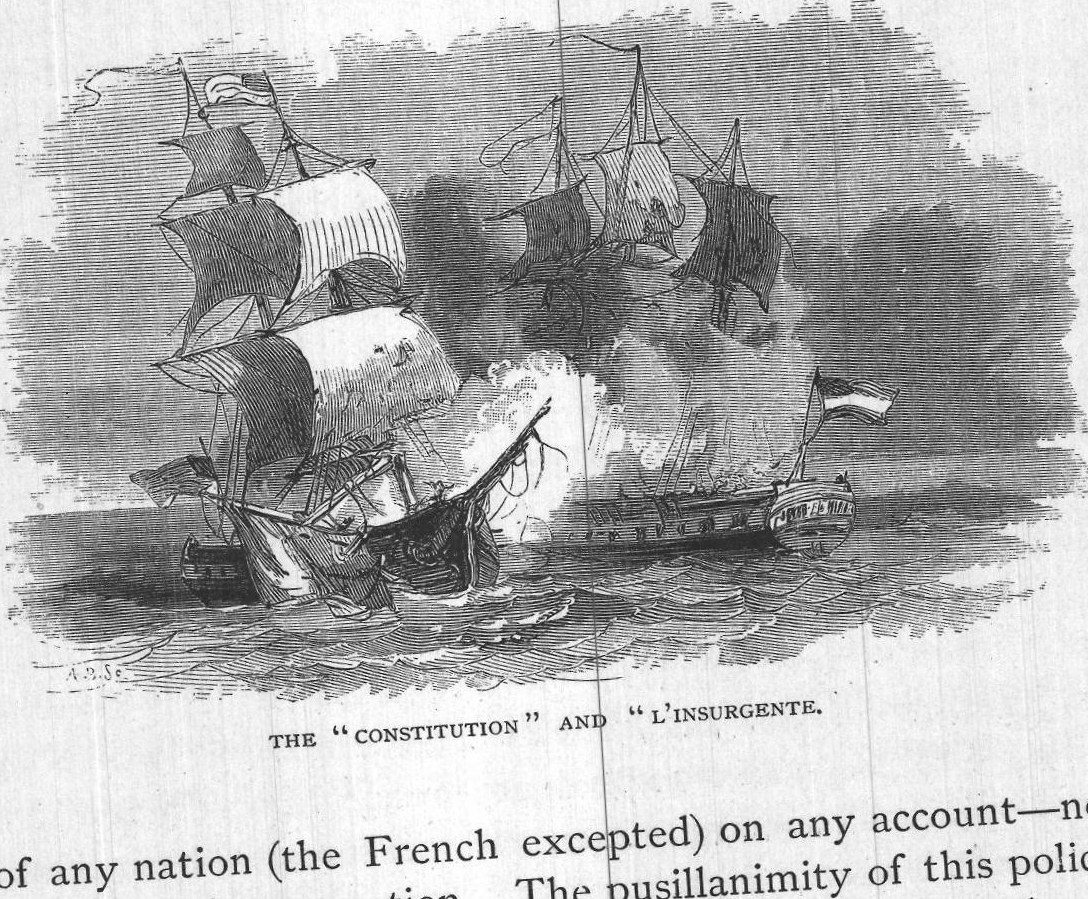
During the year 1799, the American navy was much strengthened by the launching and putting into commission of several new vessels. In February, the frigate Constellation, Commodore Truxton commanding, fell in with and captured the famous French frigate L'Insurgente, of 44 guns and 409 men, off the Island of Nevis, in the West Indies. The American and English press teemed with eulogies of Truxton. Many congratulatory addresses were sent to him; and the merchants of London gave him a service of silver-plate worth more than three thousand dollars, on which was engraved a picture of the battle. For a long time a popular song called "Truxton's Victory" was sung everywhere at private and public gatherings.
Very little of importance occurred on the ocean during the remainder of that year; but at the beginning of February, 1800, Truxton, in the Constellation, gained a victory over the French frigate La Vengeance, of 54 guns and 500 men. The battle was fought on the 1st of February, off Guadaloupe. In consequence of the falling of the mainmast of the Constellation, the supporting shrouds of which had been cut away, the Vengeance escaped. For this exploit Congress gave Truxton a gold medal. La Vengeance would have been a rich prize. She had on board a large amount of merchandise and specie, and the governor of Guadaloupe and his family returning to France. The convention at Paris brought peace, and the navy of the United States was soon called into another field of service.
The action of President Adams in the nomination of envoys to France before official intimations from the Directory that negotiations were desirable had been received, caused very serious divisions in the Federal party. Hostile feelings, already existing, were thereby intensified, and the speedy downfall of the Federal party, as a controlling power in the government, was charged to the errors of judgment and temper on the part of Mr. Adams. He had already become unpopular because of his obstinacy and personal strictures. Very vain and egotistical, he was sensitive and jealous. His judgment was often swayed by his vivid imagination. His prejudices were violent and implacable, and his honesty and frankness, which made him almost a stranger to policy and expediency, made him very indiscreet in his expressions of opinions concerning men and measures. These characteristics made him an unfit leader of a great party. Persons who disagreed with him concerning measures of public policy, he regarded as personal enemies, and for this reason his feelings toward Hamilton were as bitter as ever were those of Jefferson. The consequence was that he was at variance with many of the leaders of the Federal party, who, regarding him as a Jonah, laid a plan to defeat his re-election to the Presidency--an event which they knew he earnestly desired should take place. The cunning Democrats fanned the flame of separation in the Federal party. Mr. Adam's political partisans succeeded in the scheme for his defeat; but they did more. They defeated the Federal party. The Democratic candidate for President, Mr. Jefferson, was elected, with Aaron Burr as Vice-President. The controlling power of that party, in the government, was then lost forever, after a most useful existence of about ten years. The odium in which Adam's administration was held was in consequence of the passage of the Alien and Sedition Laws which he favored--laws which authorized the President to expel aliens from our country under certain conditions, and by which citizens might be punished by fine and imprisonment who might combine in opposing government measures, or who might resist the government in words, in a "false and scandalous manner." Hamilton deprecated the laws and wrote: "Let us not establish a tyranny. Energy is a very different thing from violence." He saw the danger, and wrote prophetically: "If we push things to the extreme, we shall then give to faction body and solidity." A rhymer of the day wrote exultantly:
The Monarchists completely cast!
The Aristocrats are stripped of power--
Storms o'er the British faction lower.
Soon we Republicans shall see
Columbia's sons from bondage free.
Lord! how the Federalists will stare
At Jefferson in Adams's chair.