Death of Washington
In the closing month of the 18th century the inhabitants of the young republic were bereaved by the death of Washington. At his grave the hoarser croakings of the ravens of detraction were silenced, and were never heard afterward. He had led his fellow-citizens safely through the perils of war to political independence, and the equal perils of faction to the dignity of a righteous and prosperous nation.
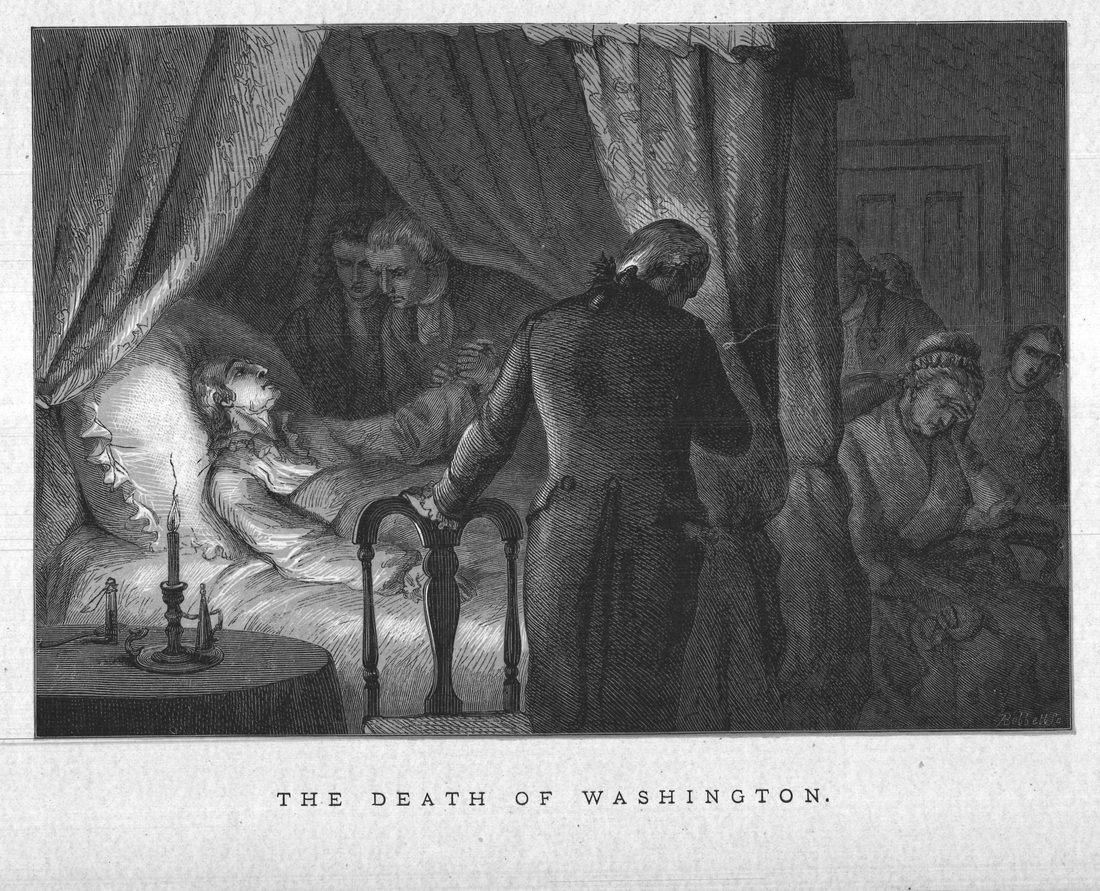
On the 13th of December, 1799, Washington was exposed to a storm of sleet, and took cold. At three o'clock in the morning of the 14th he awoke, and found himself the victim of a severe attack of membranous croup. At daybreak, himself and Mrs. Washington being alarmed, the family physician, Dr. Craik, was sent for. In the course of the day, two other physicians were called and came. All that medical skill and affectionate devotion could do to relieve the sufferer was done, but without effect. The malady increased in intensity, and before midnight the spirit of the Beloved Patriot took its flight.
Toward evening Washington said to his friend and physician: "Doctor, I die hard, but I am not afraid to go. I believed, from my first attack, that I should not survive it. My breath cannot last long." Relatives of the family were sent for, but did not arrive in time to hear his last words. At six o'clock he said to Mr. Lear, his secretary, as the latter raised him up in bed: "I feel myself going; I thank you for your attentions; but I pray you take no more trouble about me. Let me go off quietly. I cannot last long." At about ten o'clock he attempted to speak to Mr. Lear, but failed several times. At length he audibly murmured: "I am just going. Have me decently buried; and don't let my body be put into the vault in less than three days after I am dead." Mr. Lear could not speak, but bowed his assent. Washington whispered: "Do you understand?" Mr. Lear replied, "Yes." "'Tis well," said the dying Patriot; and these were the last words that he spoke--"'Tis well!"
"About ten minutes before he expired," Mr. Lear afterward wrote (which was between ten and eleven o'clock)," his breathing became easier. He lay quietly; he withdrew his hand from mine and felt his own pulse. I saw his countenance change. I spoke to Dr. Craik, who sat by the fire. He came to the bedside. The General's hand fell from his wrist. I took it in mine and pressed it to my bosom. Dr. Craik put his hand over his eyes, and he expired without a struggle or a sigh. While we were fixed in silent grief, Mrs. Washington, who was sitting at the foot of the bed, asked with a firm and collected voice, 'Is he gone?' I could not speak, but held up my hand as a signal that he was no more. ''Tis well,' she said, in the same voice; 'all's now over; I shall soon follow him; I have no more trials to pass through.'"
So departed the spirit of this great and good man whose body, thirty hours before, was in robust health, and which gave promise of a vigorous and serene old age. His attendants at that solemn hour were his wife, with whom he had lived forty-one years; his secretary, Mr. Lear; the three physicians, and his faithful colored body-servant Christopher, and equally faithful old colored woman, who was the nurse of the family. The style of the room in which he died (an upper chamber) and the bedstead of uncommon width on which rested his dying couch, are both delineated in the accompanying illustration copied from drawings from the originals by the author.