Commissioners Appointed
The bill provided for a National Commission to be appointed by the President of the United States, and to be composed of one commissioner and one alternate commissioner for each State and Territory in the Union; these commissioners to be nominated by the governors of the respective States and Territories. The bill also provided for the celebration or exhibition to be held at Philadelphia, and secured the National Government against all liability for any expenses or losses incident to the conduct of the affair.
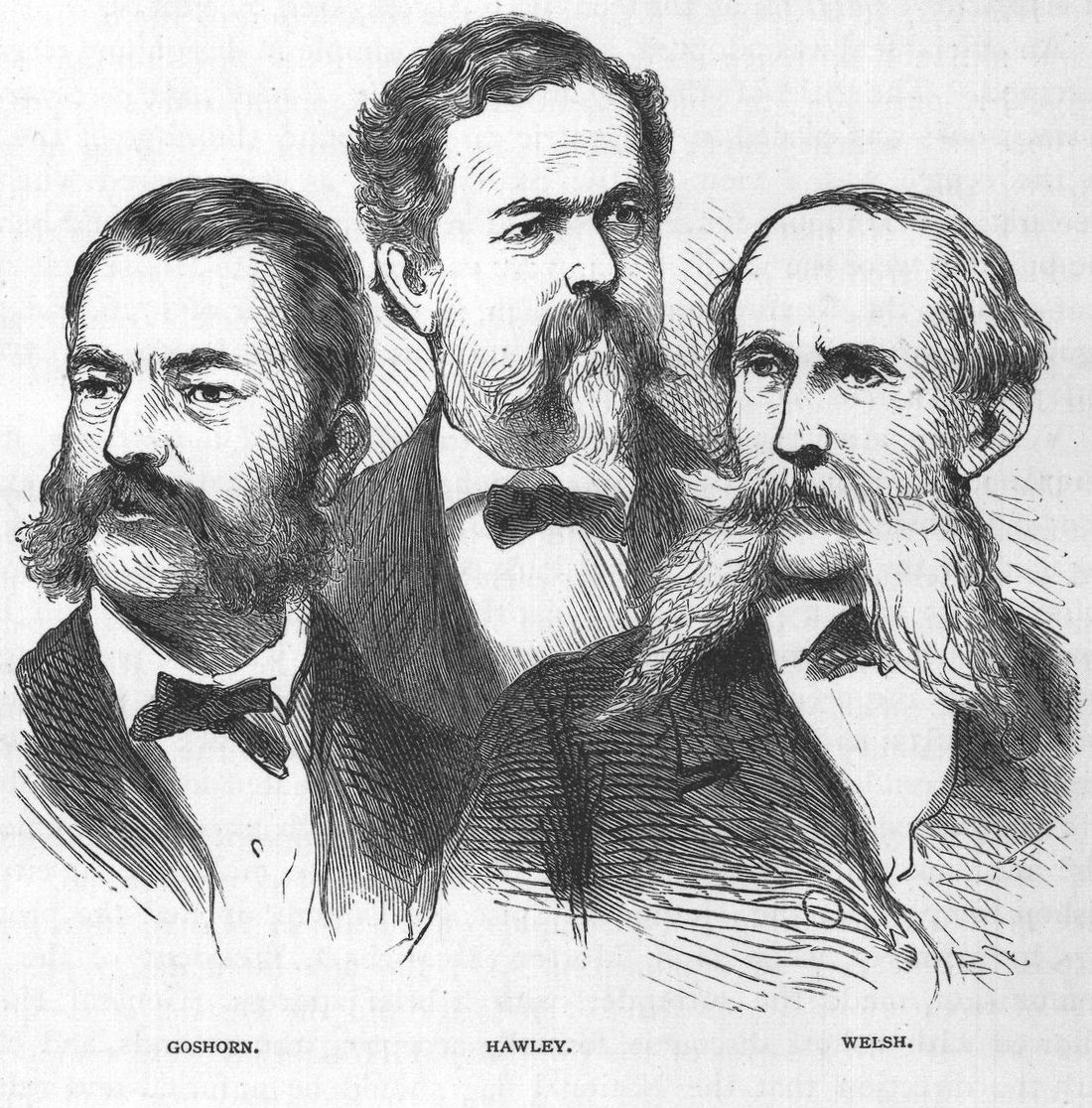
Under the provisions of this bill the President appointed commissioners and alternate commissioners, and these were named as corporators. They were invited to assemble at Philadelphia on the 4th of March, 1872, for the purpose of effecting an organization. On the appointed day, representatives of twenty-four States, three Territories and the District of Columbia, were present. In a parlor of the Continental Hotel they were temporarily organized, when they proceeded in a body to Independence Hall, in the State-House, where they were received with an address of welcome by the mayor of the city (Mr. Stokeley), which was responded to by General Jos. R. Hawley of Connecticut. In another room, they made a permanent organization, by the appointment of General Hawley President of the Centennial Commission, and other officers. Some changes were afterward made; and at the opening of the Centennial year, the following persons composed the officers of the Commission: President, Joseph R. Hawley; Vice-Presidents, Orestes Cleveland, John D. Creigh, Robert Lowry, Thomas H. Coldwell, John McNeil, and William Gurney; Director-General, Alfred T. Goshorn; Secretary, John L. Campbell; Counsellor and Solicitor, John L. Shoemaker.
On the first of June, 1872, Congress passed an act by which provision was made for a Centennial Board of Finance. The members of this board were authorized to secure subscriptions to a capital stock not exceeding $10,000,000, in shares of $10 each. Provision was also made for the opening of books of subscription to the stock on the 21st of November, 1872, to be kept open one hundred days, in order to give citizens in each State and Territory an opportunity to subscribe for the stock. Under this act, a meeting of the corporators and subscribers to the stock was held in Philadelphia after the expiration of the one hundred days, to choose the Centennial Board of Finance--another name for a board of directors. The meeting was held in the spring of 1873, when a board was chosen consisting of twenty-five stockholders. It was organized by the appointment of John Welsh of Philadelphia, President; William Sellers of Philadelphia and John S. Barbour of Virginia, Vice-Presidents, and Frederick Fraley of Philadelphia, Secretary and Treasurer. The remainder of the twenty-five were appointed Directors. William Bigler was chosen Financial Agent; Henry Pettit, Joseph M. Wilson and H. Swarzmann, Engineers and Architects; and an Executive Committee of thirteen, with Myers Asch, Secretary.
An official seal was adopted. It was quite simple in design and elegantly executed. The title of the organization--The United States Centennial Commission--was placed in concentric circles around the edge of the seal. In the centre was a view of the State-House as it appeared when the Declaration of Independence was signed in its principal room; and beneath the building were the words which were cast on the State-House bell, many years before the Revolution, and which, in the summer of 1776, had great significance: "PROCLAIM LIBERTY THROUGHOUT THE LAND, AND TO ALL THE INHABITANTS THEREOF."
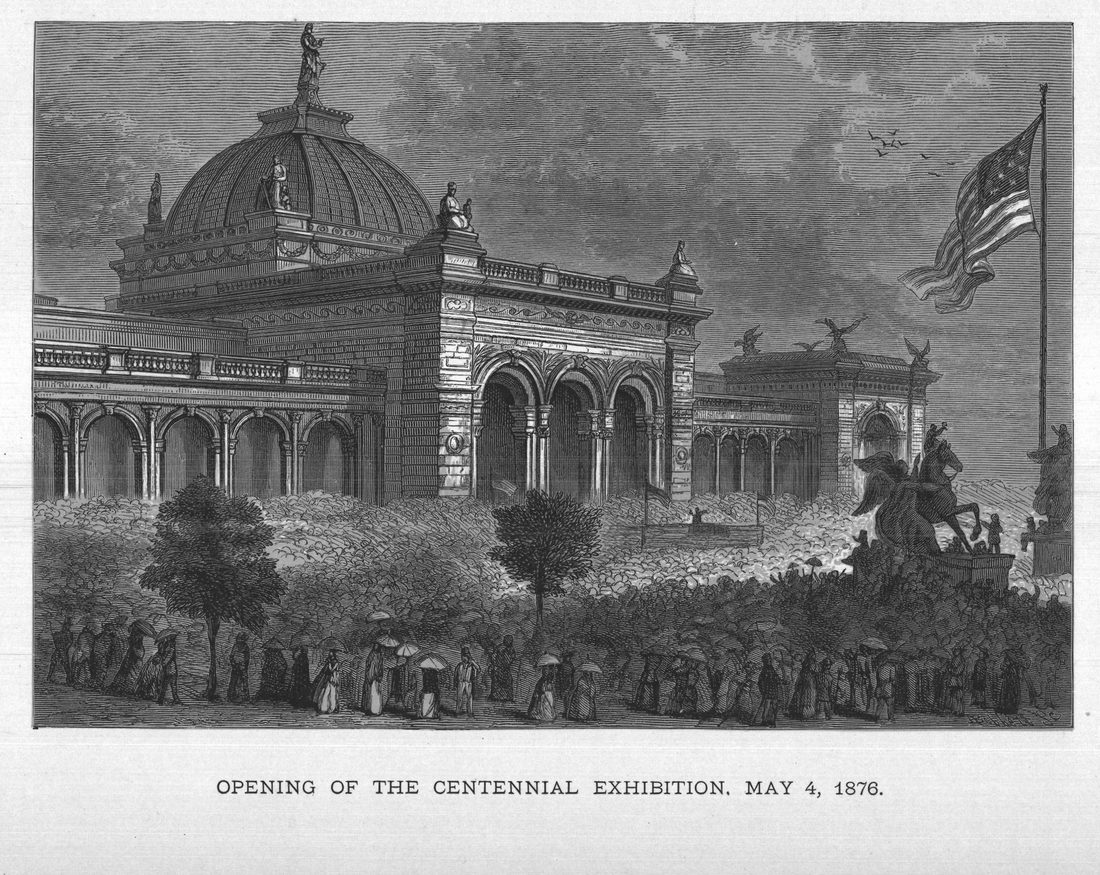
Very soon after the organization of the Centennial Commission, it was determined to make the affair international instead of national--an exhibition of the products of the industry of all nations. Fairmount Park was engaged for the Exhibition. That Park consists of extensive public grounds belonging to the city of Philadelphia, through which the Schuylkill River flows in a sinuous course about seven miles. The work of preparing the grounds for the erection of buildings for the Exhibition was begun in the spring of 1873, and on the 4th of July that year, the Park Commissioners formally surrendered a portion of the grounds designated for the Exhibition into the custody of the Centennial Commission, with imposing ceremonies. The act took place in the presence of an immense multitude of citizens. Bishop Simpson, of the Methodist Episcopal Church, opened the proceedings by a prayer, when Hon. Morton McMichael, President of the Park Commission, made the surrender, with a brief address. General Hawley followed with a short discourse, formally accepting the grounds, and closed with the direction that the National flag should be unfurled and saluted. When it was spread to the gentle breeze, the trumpeter of the "City Troop" gave a signal blast. Then the "Keystone Battery," stationed near, fired thirteen guns in honor of the event. A military review, a banquet, and fireworks succeeded. The plat of ground assigned for the Exhibition contains four hundred and sixty-five acres, and occupies a plateau, on rising ground.
Before the transfer of the ground, the President of the United States had issued a proclamation, setting forth that an exhibition of "arts, manufactures, and the products of the soil and mines" would be held at the city of Philadelphia, beginning on the 19th of April, and ending on the 19th of October, 1876. The proclamation concluded with the following words:
"And in the interest of peace, civilization, and domestic and international friendship and intercourse, I commend the Celebration and Exhibition to the people of the United States; and in behalf of the Government and people, I cordially commend them to all nations who may be pleased to take part therein."